.png)

The Role of Benefits Administration in PEO Partnerships
Every benefits administration error costs your business an average of $500 per incident in direct costs alone. Multiply that across open enrollment mistakes, eligibility oversights, and COBRA notification failures, and the financial exposure adds up fast. The role of benefits administration in PEO partnerships is precisely to eliminate that exposure. A Professional Employer Organization, or PEO, enters a co-employment arrangement with your business, taking on shared employer responsibilities that include managing the full lifecycle of employee benefits. For HR professionals and business owners trying to do more with less, understanding how this works is the first step toward making it work for you.
Table of Contents
- Key takeaways
- The role of benefits administration in a PEO structure
- How PEOs use technology to improve benefits management
- Business outcomes driven by PEO benefits management
- In-house benefits management vs. PEO administration
- My perspective on benefits admin as a strategic tool
- How Inclusive PEO Brokers can help you optimize benefits administration
- FAQ
Key takeaways
| Point | Details |
|---|---|
| PEOs own the benefits admin burden | Enrollment, eligibility, compliance, and carrier coordination are handled by the PEO under the co-employment model. |
| Integrated technology cuts errors significantly | Platforms connecting payroll, HRIS, and benefits carriers reduce enrollment processing time by 40 to 60 percent. |
| Small businesses gain Fortune 500 access | PEOs pool employees across clients, giving your team access to benefits typically reserved for large employers. |
| Benefits admin drives retention, not just compliance | Well-managed benefits communication and administration directly improve employee satisfaction and reduce turnover. |
| Expert broker guidance protects transitions | Switching PEOs without a specialist risks payroll tax restarts and coverage gaps that hurt both employees and employers. |
The role of benefits administration in a PEO structure
When you partner with a PEO, you are not simply outsourcing payroll. You are handing off one of the most complex, error-prone functions in your entire HR operation. Benefits administration encompasses enrollment, eligibility management, carrier communication, and compliance. Each of those four functions carries its own set of deadlines, regulations, and data dependencies. Miss one, and you are looking at penalties, employee complaints, or both.
Here is what a PEO actually handles on your behalf:
- Enrollment management. The PEO runs open enrollment, processes new hire enrollments, and handles qualifying life events such as marriage, birth, or loss of other coverage. Employees get guided through their options without your HR team managing every form.
- Eligibility verification. The PEO continuously monitors and updates eligibility records, so terminated employees are removed from plans promptly and new hires are added without gaps.
- Carrier coordination. Your PEO maintains direct relationships with insurance carriers, resolving billing discrepancies and claims issues that would otherwise land on your desk.
- Payroll integration. Benefits deductions sync with payroll automatically, eliminating the manual reconciliation that causes most administrative errors.
- Regulatory compliance. This includes COBRA notifications, ACA reporting, Section 125 plan administration, and annual filings. The PEO tracks deadlines and manages documentation.
- Employee communication. Benefits guides, enrollment reminders, and plan change notices go out through the PEO’s communication infrastructure, keeping your workforce informed without extra effort from your team.
The cumulative effect of handling all of these tasks through a single PEO structure is a dramatic reduction in administrative burden. When enrollment, eligibility, and compliance are managed in one integrated system rather than across disconnected vendors, errors drop and processing speed improves.
Pro Tip: Ask any PEO you are evaluating to show you their error rate on benefits deductions and their average time to resolve a carrier billing discrepancy. Those two numbers tell you more about their administration quality than any sales deck will.
How PEOs use technology to improve benefits management
Technology is where the difference between a mediocre PEO and a great one becomes visible. Many HR teams still rely on point solutions that do not talk to each other. Payroll lives in one system, benefits enrollment in another, and HRIS data in a third. The result is duplicate data entry, reconciliation headaches, and errors that increase administrative burden across the board.
A well-structured PEO eliminates that fragmentation. Here is how the technology stack typically works:
- Unified data entry. Employee information entered once flows automatically to payroll, benefits carriers, and compliance reporting. No re-keying, no version conflicts.
- Centralized dashboards. HR managers get a single view of enrollment status, deduction accuracy, and benefits utilization. You can pull a report in minutes instead of hours.
- Automated eligibility updates. When an employee’s status changes, the system triggers updates to carriers, adjusts deductions, and logs the change for audit purposes, all without manual intervention.
- COBRA and ACA automation. Notifications go out on schedule. Deadlines are tracked. Penalties become far less likely because the system does not forget.
- Continuous monitoring. Rather than treating benefits as an annual open enrollment project, integrated platforms allow HR teams to focus on workforce strategy because routine tasks run automatically in the background.
The data on this is clear. Organizations using integrated platforms report up to 90% time savings on administrative tasks. Enrollment processing time alone drops by 40 to 60 percent when payroll, compliance, and carrier workflows are connected.
| Administration approach | Enrollment processing time | Error risk | Compliance tracking |
|---|---|---|---|
| Disconnected point solutions | High (manual reconciliation) | High | Manual, deadline-dependent |
| PEO integrated platform | Reduced by 40 to 60 percent | Low | Automated, continuous |
Pro Tip: When comparing PEO platforms, ask for a live demo of how a mid-year qualifying event is processed. That workflow touches eligibility, carrier notification, payroll, and employee communication simultaneously. It is the best stress test for their integration quality.
Business outcomes driven by PEO benefits management
The importance of benefits administration goes well beyond avoiding errors. When a PEO manages your benefits well, the downstream effects show up in your retention numbers, your recruiting results, and your bottom line.
Start with cost. A 97-employee company case study found that switching to a PEO broker solution saved $399,484 annually, secured a 15-month rate guarantee, and added $3 million in EPLI coverage. That is not a rounding error. It reflects the purchasing power that comes from the role of benefits pooling in PEO arrangements, where your employees join a much larger group, giving the PEO leverage to negotiate rates that a 50-person company simply cannot access on its own.
“PEOs enable small businesses to offer Fortune 500-level benefits, improving labor market competitiveness, employee retention, and compliance management.”
That access matters enormously in a competitive hiring market. When your 30-person company can offer the same medical, dental, vision, and supplemental coverage as a large corporation, you compete for talent on equal footing. That is a structural advantage most small business owners do not realize they can have.
On the compliance side, the co-employment model means the PEO shares legal responsibility for benefits-related regulatory requirements. ACA reporting, ERISA compliance, COBRA administration — the PEO’s legal and compliance team stays current on regulatory changes so yours does not have to. That shared risk model is one of the most underappreciated aspects of how the role of PEO in employee benefits extends beyond simple administration.

Retention is the third outcome worth examining closely. Automated benefits platforms free HR teams from reactive administration, which means your HR staff can spend time on the things that actually build culture and reduce turnover. Benefits communication improves. Employees understand what they have. And when employees understand and value their benefits, they stay longer.
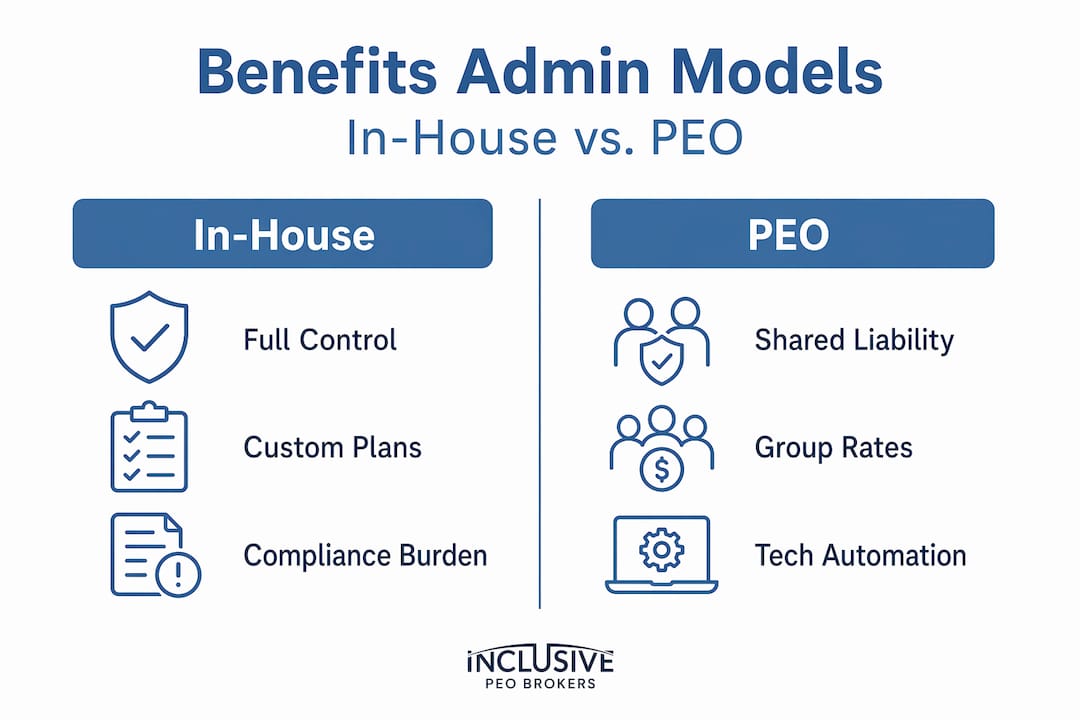
In-house benefits management vs. PEO administration
Managing benefits independently is not impossible. It is just expensive, time-consuming, and increasingly risky as regulations grow more complex. Here is what that looks like in practice for most small to mid-size businesses:
- Vendor fragmentation. You are managing separate contracts with a health insurance broker, a dental carrier, a vision provider, a 401(k) administrator, and possibly an FSA or HSA vendor. Each has its own billing cycle, renewal date, and customer service contact.
- Data silos. Without a unified platform, eligibility data lives in multiple places. When an employee terminates, someone has to manually notify every vendor. That lag creates coverage liability.
- Compliance gaps. ACA reporting requirements, COBRA deadlines, and Section 125 nondiscrimination testing require specialized knowledge most small HR teams do not have in-house.
- Limited negotiating power. A 40-person company negotiating directly with a health carrier has almost no leverage. Rates reflect your group’s claims history, not a pooled risk model.
- Transition risks. Moving from one PEO to another, or exiting a PEO entirely, carries hidden risks. PEO transitions without expert guidance can trigger payroll tax restarts mid-year and create coverage gaps that leave employees uninsured between plans.
The case for keeping benefits administration in-house typically rests on control and customization. Some larger companies do want direct carrier relationships and fully custom plan designs. That is a legitimate reason to consider moving off a PEO once your headcount and HR infrastructure can support it. But for most businesses under 200 employees, the tradeoffs heavily favor the PEO model.
Pro Tip: If you are considering exiting a PEO, map out your benefits renewal dates, payroll tax schedules, and carrier transition timelines before you give notice. The exit strategy planning process is where most businesses run into unexpected costs.
My perspective on benefits admin as a strategic tool
I have worked with hundreds of businesses evaluating PEOs, and one pattern stands out consistently. Most HR leaders come to the conversation focused on cost. They want to know what the per-employee fee is and whether they can get a better rate on health insurance. That is a reasonable starting point. But it misses the bigger picture.
Benefits administration has shifted from a back-office burden into a genuine growth lever. The businesses that get the most out of a PEO partnership are the ones that treat benefits administration as workforce infrastructure, not just a compliance checkbox. They use the data their PEO platform generates to make smarter decisions about plan design, compensation strategy, and hiring.
What I see most employers overlook is the value of separating routine administration from strategic benefits management. A good PEO handles the former automatically. Your job is to engage with the latter. That means reviewing utilization reports, asking your PEO about plan design alternatives at renewal, and using benefits communication as a retention tool rather than an annual obligation.
The other thing I would tell any HR leader: do not underestimate the transition risk. Switching PEOs without a specialist in your corner is one of the most common ways businesses end up with coverage gaps, payroll tax complications, and employee frustration. The right broker does not just find you a better PEO. They manage the entire transition so nothing falls through the cracks.
Benefits administration done well is quiet. Your employees get their cards, their claims process correctly, and their deductions match their pay stubs. When it is done poorly, everyone notices. Build the infrastructure to make it quiet.
— John
How Inclusive PEO Brokers can help you optimize benefits administration
If you are rethinking your PEO setup or exploring one for the first time, the quality of benefits administration should be at the top of your evaluation criteria. It affects your costs, your compliance exposure, and your employees’ day-to-day experience.

Inclusive PEO Brokers specializes in matching businesses with PEOs whose benefits administration capabilities align with your specific workforce needs. Their process has produced 133 successful implementations, saving clients an average of 80 hours in the selection process and $634 in direct costs. Whether you need expert PEO broker guidance on your first PEO selection or a second opinion on your current provider’s benefits management, Inclusive PEO Brokers gives you a clear, unbiased path forward. Explore your options and get a tailored PEO match that puts benefits administration to work for your business.
FAQ
What is the role of benefits administration in a PEO?
Benefits administration in a PEO covers enrollment, eligibility management, carrier coordination, payroll deductions, and compliance tasks like COBRA and ACA reporting. The PEO handles these under the co-employment model, reducing your administrative burden and compliance risk.
How does benefits pooling in a PEO work?
PEOs pool employees from multiple client companies into a single large group, giving smaller businesses access to better insurance rates and plan options than they could negotiate independently. This is one of the primary financial advantages of the PEO model.
How long does a PEO benefits transition take?
A PEO benefits transition typically takes two to four weeks when managed properly, with carrier relationships and benefits documentation transferred without coverage gaps for employees.
What are the biggest risks of managing benefits without a PEO?
The main risks include vendor fragmentation, compliance gaps, limited carrier negotiating power, and data errors from disconnected systems. Benefits administration errors cost employers an average of $500 per incident, and those costs compound quickly without integrated oversight.
When should a business consider leaving a PEO for direct benefits management?
Businesses with 200 or more employees and a dedicated HR team may benefit from direct carrier relationships and custom plan designs. However, exiting a PEO without expert guidance can trigger mid-year payroll tax restarts and coverage gaps, so transition planning is critical.
Recommended
.svg)
Seeking a different solution? Meet Your Business Needs