.png)

Best PEO for Startups in 2026: Your Shortlist Guide
If you’re a startup founder spending hours on payroll, benefits, and compliance instead of building your product, a Professional Employer Organization (PEO) is almost certainly the right next step. The fastest way to find the right one is by using a broker-assisted match. Under the co-employment model, a PEO becomes your administrative employer of record for payroll, tax filings, and benefits, while you keep full day-to-day control of your team. Companies using PEOs tend to see lower turnover and faster growth than comparable firms that handle HR in-house.
Your quick-match guide by startup stage:
- 1–5 employees: Evaluate month-to-month or short-term PEO options; prioritize benefits access and payroll accuracy over feature depth.
- 6–25 employees, single state: A startup-focused or tech-enabled PEO with transparent flat-fee pricing fits well here.
- Multi-state hires or remote team: Use a broker or national full-service PEO to confirm state licensing and SUI handling before signing.
- Scaling fast (Series A+): A national full-service PEO with a dedicated account rep and strong benefits carrier relationships is worth the premium.
- **Unsure where to start? Inclusive PEO Brokers runs a structured matchmaking process that saves founders significant time and money in selection costs, based on over a hundred completed implementations.
Table of Contents
- How do the top PEO categories compare for startups?
- How do you choose the right PEO for your startup?
- Which PEO category fits your startup’s profile?
- What do PEO pricing models actually cost your startup?
- What are the real risks of using a PEO as a startup?
- How does the co-employment model actually work for U.S. startups?
- How Inclusive PEO Brokers helps startups find the right fit
- Key Takeaways
- Why broker-first beats DIY for most startup founders
- Inclusive PEO Brokers: get a modeled quote before your first demo
- Authoritative sources and further reading
How do the top PEO categories compare for startups?
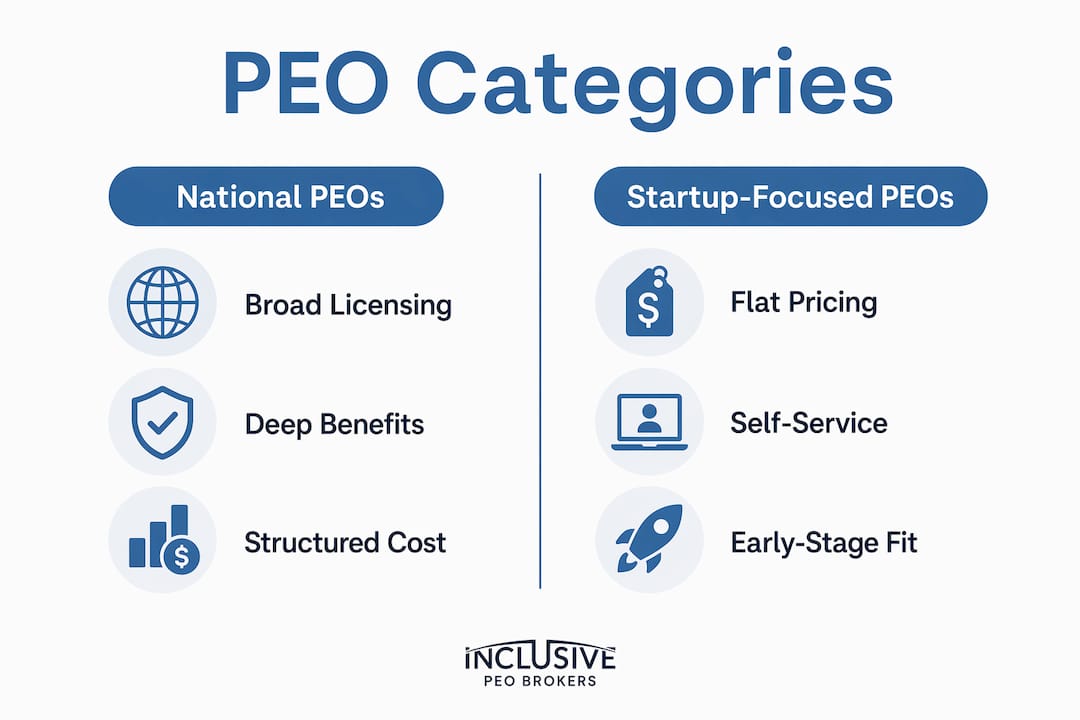
The table below maps four PEO categories against the dimensions that actually drive selection decisions. Pricing is directional: the U.S. Chamber of Commerce puts the typical per-employee monthly range at $40–$150, with wide variance based on benefits selection and risk profile.
| Category | Best for / Ideal customer | Services included | Pricing model | Multi-state coverage | Benefits quality | Onboarding & support | Key trade-offs |
|---|---|---|---|---|---|---|---|
| Inclusive PEO Brokers (brokerage) | Any startup stage; founders who want a vetted shortlist without spending weeks on demos | PEO matchmaking, side-by-side cost modeling, negotiation support, exit-term review, post-implementation guidance | Broker fee / consulting engagement; no ongoing per-employee charge | Verifies coverage across all states before recommending a PEO | Matches you to PEOs with the strongest carrier rates for your profile | Dedicated advisor through selection and onboarding | Does not directly employ; you still sign with a PEO |
| National full-service PEOs | Multi-state teams, Series A+ startups, companies needing broad compliance coverage | Payroll, benefits, HRIS, workers’ comp, compliance, risk management | % of payroll or PEPM; higher minimums | Strong; licensed in most or all states | Top-tier group health, dental, vision, 401(k) | Dedicated rep; structured SLAs | Higher cost; longer contracts; less flexibility for micro-teams |
| Startup/tech-focused PEOs | Early-stage, remote-first, developer-heavy teams | Payroll, benefits, HRIS, equity/stock admin, global contractor support | Flat PEPM; often transparent pricing | Varies; confirm state-by-state | Competitive; often includes mental health and equity perks | Self-serve + support tiers | Fewer customization options; benefits depth varies |
| Regional/specialist PEOs | Single-state or niche-industry startups (healthcare, construction, staffing) | Payroll, benefits, industry-specific compliance | PEPM or % of payroll | Limited; strong in home state only | Industry-specific plans | High-touch local support | Not suitable for remote or multi-state growth |
Note on pricing: Always ask for the carrier rate versus the PEO invoice separately. The headline service fee rarely tells the full story. Workers’ comp deposits and benefits markups can shift your true monthly cost significantly.
How do you choose the right PEO for your startup?
The selection process has a logical order. Skipping steps is where founders lose money or end up locked into the wrong contract.
1. Define your requirements first
Before you talk to a single PEO sales rep, write down your employee count, states where you hire, benefits you need to offer to compete for talent, and how much founder time currently goes to HR tasks. That list becomes your filter.
2. Model the all-in cost
The hidden costs of DIY HR — benefits premiums, workers’ comp deposits, multi-state compliance penalties, and administrative time — often outweigh the PEO service fee. Build a side-by-side model that includes payroll fees, benefits carrier costs (not just the invoice), workers’ comp deposit and audit exposure, and estimated tax reconciliations. Inclusive PEO Brokers provides this model as part of its standard process.
3. Check multi-state licensing
Founders must verify that any PEO they consider holds the required state registrations and handles SUI (state unemployment insurance) in every state where their employees work. A PEO without proper licensing in your employees’ states creates compliance risk, not protection.
4. Vet the benefits package
Ask for the actual carrier name, plan details, and current rates. A PEO’s pooled buying power can deliver group health coverage that a 10-person startup could never access independently. That benefit is worth more than the service fee in many cases.
5. Negotiate exit terms before signing
Leaving a PEO mid-year without clear exit terms can trigger complex payroll tax reconciliations and penalties. Require explicit termination language, a defined transition timeline, and a clear process for W-2 issuance before you sign anything.
Must-ask questions for any PEO sales rep
- What states are you licensed to operate in, and how do you handle SUI in each?
- What is your workers’ comp modification rate for clients in my industry?
- Can you provide the actual carrier name and current rates for health benefits?
- What is your SLA for payroll errors, and who is my dedicated account rep?
- What does the exit process look like, and what triggers a tax reconciliation?
Red flags to walk away from
- Opaque or bundled pricing with no line-item breakdown
- No multi-state licensing or vague answers about state coverage
- No dedicated account rep; support is purely ticket-based
- Automatic annual renewals with no early-exit clause
- Inability to show historical workers’ comp mod rates for similar clients
Pro Tip: Bring a broker into the process before your first PEO demo. A broker like Inclusive PEO Brokers has already vetted the market, knows which PEOs serve your industry and states, and can run the cost model for you. That typically saves founders 80 hours and surfaces pricing leverage they would not find on their own.
Which PEO category fits your startup’s profile?
Inclusive PEO Brokers
Inclusive PEO Brokers is not a PEO itself. It is a matchmaking and brokerage service that sits between your startup and the PEO market, doing the evaluation work for you. The process runs from a discovery call through cost modeling, shortlisting, negotiation support, and post-implementation guidance. Founders who use the service save an average of 80 hours in the selection process and $634 in costs, across 133 completed implementations.
Best for: Any startup stage, especially founders who lack the time or market knowledge to run a proper PEO evaluation.
Pros:
- Structured, proven selection process with side-by-side cost modeling
- Negotiation support that surfaces better pricing and exit terms
- No ongoing per-employee fee after placement
- Post-implementation guidance if issues arise
Cons:
- You still sign directly with a PEO; Inclusive PEO Brokers is the advisor, not the employer
- Best value when you have at least a few employees and a defined hiring plan
National full-service PEOs
These are large, established providers with broad state licensing, deep benefits carrier relationships, and structured compliance infrastructure. They suit startups that are already scaling, hiring across multiple states, or need enterprise-grade benefits to compete for talent.

Best for: Series A+ startups, remote-first teams with employees in five or more states, companies in regulated industries.
Pros:
- Licensed in most or all U.S. states
- Strong group health, dental, vision, and 401(k) options
- Dedicated account reps and structured SLAs
Cons:
- Higher minimum fees; less flexible for teams under 10
- Longer contract terms; exit can be complex
- Less startup-friendly onboarding experience
Startup/tech-focused PEOs
These providers are built for early-stage companies. They typically offer flat per-employee-per-month pricing, self-serve HRIS platforms, and perks like equity administration and mental health benefits. Providers like Deel PEO, Justworks, and Sequoia One fall into this category.

Best for: Seed to Series A startups, remote-first teams, companies hiring engineers who expect modern HR tooling.
Pros:
- Transparent flat-fee pricing
- Modern HRIS and self-serve employee portals
- Startup-friendly onboarding and integrations
Cons:
- Benefits depth varies; confirm carrier details before assuming parity with national PEOs
- Multi-state coverage is not universal; verify state by state
- Support tiers may limit access to a dedicated rep at lower plan levels
Regional/specialist PEOs
These providers serve a specific state or industry vertical. If your startup operates in a single state and in a niche like healthcare, construction, or staffing, a regional PEO may offer better-fit compliance expertise and industry-specific benefits than a national provider.
Best for: Single-state startups in regulated or high-risk industries.
Pros:
- Deep local compliance knowledge
- Industry-specific workers’ comp and benefits plans
- High-touch support
Cons:
- Not suitable for remote or multi-state growth
- Limited HRIS capabilities compared to tech-focused PEOs
Before you sign any PEO contract: Confirm the exit terms in writing. A clear termination clause, a defined transition timeline, and an explicit process for final W-2 issuance are non-negotiable. Without them, a mid-year exit can create payroll tax reconciliation headaches that cost more than the PEO saved you.
What do PEO pricing models actually cost your startup?
Two models dominate the market. Understanding which one fits your cash flow is worth doing before your first sales call.
Per-employee-per-month (PEPM)
A flat fee per employee, regardless of salary. Predictable and easy to budget. Startup-focused PEOs typically use this model. The U.S. Chamber of Commerce puts the typical per-employee monthly cost range at $40–$150, with the wide variance driven by benefits selection.
Works well for: Early-stage startups with consistent headcount and a need for budget predictability.
Watch out for: Setup fees, benefits carrier markups baked into the PEPM, and minimum employee counts.
Percentage of payroll
A fee calculated as a percentage of total gross payroll, typically in the 2%–12% range depending on services and risk profile. This model scales with your payroll, which can work against you as salaries grow.
Works well for: Startups with variable headcount or project-based hiring.
Watch out for: As you hire senior engineers or executives, the fee grows fast. Model this against PEPM before committing.
Sample calculations
Early-stage startup (5 employees, average salary $60,000):
- PEPM at $80/employee: $400/month, $4,800/year in PEO fees
- Benefits, workers’ comp, and SUI add to this; the all-in cost depends on plan selection
Scaling startup (25 employees, average salary $75,000):
- PEPM at $100/employee: $2,500/month, $30,000/year in PEO fees
- At 4% of payroll: $75,000 gross payroll/month × 4% = $3,000/month, $36,000/year
These are directional estimates. Actual costs depend on your benefits choices, state mix, and workers’ comp classification.
Hidden cost drivers to model
- Benefits carrier markups (ask for the carrier rate, not just the invoice)
- Workers’ comp deposit requirements and annual audit exposure
- State unemployment insurance variances across multiple states
- Implementation and setup fees (often $500–$2,000 one-time)
- Mid-year exit penalties if termination terms are not negotiated upfront
Pro Tip: Ask every PEO to provide a sample SUI certificate and their current workers’ comp mod rates for clients in your industry. If they hesitate, that hesitation is your answer.
What are the real risks of using a PEO as a startup?
A PEO is not a risk-free decision. These are the trade-offs worth negotiating before you sign.
Operational and legal risks
- Co-employment liability nuances: Under the co-employment arrangement, both you and the PEO carry employer responsibilities. If the balance is poorly defined, it can create confusion about who is liable for employment decisions.
- Diluted HR control: Some founders find that employees feel disconnected when HR processes run through a third party. Onboarding, culture, and performance management must stay firmly in your hands.
- Employee confusion: Workers may receive communications from the PEO’s brand rather than yours. Clarify this in your onboarding process.
- State licensing gaps: A PEO without proper licensing in a state where you hire creates compliance exposure, not protection. Verify coverage before signing.
Business risks
- Pricing variability at renewal: Initial rates are often negotiated. Renewal rates can increase, especially if your claims history changes.
- Vendor lock-in: Switching PEOs mid-year is operationally complex. Plan your evaluation carefully so you do not rush into a contract.
- Complex mid-year exits: Without explicit exit terms, leaving a PEO triggers payroll tax reconciliations, potential W-2 reissuance, and termination fees.
- Workers’ comp audit surprises: Annual workers’ comp audits can result in unexpected additional premiums if your payroll or job classifications changed during the year.
A realistic exit scenario: A startup that signed a 12-month PEO contract without a termination clause, then needed to switch providers after a Series A, faced a mid-year exit that required manual payroll tax reconciliation across three states and delayed W-2 issuance for employees. The administrative cost and distraction far exceeded any savings from the original contract. Negotiate exit terms before you sign, not after.
One-sentence mitigations
- Co-employment confusion: Define the division of employer responsibilities in writing during onboarding.
- State licensing gaps: Require a written state-coverage confirmation before signing.
- Pricing variability: Negotiate a rate cap or renewal notice period into the contract.
- Mid-year exit risk: Require an explicit termination clause with a defined transition timeline.
- Workers’ comp audits: Ask for historical audit results and confirm your job classifications are correct at setup.
How does the co-employment model actually work for U.S. startups?
A PEO becomes your administrative employer of record for payroll and benefits, while you retain full day-to-day management of your team. That split is the foundation of the co-employment model, and understanding it clearly prevents most of the operational problems founders encounter.
What the PEO handles
- Payroll processing and tax filings (federal, state, local)
- W-2 issuance and year-end tax reporting
- Benefits administration (health, dental, vision, 401(k) enrollment)
- Workers’ comp policy management and claims handling
- Compliance with federal employment laws (FMLA, ADA, FLSA)
What you retain
- Hiring and termination decisions
- Day-to-day performance management
- Company culture, values, and team structure
- Compensation decisions and equity grants
- Vendor and contractor relationships outside the PEO scope
Multi-state compliance checklist
When hiring across state lines, confirm the following with any PEO before signing:
- State business registration and employer registration in each state
- SUI account setup and rate handling per state
- State-specific leave law compliance (paid family leave, sick leave mandates)
- Workers’ comp coverage in each state where employees physically work
- Local tax withholding for cities or counties with their own payroll taxes
Reference data for planning
| Metric | Typical range | Source |
|---|---|---|
| PEO onboarding timeline | 2–8 weeks | U.S. Chamber of Commerce |
| Per-employee monthly cost | $40–$150 | U.S. Chamber of Commerce |
| Percentage-of-payroll fee range | 2%–12% (varies by services and risk) | Industry guidance |
Implementation checklist for your first PEO onboarding call
- Confirm your EIN and state employer registration numbers are ready
- Gather current payroll records and employee classification data
- List every state where employees work or will work within 12 months
- Identify current benefits plans and carrier names for comparison
- Prepare your workers’ comp classification codes and prior claims history
- Define your go-live date and confirm it aligns with a payroll cycle start
How Inclusive PEO Brokers helps startups find the right fit
Inclusive PEO Brokers runs a structured, five-step matchmaking process designed specifically for founders who do not have weeks to spend evaluating PEO contracts.
The process
- Discovery call: A consultant reviews your employee count, states, benefits needs, and budget constraints to build a requirements profile.
- Cost modeling: A side-by-side model is built comparing your current HR costs against two or three PEO options, including benefits carrier rates, workers’ comp, and SUI.
- Shortlisting: Based on your profile, two or three PEOs are recommended with a clear rationale for each.
- Negotiation support: The team negotiates pricing, exit terms, and SLA commitments on your behalf before you sign.
- Onboarding support: Post-placement guidance helps you navigate the implementation process and resolve any issues that arise in the first 90 days.
Proof points
Inclusive PEO Brokers has completed numerous successful PEO implementations. Clients save significant time in the selection process and substantial costs compared to running the evaluation independently. Those figures reflect the time and negotiation value of having an expert who already knows the market.
The deliverables you receive include a side-by-side cost model, an exit-term checklist, and a state-coverage verification report. These are not generic templates. They are built around your specific employee profile, states, and benefits requirements.
For founders evaluating whether a broker is worth it, the math is straightforward: 80 hours of founder time spent on PEO demos and contract reviews is 80 hours not spent on product, sales, or fundraising. Learn more about what a PEO broker does and how the selection process works.
Key Takeaways
A PEO is the right move for most startups making their first hires or scaling across states, and broker-assisted selection is the fastest way to get there without overpaying or signing a bad contract.
| Point | Details |
|---|---|
| When to use a PEO | From your first hire onward, especially when benefits access and multi-state compliance are priorities. |
| Model all-in cost | Include benefits carrier rates, workers’ comp, SUI, and setup fees — not just the headline service fee. |
| Negotiate exit terms | Require explicit termination language and a transition timeline before signing any PEO contract. |
| Verify multi-state licensing | Confirm state registrations and SUI handling in every state where your employees work. |
| Inclusive PEO Brokers | Saves founders an average of 80 hours and $634 through a structured matchmaking and negotiation process across 133 implementations. |
Why broker-first beats DIY for most startup founders
The conventional wisdom says you should demo three PEOs, compare their proposals, and pick the best one. That sounds reasonable until you realize that PEO pricing is tailored to your risk profile and that most founders have no baseline to evaluate whether a proposal is competitive. You are negotiating blind.
What actually happens in a DIY evaluation: founders spend weeks on demos, receive proposals in different formats that cannot be compared directly, and eventually pick the PEO with the best sales rep rather than the best contract. The exit terms get skimmed. The workers’ comp deposit structure goes unquestioned. The benefits carrier markup is invisible.
A broker changes the dynamic entirely. You get a structured cost model before the first demo, a shortlist of PEOs that actually cover your states and industry, and a negotiator who has seen dozens of contracts and knows which terms are movable. Founders also retain full operational control throughout. The broker’s job is to get you into the right PEO on the right terms, not to manage your team.
The one nuance worth naming: a broker is most valuable when you have at least a few employees and a defined hiring plan. If you are a solo founder with no immediate hiring plans, the matchmaking value is limited. But for any startup making its first hires or preparing to scale, the 80-hour time savings alone justifies the conversation.
Inclusive PEO Brokers: get a modeled quote before your first demo
Founders who have already read this far know the selection process matters as much as the PEO itself. Inclusive PEO Brokers gives you a concrete advantage: a side-by-side cost model, a vetted shortlist, and negotiated exit terms before you sign anything.

The first step is a free discovery call where a consultant reviews your employee count, states, benefits needs, and budget. From there, you receive a modeled cost comparison and a shortlist of two or three PEOs matched to your profile. Inclusive PEO Brokers has guided 133 startups and small businesses through this process, saving each an average of 80 hours and $634 in selection costs.
- Free discovery call: Review your requirements and build a profile.
- Modeled cost comparison: Side-by-side analysis including benefits carrier rates and workers’ comp.
- Exit-term checklist: Know what to negotiate before you sign.
- Post-implementation support: Guidance through the first 90 days.
Book a free consultation or review the broker engagement process to see exactly what you get before committing.
Authoritative sources and further reading
These are the primary sources used in this article, along with guidance on what each covers.
- U.S. Chamber of Commerce: Choosing a PEO — Covers per-employee cost ranges ($40–$150/month), onboarding timelines (2–8 weeks), and general selection criteria. Start here for budgeting anchors.
- ESI PEO: When Should Startups Consider PEO Support? — Covers multi-state compliance triggers and the importance of verifying state registrations before signing.
- COMPEO: PEO for Startups — Covers co-employment model mechanics, exit term risks, broker value, and the hidden cost of evaluating benefits by headline fee alone.
- EORHQ: PEO for Startups Guide — Covers the hidden costs of DIY HR and how to model the all-in cost of a PEO versus managing HR independently.
- Inclusive PEO Brokers: PEO Selection Guide — In-depth methods for side-by-side cost modeling and negotiation support, tailored to small and mid-sized businesses.
- Inclusive PEO Brokers: Exit Strategy Planning — Covers exit and transition planning, including what to negotiate in a PEO contract before signing.
For specific tasks:
- Pricing modeling: Use the U.S. Chamber guide for cost ranges and EORHQ for all-in cost methodology.
- Multi-state licensing checks: Use ESI PEO’s guidance and confirm directly with each PEO’s compliance team.
- Benefit comparisons: Request carrier names and current rates from each PEO; do not rely on summary plan descriptions alone.
Recommended
.svg)
Seeking a different solution? Meet Your Business Needs