.png)

TriNet vs Insperity: Best PEO for SMBs in 2026

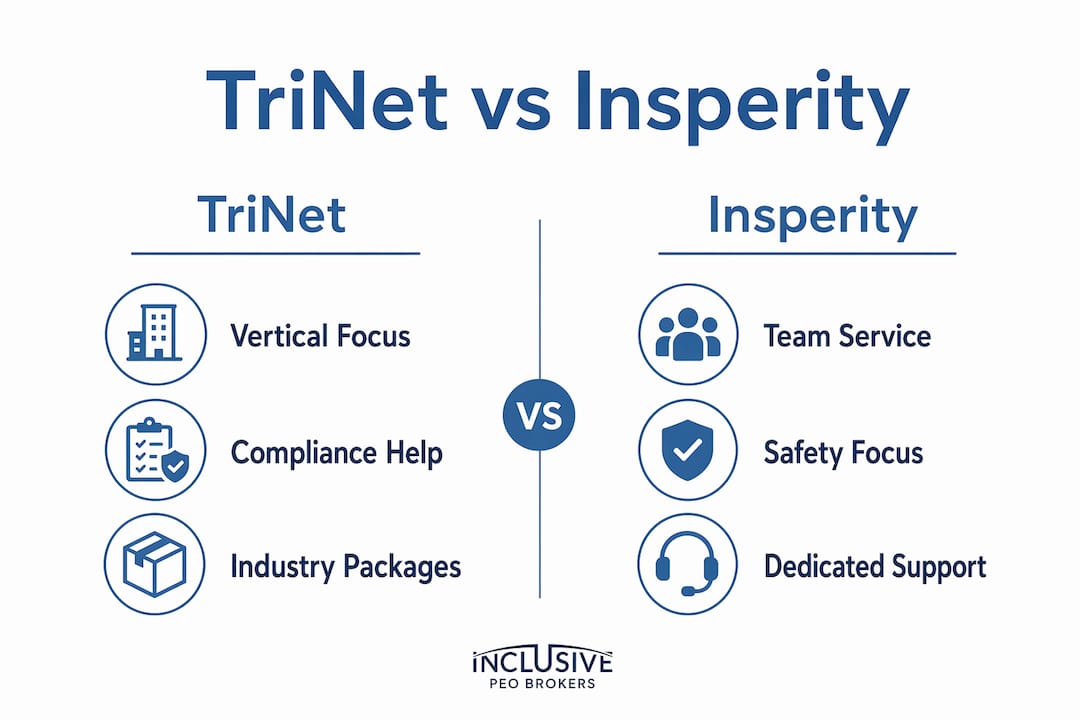
If you need the short answer: Insperity is the stronger fit for companies that want a dedicated, team-based HR partner with deep safety and workers’ comp support. TriNet wins for businesses in technology, life sciences, financial services, or other regulated verticals where industry-specific benefits and compliance packaging matter more than white-glove generalist service. If you’re not sure which model fits your company, or you want competing proposals before committing, Inclusive PEO Brokers is the broker alternative that does the comparison work for you.
Quick scenario guide:
- Pick Insperity if your team wants an outsourced HR department that feels internal, you have workers’ comp exposure, and local office access matters.
- Pick TriNet if your company operates in a defined vertical (tech, life sciences, financial services, nonprofits) and needs sector-tailored benefits and multi-state compliance tools.
- Use Inclusive PEO Brokers if you want a guided, side-by-side evaluation of both options, cost modeling, and negotiation support before you sign anything.
Both Insperity and TriNet operate under the co-employment model, meaning they become the employer of record for tax and benefits purposes while you retain day-to-day control. Neither is IRS-certified as a CPEO in the same way smaller niche providers are, so it’s worth confirming current certification status directly. ESAC accreditation and third-party review snapshots on G2 and Trustpilot are also worth checking during your evaluation.
Table of Contents
- TriNet vs Insperity: Side-by-side comparison
- What makes Insperity stand out
- What makes TriNet stand out
- Head-to-head: which provider wins each dimension?
- How do you choose between TriNet and Insperity?
- What does implementation actually look like?
- How we evaluated TriNet and Insperity
- Key Takeaways
- The dimension most buyers overlook
- Inclusive PEO Brokers: get competing proposals without the 80-hour evaluation
- Useful sources
TriNet vs Insperity: Side-by-side comparison
Neither provider publishes standardized pricing online. Every quote is customized by headcount, industry, and benefits selections, which makes a direct cost comparison difficult without requesting competing proposals.
| Dimension | Inclusive PEO Brokers | Insperity | TriNet |
|---|---|---|---|
| Best for | SMBs wanting guided selection, cost modeling, and negotiation support | Companies wanting a high-touch, team-based outsourced HR model | Companies in defined verticals (tech, life sciences, financial services) |
| Pricing model | Broker fee; no PEPM cost to the buyer | — | — |
| Benefits carriers | Access to all carriers through matched PEO | Large-group national carriers; geography-dependent | National carriers; vertical-tailored options |
| Support model | Dedicated broker; side-by-side proposals | Dedicated HR team (HR business partner, payroll specialist, benefits consultant, safety consultant) | Dedicated account manager; industry-specialist support |
| Technology | Comparison platform; proposal tools | Mobile app (payroll, time tracking, expense submissions) | Modern, mobile-first platform; equity management, multi-state compliance tools |
| Employee minimum | No minimum | 5 employees | 5 employees |
| Contract terms | No long-term commitment | Long-term contracts typical | More flexible contract terms |
| Onboarding timeline | 2–4 weeks (broker matching) | 4–8 weeks typical | 4–6 weeks typical |
Key takeaways from the comparison:
- Insperity’s PEPM pricing typically ranges from $150–$250, reflecting its deeper service team structure.
- TriNet’s PEPM pricing commonly runs $125–$200, varying based on which vertical package and add-ons you select.
- Both require a custom quote, which means you can’t compare them accurately without running a formal proposal process. That’s exactly where a broker adds value.
Pro Tip: Request proposals from both providers simultaneously. Competing quotes create negotiating leverage on setup fees, PEPM rates, and implementation credits that you simply won’t get by approaching one vendor at a time.
What makes Insperity stand out

Insperity’s defining feature is its team-based service model. When you sign with Insperity, you don’t get a single account manager. You get a dedicated HR business partner, a payroll specialist, a benefits consultant, and a safety consultant assigned to your account. That structure reduces single-point-of-contact risk: if one specialist is unavailable, the rest of the team covers without service degradation.
The safety and workers’ comp emphasis is a genuine differentiator, not just a checkbox. Insperity’s proactive claims management and on-staff safety consultants are built for companies with real physical-risk exposure, whether that’s a light manufacturing operation, a field services team, or a retail chain with high turnover. For a professional services firm with minimal workers’ comp exposure, this feature is less relevant, but it’s a strong reason to choose Insperity if your workforce operates in the field.
Insperity also reports a high payroll success rate, cited in competitive comparisons as a benchmark for payroll reliability. Payroll accuracy at that level is table stakes for a PEO, but it’s worth confirming in your reference checks.
Insperity strengths:
- Dedicated multi-person HR team across specializations
- 90+ physical offices nationwide for in-person support
- Strong safety consulting and proactive workers’ comp management
- Broad access to large-group benefits carriers
- Payroll processing, tax filing, and compliance support under one roof
Insperity trade-offs:
- PEPM pricing tends to run higher than TriNet’s
- Long-term contracts are typical; exit terms require careful review
- No public pricing; a quote requires a full business evaluation
- Technology platform is functional but less modern than TriNet’s mobile-first experience
- Benefits carrier availability varies by geography
Insperity suits companies that want their PEO to feel like an internal HR department, not a software subscription. If your leadership team wants direct access to specialists who know your account, Insperity’s model is built for that.
What makes TriNet stand out

TriNet’s core advantage is vertical specialization. Rather than offering a single generalist HR package, TriNet organizes its service model around industry sectors: technology, life sciences, financial services, nonprofits, and professional services. Benefits packages, compliance tools, and HR guidance are calibrated to the regulatory and talent environment of each vertical. For a 60-person SaaS company competing for engineers, TriNet’s tech-sector benefits packaging looks meaningfully different from a generic PEO offering.
The platform itself is TriNet’s second major differentiator. It’s consistently described as modern and mobile-first, with built-in tools for equity management, multi-state compliance, and employee self-service. The mobile app covers paycheck summaries, benefits access, time-off requests, clock-in/out, and expense submissions. TriNet also offers live chat support 24/7 through its platform, with phone support available from 6 a.m. to midnight ET on weekdays.
TriNet strengths:
- Industry-vertical model tailored to tech, life sciences, financial services, and nonprofits
- Modern, mobile-first HR platform with strong employee self-service
- Equity management tools relevant to startup and growth-stage companies
- Multi-state compliance built into the platform
- More flexible contract terms than Insperity
TriNet trade-offs:
- Benefits carrier options and quality vary by geography
- Pricing can run higher for smaller companies within certain verticals
- Some users report the platform can feel less intuitive in specific workflows
- Service responsiveness has drawn mixed feedback in forum discussions; worth checking references
- Less emphasis on safety consulting and workers’ comp depth than Insperity
For companies in highly regulated sectors, TriNet’s vertical compliance packaging often reduces hidden compliance work that a generalist PEO would leave to the client to manage. That’s a real cost savings that doesn’t show up in the PEPM comparison.
Head-to-head: which provider wins each dimension?
The real differentiator between these two providers is service philosophy: Insperity favors depth of service through dedicated teams; TriNet favors depth of industry expertise through vertical specialization. Neither approach is universally better. The right choice depends on what your company actually needs from a PEO.
| Dimension | Winner | Why |
|---|---|---|
| Support model depth | Insperity | Multi-specialist team vs. single account manager |
| Industry/vertical fit | TriNet | Sector-specific benefits, compliance, and HR guidance |
| Platform & mobile UX | TriNet | Modern, mobile-first design with equity and multi-state tools |
| Safety & workers’ comp | Insperity | Dedicated safety consultant; proactive claims management |
| Benefits competitiveness | Tie | Both access large-group carriers; vertical packaging gives TriNet an edge in specific sectors |
| Pricing transparency | Tie | Neither publishes rates; both require custom quotes |
| Contract flexibility | TriNet | More flexible terms; Insperity typically requires longer commitments |
| Office/local access | Insperity | 90+ physical offices nationwide |
Scenario-based recommendations:
- 50–200-employee distributed SaaS startup: TriNet. The vertical benefits packaging, equity management tools, and mobile-first platform align with the talent and compliance demands of a tech company.
- 80-employee professional services firm with field staff: Insperity. The dedicated HR team and safety consulting depth are worth the higher PEPM for a company with real workers’ comp exposure.
- 100-employee nonprofit or financial services firm: TriNet. Vertical compliance packaging reduces regulatory overhead that a generalist PEO would leave on your plate.
- Growing SMB that hasn’t decided yet: Inclusive PEO Brokers. Get a side-by-side proposal from both, with cost modeling and negotiation support, before committing to either.
Analysts note that firms in high-cost or highly regulated industries often get better long-term value from TriNet’s vertical-focused benefits and compliance packaging. Leaders who want their PEO to feel like an internal HR department tend to prefer Insperity.
How do you choose between TriNet and Insperity?
The decision comes down to three questions: What does your workforce actually look like? What’s your risk profile? And how much do you value technology versus human service depth?
Prioritized evaluation checklist:
- Define your service model priority. Do you want a dedicated team of specialists (Insperity) or an industry-aligned account manager with vertical expertise (TriNet)?
- Assess your workers’ comp exposure. If your team works in the field, in retail, or in any physical environment, Insperity’s safety consulting depth is a meaningful differentiator.
- Map your industry. If you’re in tech, life sciences, financial services, or nonprofits, TriNet’s vertical packaging is worth evaluating seriously.
- Request competing proposals simultaneously. Custom quotes are required from both providers; running them in parallel creates negotiating leverage.
- Ask about benefits carrier options in your geography. Carrier availability varies by region for both providers. Confirm which carriers are available where your employees actually live.
- Review contract and exit terms carefully. Insperity typically requires longer commitments. Ask specifically about termination notice periods, auto-renewal clauses, and data portability.
- Check third-party reviews and ask for references. Forum feedback and review platforms consistently highlight service responsiveness and onboarding speed as the most variable factors. Ask for references from companies similar in size and industry to yours.
Questions to ask on sales calls:
- What is the full PEPM cost, including all fees and add-ons?
- Who specifically will be on my service team, and what are their response time commitments?
- Which benefits carriers are available in my employees’ states?
- What does the onboarding timeline look like, and what do you need from us to hit it?
- What are the termination notice requirements and any associated fees?
Red flags to watch for:
- Vague answers on carrier availability by state
- No written SLA for service response times
- Auto-renewal clauses buried in contract language
- Setup fees that weren’t mentioned in the initial proposal
Pro Tip: Ask both vendors for an implementation credit or a waived setup fee. Both providers have room to negotiate on these line items, especially when you’re presenting a competing proposal. A broker can often surface these levers before you ever get on a sales call.
What does implementation actually look like?
Both Insperity and TriNet require a minimum number of employees to start PEO service, which may not suit very small businesses. Confirm this minimum during your evaluation.
Typical onboarding timeline:
- Weeks 1–2: Data handoff (employee records, payroll history, benefits elections, workers’ comp details)
- Weeks 2–4: System setup, benefits carrier enrollment, payroll cutover planning
- Week 4–6: First payroll run under the PEO; benefits effective date confirmed
- Week 6–8: Full transition complete; ongoing service team relationship established
Insperity’s onboarding tends to run 4–8 weeks depending on company complexity. TriNet typically runs 4–6 weeks, with the mobile platform enabling faster employee self-enrollment.
Contract essentials to confirm before signing:
- Termination notice period (typically 30–90 days; confirm in writing)
- Auto-renewal language and opt-out deadlines
- Setup or implementation fees and whether they’re negotiable
- Payroll cutover timing relative to your current pay cycle
- Data portability and offboarding support if you exit the PEO
For first-time PEO buyers, the first-time PEO selection process involves more complexity than most expect. The payroll cutover alone requires coordinating with your current provider, your bank, and the new PEO simultaneously. Build buffer time into your timeline.
Implementation tips:
- Assign a single internal point of contact to own the data handoff. Fragmented ownership is the most common cause of delays.
- Confirm your benefits effective date before signing. A gap in coverage during transition is a real risk.
- Get the onboarding timeline in writing as part of the contract, not just as a verbal commitment.
- If you have workers’ comp claims in flight, flag them explicitly during the transition. Both providers handle open claims differently.
How we evaluated TriNet and Insperity
This comparison draws on multiple data sources: published competitive analyses from PEO-focused review platforms, third-party review snapshots from G2 and Trustpilot, forum feedback from HR practitioners on Reddit and similar communities, documented minimums and pricing ranges from market reporting, and Inclusive PEO Brokers’ own brokerage experience across 133 completed PEO implementations.
Evaluation methodology:
- Pricing ranges sourced from market-reported PEPM figures and cross-referenced across multiple review platforms
- Service model claims verified against provider documentation and practitioner commentary
- Customer counts and minimums confirmed from published competitive comparisons
- Third-party review signals (G2, Trustpilot, Reddit) used as qualitative indicators of service responsiveness and onboarding experience, not as primary ranking criteria
- Broker proof points drawn from Inclusive PEO Brokers’ internal implementation data: 80-hour average time savings in the selection process, $634 average cost saving, and 133 successful implementations
Broker credentials and proof points:
- Inclusive PEO Brokers has completed 133 PEO implementations for U.S. small and mid-sized businesses
- Clients save an average of 80 hours in the selection process by using a broker instead of running evaluations independently
- Average cost saving of $634 per engagement through negotiated proposals and cost modeling
- Post-selection implementation support is included, covering the transition period where most first-time PEO buyers encounter delays
You can review client results directly, or book a broker review to request a side-by-side proposal for your specific situation.
Key Takeaways
Insperity suits companies that want a dedicated, team-based HR model with deep safety support; TriNet wins for defined-vertical companies in tech, life sciences, or financial services; and Inclusive PEO Brokers gives SMBs a guided, cost-modeled path to the right choice without the 80-hour evaluation burden.
| Point | Details |
|---|---|
| Service philosophy drives the choice | Insperity offers team-based depth; TriNet offers vertical industry expertise. Match to your actual needs. |
| Pricing requires competing proposals | Insperity typically ranges from $150–$250 PEPM; TriNet commonly runs $125–$200 PEPM, but all pricing is customized by headcount, industry, and benefits selection. Neither publishes rates publicly. |
| Workers’ comp exposure favors Insperity | Insperity’s dedicated safety consultant and proactive claims management are a real differentiator for field-based teams. |
| Vertical fit often reduces hidden costs | TriNet’s sector-specific compliance packaging can reduce regulatory overhead for tech, life sciences, and financial services firms. |
| Inclusive PEO Brokers shortens the process | With 133 implementations and an average 80-hour time savings, Inclusive PEO Brokers delivers side-by-side proposals and negotiation support at no PEPM cost to the buyer. |
The dimension most buyers overlook
The TriNet vs. Insperity comparison almost always gets framed as a features race: who has the better app, who has more carriers, who charges less per employee per month. Those things matter, but they’re not what determines whether a PEO relationship actually works.
The real question is whether the service model matches how your leadership team operates. Insperity’s multi-specialist team structure is genuinely valuable if your HR function is thin and your leaders want direct access to people who know your account. But if your team is self-sufficient and what you actually need is a platform that handles multi-state compliance without constant hand-holding, that same service depth becomes overhead you’re paying for but not using.
TriNet’s vertical model has a similar nuance. The industry-specific benefits packaging is a real advantage in talent-competitive sectors. But vertical specialization only pays off if your company is actually operating in one of TriNet’s defined verticals. A general services business trying to fit into a vertical package it doesn’t belong in will get less value than a company that maps cleanly to the model.
The buyers who get the most out of this decision are the ones who map their choice to the regulatory and talent intensity of their sector, not to a feature checklist. That’s the framing worth carrying into your vendor calls.
Inclusive PEO Brokers: get competing proposals without the 80-hour evaluation
Choosing between Insperity and TriNet without a broker means running two parallel evaluations, decoding custom quotes with no benchmark, and negotiating contract terms without knowing what’s actually movable. Most SMB owners spend 80 hours on that process and still aren’t confident they got the best deal.

Inclusive PEO Brokers handles the evaluation for you. The process covers cost modeling, side-by-side proposal comparison, negotiation support, and post-selection implementation guidance. Across 133 completed implementations, clients have saved an average of $634 per engagement and 80 hours of selection time. The broker fee comes from the PEO, not from you.
Whether Insperity or TriNet is the right fit for your business depends on factors specific to your headcount, industry, and risk profile. Inclusive PEO Brokers builds that analysis before you ever get on a vendor call. Book a free consultation to request your side-by-side proposal, or review the broker process to see exactly how the matching works.
Useful sources
- IRS: Certified Professional Employer Organizations (CPEO) — Verify CPEO certification status for any PEO you’re evaluating.
- NAPEO: National Association of Professional Employer Organizations — Industry standards, ESAC accreditation information, and PEO market data.
- Insperity vs. TriNet: Which Enterprise PEO Wins? (PEO Marketplace) — PEPM pricing ranges, service model comparison, and benefits carrier analysis.
- Insperity vs. TriNet (PeopleOpsClub) — Vertical specialization analysis and service philosophy comparison.
- Insperity vs. TriNet: Full Comparison in 2026 (SoftwareFinder) — Pricing transparency, payroll reliability data, and custom quote requirements.
- Insperity PEO vs. TriNet PEO (Several.com) — Employee minimums, forum feedback signals, and onboarding considerations.
- PEO administrative fees explained — How PEPM fees are structured and which line items drive price differences.
Recommended
.svg)
Seeking a different solution? Meet Your Business Needs