.png)

PEO for Healthcare: Benefits, Costs, and How to Choose

Yes, a Professional Employer Organization (PEO) can provide health insurance for your healthcare practice. Through a co-employment model, your employees join the PEO’s master group health plan, giving a very small clinic access to the same large-group rates a much larger corporation negotiates.
- What changes most for you: The PEO takes over benefits administration, payroll processing, ACA reporting, and premium remitting. Your team stops managing carriers and starts managing patients.
- The key trade-off: You gain buying power and administrative relief, but you give up some control over plan design and pay a per-employee fee on top of premiums.
Table of Contents
- How PEO health plans work for healthcare employers
- Why healthcare practices benefit from partnering with a PEO
- How a PEO affects your health insurance costs
- PEO health plans vs. traditional small-group employer plans
- How to choose the right PEO for your healthcare practice
- Downsides and trade-offs to consider before switching
- What to expect during PEO onboarding
- How PEOs support healthcare-specific compliance
- What coverage options and limitations do PEO health plans offer healthcare workers?
- How does a PEO affect your employees’ access to providers and networks?
- How PEO health plans affect employee retention at your practice
- Key Takeaways
- What brokers actually see when healthcare practices choose a PEO
- Inclusive PEO Brokers matches healthcare practices with the right PEO
- Useful sources and further reading
How PEO health plans work for healthcare employers
A PEO health plan is a group benefits arrangement where your employees are co-employed by the PEO and enrolled under its master insurance policy. Co-employment means the PEO becomes the employer of record for HR and tax purposes while you retain full operational control of your practice.
Here is how the mechanics work in practice. The PEO pools your employees with thousands of others across its client base, which gives it the negotiating leverage of a large employer when purchasing medical, dental, and vision coverage. That pooled buying power is what allows a 12-person urgent care clinic to access plan tiers that would otherwise require 200+ employees to unlock.
The PEO typically handles payroll processing, benefits enrollment, premium remitting to carriers, eligibility tracking, and ACA compliance reporting. A few terms worth knowing:
- Master policy: A single group insurance contract held by the PEO that covers all co-employed workers across its client businesses.
- PEPM (per-employee-per-month): The administrative fee structure many PEOs use, charged per covered employee each month.
- Co-employment: A shared employment arrangement where both you and the PEO have legal employer responsibilities, divided by contract.
For healthcare employers specifically, PEOs can also configure payroll for salaried physicians, hourly nurses, shift differentials, and per-visit pay structures, and handle multi-location tax filings where a single-site payroll system would fall short.
Why healthcare practices benefit from partnering with a PEO
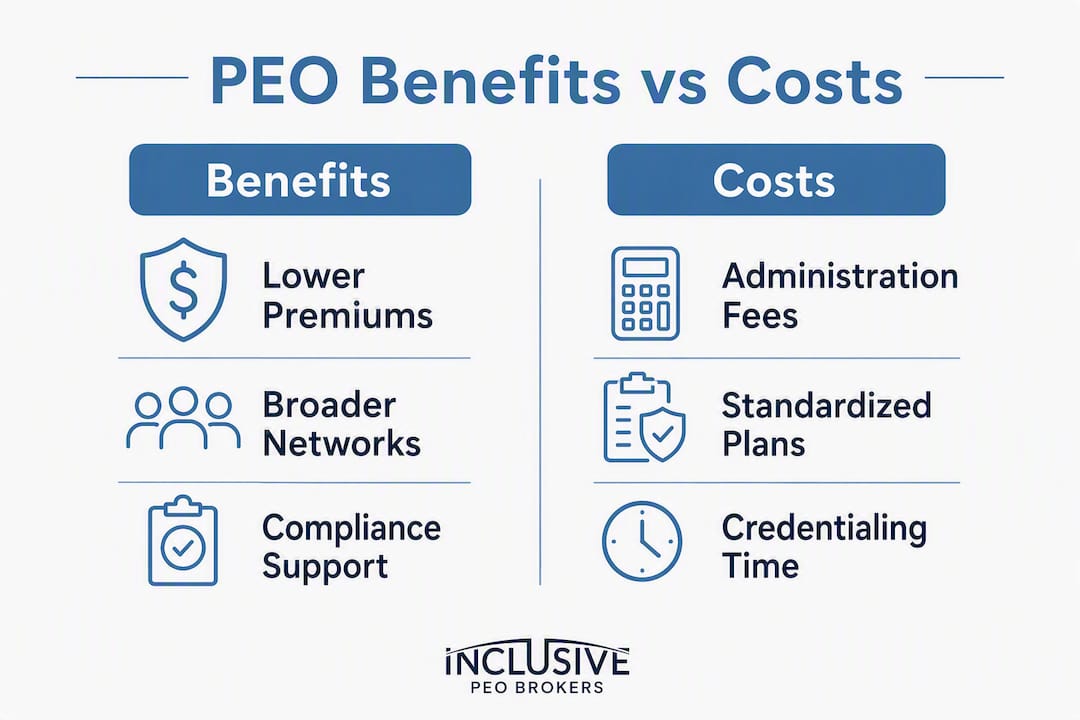
Small and mid-size medical practices face a benefits gap that larger hospital systems do not. A solo-physician office or a three-site outpatient clinic simply cannot negotiate the same health plan terms as a regional health network. A PEO closes that gap.
The most direct benefits for healthcare employers:
- Large-group plan access: Medical, dental, vision, and retirement plans at rates your headcount alone cannot secure. This is the single biggest financial lever for practices under 50 employees.
- Administrative relief: Enrollment management, billing reconciliation, ACA 1094/1095 reporting, and consolidated vendor management move off your plate entirely.
- Workers’ compensation programs: PEOs bundle workers’ comp quoting and management, EPLI support, and OSHA-oriented safety training tailored to clinical settings, which matters when your staff handles sharps, biohazards, and physically demanding patient care.
- Talent and retention: Nurses, medical assistants, and mid-level providers compare benefit packages when choosing employers. A PEO-backed benefits package, complete with 401(k) options and robust health coverage, makes a smaller practice competitive with larger systems.
Healthcare-focused PEOs often add time-and-attendance tools built for 24/7 operations, helping clinics manage safe staffing levels while staying compliant with healthcare labor rules. That operational layer goes well beyond what a standard HR platform provides.
How a PEO affects your health insurance costs

The short answer: your per-employee premium costs often decrease, but you add a PEO administrative fee. Whether the net result is savings depends on your current plan, headcount, and employee mix.
Common fee structures:
- Percentage of payroll: An administrative fee that is typically a percentage of gross payroll, meaning costs scale with compensation levels. This can be expensive for practices with high-earning physicians.
- PEPM: A flat monthly fee per covered employee, often ranging from $80–$200 depending on the PEO and service tier. More predictable for budgeting.
- Bundled admin fees: Some PEOs fold administrative costs into the premium itself, making true cost comparison harder without a side-by-side model.
Healthcare-specific cost drivers include your mix of MDs/DOs, NPs/PAs, RNs, and medical assistants. A practice heavy on physicians carries a higher payroll base, which inflates percentage-of-payroll fees. Multi-site operations add payroll tax complexity that can affect the PEO’s pricing. According to KFF’s 2024 Employer Health Benefits Survey, the average annual premium for employer-sponsored family coverage reached $25,572, a figure that underscores why pooled purchasing matters for smaller employers.
Pro Tip: When you request a PEO proposal, ask for a complete side-by-side cost model that includes your current premium spend, the projected PEO premium, the PEPM or percentage fee, and an estimate of administrative hours saved valued at your staff’s hourly rate. The last column is where the real ROI often lives.
For a practical cost-reduction framework, the strategic cost analysis from Inclusive PEO Brokers walks through the levers that matter most in 2026.
PEO health plans vs. traditional small-group employer plans
For clinics with fewer than 50 employees, a PEO plan almost always delivers better value than a standalone small-group plan. For larger, multi-site practices with custom coverage needs, the calculus gets more nuanced.
| Dimension | PEO Health Plan | Traditional Small-Group Plan |
|---|---|---|
| Cost shape | Pooled large-group rates plus admin fee | Small-group market rates, no admin fee |
| Plan flexibility | Limited to PEO’s carrier menu | Full carrier and plan design choice |
| Admin burden | PEO manages enrollment, billing, ACA reporting | Employer manages or hires broker/TPA |
| Network control | PEO’s contracted networks | Employer selects network directly |
| Eligibility rules | PEO’s standard eligibility policies apply | Employer sets eligibility within ACA rules |
| Onboarding speed | 30–90 days with structured process | Varies; can be faster for simple renewals |
A few healthcare-specific considerations worth weighing:
- Provider network access: PEO-contracted networks may not include every specialist or hospital system your employees prefer. Verify network breadth in your geography before signing.
- Credentialing implications: Switching to a PEO does not directly affect your providers’ clinical credentialing, but it does change the employer of record, which some hospital privilege agreements reference. Confirm with your credentialing coordinator before transitioning.
- Plan design limits: If your practice needs a custom high-deductible plan paired with an HSA contribution strategy, confirm the PEO supports that structure. Not all do.
How to choose the right PEO for your healthcare practice
The selection process for a healthcare employer is more demanding than for a typical small business. Your checklist needs to go beyond price.
- Confirm HIPAA controls. Ask specifically how the PEO handles PHI during benefits administration and payroll. Request documentation of their HIPAA compliance program, not just a verbal assurance.
- Verify credentialing and license tracking. A healthcare-capable PEO should actively track provider licenses, DEA registrations, and board certifications, and alert you before expirations. Ask for a demo of their credential-tracking system.
- Assess workers’ comp handling for clinical roles. Clinical staff face unique occupational risks. Confirm the PEO has experience classifying and insuring RNs, MAs, and physicians, and ask for loss-run history from similar practices.
- Request a role-by-role cost model. Ask for a modeled cost breakdown by employee category (MD/DO, NP/PA, RN, MA) so you can see exactly where the fee structure helps or hurts your specific workforce.
- Review the plan network in your market. Get a sample benefits booklet and verify that major local hospital systems and specialist groups are in-network for your employees.
- Ask for healthcare client references. A PEO with no medical practice clients is a risk. Request references from practices of similar size and specialty.
- Understand the exit process. Ask what happens to your employees’ benefits coverage if you leave the PEO. Transition terms matter as much as onboarding terms.
- Clarify onboarding support for credentialing transitions. If the PEO becomes the employer of record, confirm they provide documentation support for any hospital privilege or payer credentialing updates.
For first-time buyers, the first-time PEO selection guide from Inclusive PEO Brokers includes sample questions and a structured evaluation framework.
Downsides and trade-offs to consider before switching
A PEO is not the right fit for every healthcare practice. Going in with clear eyes about the trade-offs protects you from a costly switch.
Primary trade-offs:
- Reduced plan design control. You choose from the PEO’s carrier menu, not the open market. If your employees have strong preferences for a specific carrier or network, that may not be available.
- Bundled fee opacity. Some PEOs embed administrative costs inside the premium rather than disclosing them separately, making true cost comparison difficult. Always request a fully unbundled fee disclosure.
- Co-employment complexity. For practices with hospital privilege agreements or payer contracts that reference the employer of record, changing that designation requires coordination. Underestimating this step is one of the most common implementation mistakes.
Red flags to watch for during vetting:
- The PEO cannot provide healthcare-specific client references.
- Fee disclosures are vague or require multiple requests to obtain.
- The PEO has no dedicated credentialing or HIPAA compliance process.
- Workers’ comp classifications for clinical roles are handled generically.
When a PEO is less attractive: Large multi-site practices with 200+ employees and custom self-funded plan needs often find that a PEO’s standardized structure limits rather than helps them. Specialty practices with unique malpractice structures, such as surgical centers or high-risk OB/GYN groups, may also need more tailored risk management than a PEO’s bundled workers’ comp program provides.
What to expect during PEO onboarding
Most healthcare practices complete PEO onboarding in 30–90 days. The range is wide because healthcare employers carry more complexity than typical small businesses: credentialing records, multi-site payroll configurations, and clinical workers’ comp classifications all require additional setup time.
Typical onboarding timeline:
- Weeks 1–2: Data collection. You provide current plan documents, payroll records, employee census by role and location, and state licenses. The PEO uses this to finalize pricing and configure payroll.
- Weeks 2–4: Benefits open enrollment. Employees review and elect coverage under the PEO’s plan. Your HR team or the PEO’s enrollment support team guides the process.
- Weeks 3–5: Payroll migration. Payroll configurations for salaried physicians, hourly staff, and shift differentials are built and tested. Multi-location tax registrations are confirmed.
- Weeks 4–6: Workers’ comp transfer. Existing workers’ comp policies are evaluated for mid-term cancellation or expiration alignment. Clinical role classifications are reviewed.
- Day one go-live. Employees are active in the PEO’s system, benefits are live, and payroll runs under the new structure.
Document checklist to prepare before you start:
- Current health, dental, and vision plan documents and renewal dates
- Payroll records for the prior 12 months, broken down by role
- Provider license copies, DEA registration numbers, and board certification records
- State business licenses and any multi-state registration documents
- Existing workers’ comp policy and loss-run history
Medical practices routinely underestimate the credentialing workload during vendor transitions. Building a credentialing map, including all licenses, expiration dates, and hospital privileges, before you start onboarding prevents service disruptions on day one.
How PEOs support healthcare-specific compliance
The compliance requirements for a medical practice go well beyond standard employment law. A PEO that serves healthcare employers must demonstrate capability across several distinct areas.
The most important compliance capabilities to confirm:
- HIPAA controls in HR systems: Benefits administration and payroll systems that touch employee health information must have documented HIPAA safeguards. Ask for their Business Associate Agreement (BAA) and audit log documentation.
- License and DEA tracking: A competent healthcare PEO maintains a credential-tracking system that monitors expiration dates for provider licenses, DEA registrations, and board certifications, and flags renewals proactively.
- OSHA clinical safety programs: Bloodborne pathogen training, sharps disposal protocols, and ergonomic safety programs for clinical staff are part of a healthcare-grade OSHA program. Verify these are included, not just standard office safety training.
- Dedicated compliance consultant: You should have a named compliance contact, not a generic support queue, who understands healthcare employment law.
For a practical overview of healthcare regulatory basics that apply when evaluating PEOs, Start Up MD’s founder guide covers licensing, HIPAA fundamentals, and early compliance priorities clearly.
Pro Tip: Ask any PEO candidate to walk you through a specific scenario: “One of our NPs’ DEA registration expires in 45 days. How does your system catch that, and what happens next?” Their answer tells you more than any sales deck.
Practices that partner with healthcare-specialized PEOs consistently report meaningful improvements in staff retention. The administrative relief, competitive benefits, and compliance confidence all contribute to a work environment where clinical staff stay longer.
What coverage options and limitations do PEO health plans offer healthcare workers?
PEO health plans typically offer medical, dental, vision, life, and disability coverage, often with multiple plan tiers (HMO, PPO, HDHP with HSA). For healthcare workers, the depth of the medical plan matters more than the breadth of ancillary benefits.
The coverage strengths of PEO plans for clinical staff include access to PPO networks with broad specialist access, mental health parity compliance, and prescription drug coverage that meets ACA minimum value standards. Many PEOs also offer supplemental benefits like critical illness, accident, and hospital indemnity plans that appeal to hourly clinical staff.
The limitations are real, though. PEO plans are standardized across the PEO’s entire client base, so you cannot negotiate custom plan features for your workforce. If your employees are concentrated in a rural market with limited PPO network penetration, the PEO’s contracted network may be thinner than what a locally negotiated plan would provide. Specialty coverage needs, such as malpractice insurance or professional liability for individual providers, fall entirely outside the PEO’s health plan and must be arranged separately.
How does a PEO affect your employees’ access to providers and networks?
The network question is one of the most practical concerns for healthcare workers, who often have strong preferences about where they receive care. When your employees join a PEO’s health plan, their in-network providers are determined by the PEO’s carrier contracts, not by your practice’s geographic preferences.
For practices in major metropolitan areas, this is rarely a problem. Large PEOs typically contract with national carriers like Aetna, Cigna, UnitedHealthcare, and Blue Cross Blue Shield, which have broad urban and suburban networks. The risk is higher for practices in smaller markets or rural areas, where network adequacy can vary significantly by carrier.
Before committing to a PEO, request a network adequacy check for your employees’ zip codes. Specifically, verify that primary care physicians, mental health providers, and any specialists your employees commonly use are in-network. A PEO that cannot provide this analysis before you sign is not ready to serve a healthcare employer.

How PEO health plans affect employee retention at your practice
Retention is the business case that often closes the PEO decision for healthcare employers. Clinical staff shortages across nursing, medical assisting, and mid-level provider roles mean that benefits quality directly affects your ability to hire and keep people.
A PEO-backed benefits package gives a small practice a competitive edge it cannot build alone. The combination of robust health coverage, 401(k) access, dental and vision plans, and supplemental benefits creates a total compensation picture that competes with larger health systems. For hourly clinical staff in particular, the quality of health coverage often weighs more heavily in job decisions than base pay.
Equally important is the administrative experience. When employees can enroll online, access their benefits information without calling HR, and get claims questions answered through a dedicated support line, satisfaction with the benefits program rises. That experience reflects on your practice as an employer. Practices that move to a PEO often find that the visible improvement in benefits administration quality is noticed by staff before the open enrollment period even closes.
Key Takeaways
A PEO gives small and mid-size healthcare practices access to large-group health plan rates, full benefits administration, and healthcare-specific compliance support that most practices cannot build on their own.
| Point | Details |
|---|---|
| Co-employment unlocks large-group rates | Small clinics access medical, dental, and vision plans at rates normally reserved for 200+ employee organizations. |
| Net cost depends on fee structure | Compare current premiums plus admin time against PEO premiums plus PEPM or percentage fees using a full side-by-side model. |
| Healthcare compliance requires verification | Confirm HIPAA controls, credential tracking, and OSHA clinical programs before signing with any PEO. |
| Onboarding takes 30–90 days | Prepare a credentialing map and full payroll records before starting to avoid delays at go-live. |
| Inclusive PEO Brokers simplifies the selection | Their matchmaking process has completed 133 successful implementations and helps clients save an average of 80 hours during the selection process. |
What brokers actually see when healthcare practices choose a PEO
The practices that get the most out of a PEO are the ones that come to the process prepared. The ones that struggle almost always make one of three mistakes.
The first is bringing incomplete data. A PEO cannot model your true cost impact without a full employee census broken down by role, your current premium costs, and your workers’ comp history. Practices that show up with a rough headcount and a ballpark premium number get a ballpark proposal, and ballpark proposals lead to surprises after signing.
The second mistake is ignoring credentialing complexity. Changing the employer of record affects more than payroll. Hospital privilege agreements, payer credentialing files, and DEA registrations all reference the employing entity. Practices that do not map their credentialing obligations before transitioning often face a scramble in the first 60 days that undermines confidence in the whole arrangement.
The third is choosing on price alone. The cheapest PEO proposal is rarely the best fit for a healthcare employer. A PEO that lacks HIPAA-compliant HR systems, has no healthcare client references, and cannot demonstrate a credential-tracking workflow will cost you more in compliance risk and staff frustration than the fee savings are worth.
Dos and don’ts for HR leaders engaging a PEO and a broker:
- Do request a fully unbundled fee disclosure before any proposal review.
- Do bring a credentialing map to your first meeting with a PEO.
- Do ask your broker how they are compensated, and confirm they disclose referral fees. Brokers who are transparent about compensation are the ones whose recommendations you can trust.
- Don’t evaluate PEOs without healthcare-specific client references.
- Don’t skip the network adequacy check for your employees’ zip codes.
- Don’t assume the PEO’s HIPAA compliance covers your practice’s obligations. It covers theirs.
Inclusive PEO Brokers matches healthcare practices with the right PEO
Choosing a PEO for a medical practice is not the same as choosing one for a tech startup. The compliance requirements, payroll complexity, and credentialing obligations demand a broker who understands the difference and can filter out the PEOs that do not.

Inclusive PEO Brokers specializes in exactly this kind of PEO matchmaking for healthcare employers, handling the side-by-side cost modeling, vendor vetting, and negotiation support so you do not have to. With 133 successful implementations completed and an average of 80 hours saved per client in the selection process, the process is built to get you to the right PEO faster and with fewer surprises. The average client also saves $634 through the selection process itself.
Ready to see which PEOs fit your practice? Book a free evaluation and get a cost model built around your actual headcount, roles, and current premiums.
Useful sources and further reading
Inclusive PEO Brokers resources:
- PEO matchmaking and services overview — How Inclusive PEO Brokers evaluates and matches healthcare practices with the right PEO.
- First-time PEO selection guide — Structured checklist and sample questions for practices evaluating a PEO for the first time.
- Healthcare cost reduction analysis — Strategic framework for reducing employee health insurance costs through PEO and other levers.
Partner resources:
- Start Up MD: Healthcare regulatory basics for founders — Practical overview of HIPAA, licensing, and early compliance priorities for small healthcare businesses evaluating HR vendors.
Industry references:
- KFF 2024 Employer Health Benefits Survey — Annual benchmark data on employer-sponsored health insurance premiums and cost trends.
- Healthcare.gov employer coverage information — ACA requirements and employer mandate guidance relevant to practices evaluating coverage options.
This article is general information, not legal, tax, or benefits advice. Confirm current rules and requirements with a qualified professional or the relevant regulatory authority for your specific situation.
.svg)
Seeking a different solution? Meet Your Business Needs