.png)

PEO for Nonprofits: A Nonprofit Leader's Guide
For most U.S. nonprofits with roughly 15–75 paid staff, a PEO is the most cost-effective way to access group benefits, workers’ comp coverage, and payroll compliance without building a full internal HR department. The co-employment model lets your organization offload the administrative burden while keeping complete control over hiring, supervision, and mission-driven decisions.
Three reasons nonprofits choose PEOs:
- Benefits access: PEOs pool employees across many organizations, giving your staff access to health, dental, and retirement options that would otherwise require a much larger headcount to negotiate.
- Workers’ comp savings: Pooled claims experience can reduce premiums 20–40% compared to a standalone nonprofit policy.
- Compliance lift: Payroll tax filings, ACA reporting, and multi-state registration stay current without a dedicated HR hire.
If your nonprofit has complex benefits, staff in multiple states, or limited HR capacity, the next step is to model the numbers. A broker like Inclusive PEO Brokers can run that comparison for you before you commit to anything.
Table of Contents
- What is a PEO and how does the co-employment model work?
- Why nonprofits benefit more from PEOs than most small businesses
- How PEO pricing works and what it costs your nonprofit
- Who should think carefully before signing with a PEO
- How to choose a PEO for your nonprofit (and when to hire a broker)
- What does PEO onboarding actually look like for a nonprofit?
- Risks and downsides nonprofits should weigh honestly
- How a PEO affects nonprofit governance and board responsibilities
- Real-world examples of nonprofits using PEOs successfully
- Key Takeaways
- What most nonprofit leaders get wrong about PEO selection
- How Inclusive PEO Brokers helps nonprofits find the right PEO
- Useful sources for further reading
What is a PEO and how does the co-employment model work?
A Professional Employer Organization (PEO) enters a co-employment arrangement with your nonprofit: the PEO becomes the employer of record for tax, payroll, and benefits compliance, while your organization retains full operational control.
“A PEO does not manage an employee’s day-to-day responsibilities. The nonprofit retains 100% control over hiring, firing, and supervision while the PEO is employer of record for tax and benefits.” — Hotaling Insurance, PEO Services for Nonprofits
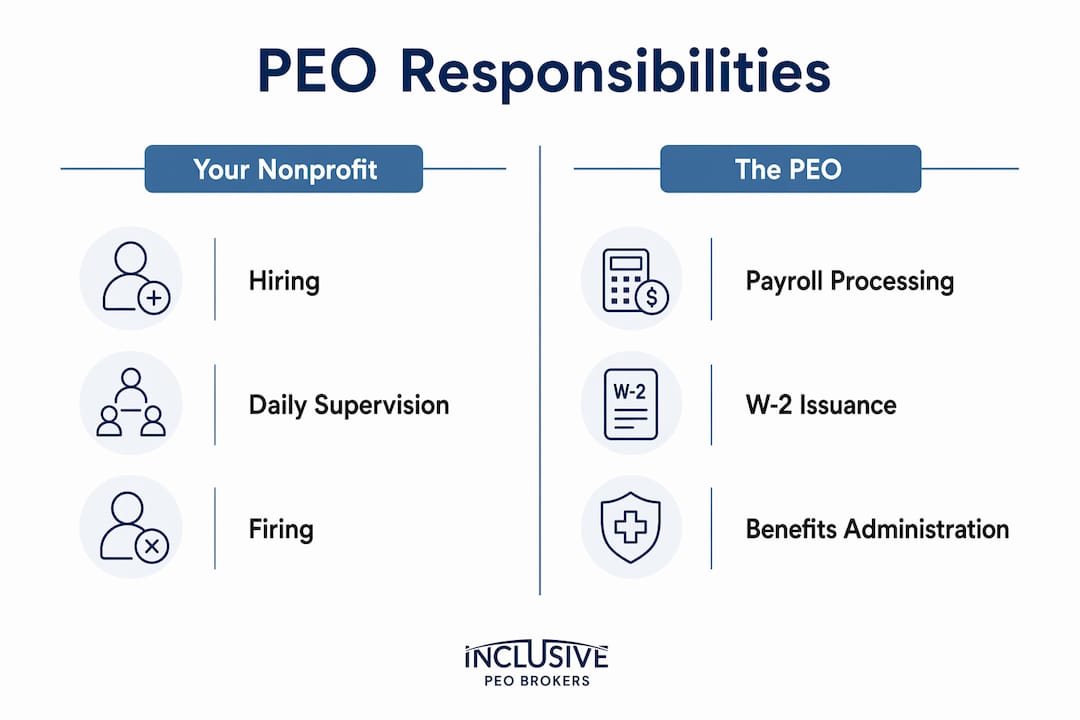
Think of it as an off-site HR department that handles the mechanics so your leadership can focus on programs and fundraising. The split of responsibilities looks like this:
| Your Nonprofit Handles | The PEO Handles |
|---|---|
| Hiring, firing, daily supervision | Payroll processing and W-2 issuance |
| Mission strategy and culture | Federal and state payroll tax filings |
| Performance management | Benefits enrollment and administration |
| Volunteer oversight | Workers’ comp coverage and claims |
| Grant reporting and compliance | ACA and COBRA reporting |

Beyond payroll, a PEO typically provides HR policy support, onboarding tools, training resources, and sometimes volunteer management tools tailored for nonprofits — a meaningful step up from a standalone payroll vendor.
Pro Tip: Before signing with any PEO, confirm whether they use their own Federal Employer Identification Number (FEIN) for payroll filings or yours. This affects how payroll appears on your Form 990 and how your auditor will treat the arrangement.
Why nonprofits benefit more from PEOs than most small businesses
Smaller nonprofits and foundations are increasingly turning to PEOs precisely because the sector’s pain points align almost perfectly with what a PEO solves.
The biggest nonprofit-specific advantages:
- Group benefits leverage: PEOs consolidate benefits across their entire client base, giving a 20-person nonprofit access to health plan options that normally require hundreds of employees to unlock.
- Workers’ comp pooling: Pooled claims across many employers reduce premium volatility. Savings are commonly reported for nonprofits moving from standalone policies.
- Multi-state and grant-funded staff support: PEOs handle state registration, withholding, and compliance for staff hired across state lines, which is a recurring headache for nonprofits with remote or field-based teams.
- Leadership time recovery: HR experts recommend using the time saved by PEOs to focus on mission-aligned talent strategies like professional development and retention, rather than paperwork.
NAPEO reports approximately 250,000 small and mid-sized businesses and about 2.5 million workers currently in PEO arrangements, a scale that drives the group purchasing power nonprofits rely on.
How PEO pricing works and what it costs your nonprofit
PEO fees for nonprofits typically run about 2–4% of total payroll, though some PEOs use a flat per-employee-per-month (PEPM) model instead. Both structures usually bundle payroll processing, tax filings, benefits administration, and workers’ comp into the base fee, with one-time onboarding costs and pass-through insurance premiums charged separately.
A simple comparison for a nonprofit with $2 million in annual payroll:
| Cost Component | PEO Model (3% of payroll) | Internal Model |
|---|---|---|
| Workers’ comp (standalone) | Included in PEO fee | — |
The gap narrows quickly when you factor in compliance errors, staff time on HR tasks, and the benefits quality difference. For cost-reduction modeling specific to your payroll and headcount, a broker can build a side-by-side comparison before you request formal quotes.
Who should think carefully before signing with a PEO
The PEO model works best for nonprofits in a specific range. Under roughly 15 employees, the fee often outweighs the savings unless workers’ comp premiums are unusually high. Above roughly 75 employees, many nonprofits can negotiate benefits directly or justify a full-time HR hire.
Red flags and situations that require extra caution:
- Unionized staff or collective bargaining agreements: Most PEOs will not co-employ workers covered by a CBA. Confirm this before any conversation goes further.
- Existing group plans mid-contract: Transitioning benefits mid-year can trigger penalties or coverage gaps. Time the switch to your benefits renewal date.
- Grant reporting complications: Some funders require payroll to appear under the nonprofit’s own FEIN. Verify this with your program officers before onboarding.
- Insurance coordination gaps: Moving to a PEO master policy can create gaps in D&O and EPLI coverage if the transition isn’t modeled carefully. Always verify continuity with your current insurer and funder requirements.
Pro Tip: Before you sign anything, notify your auditor and any cognizant federal agency. Using a PEO does not change your 501©(3) status, but payroll still appears on your Form 990 and auditors need to understand the co-employment arrangement to report it correctly.
How to choose a PEO for your nonprofit (and when to hire a broker)
A structured evaluation process saves months of back-and-forth. Work through this checklist with every PEO you shortlist:
- Ask for ESAC accreditation. The Employer Services Assurance Corporation (ESAC) sets financial and ethical standards for PEOs. Accreditation is a meaningful trust signal.
- Request SOC 1 and SOC 2 reports. These audits confirm the PEO’s payroll and data security controls meet independent standards.
- Get pricing in writing. Verbal quotes are not binding. Require a written service agreement (SOW) with itemized fees and SLAs before proceeding.
- Ask which FEIN appears on employee W-2s. This affects your Form 990 and auditor reporting.
- Confirm benefits portability. If you leave the PEO, can employees keep their plans or must they re-enroll elsewhere?
- Understand the workers’ comp model. Does the PEO carry its own master policy, or does it broker coverage? Who handles claims?
- Verify multi-state registration capability. If you have staff in more than one state, confirm the PEO is registered and compliant in each.
- Ask about ACA reporting. Who files the 1094-C and 1095-C forms, and under which FEIN?
- Review exit terms. What is the notice period? Are there termination fees? Check the exit strategy implications before you sign.
- Request client references from nonprofits of similar size and complexity.
When a broker makes sense: If your nonprofit has multi-state staff, complex benefits needs, or no one internally with procurement experience, a broker like Inclusive PEO Brokers handles the PEO selection process for you, including cost modeling, side-by-side comparisons, and negotiation support. Going direct is fine for straightforward situations; for anything complex, a broker’s market knowledge typically pays for itself. A strategic selection guide can also help you prepare the right questions before you engage vendors.
What does PEO onboarding actually look like for a nonprofit?
Most nonprofits complete the transition to a PEO in 4–8 weeks. Here is a realistic milestone timeline:
| Week | Milestone |
|---|---|
| 1–2 | Discovery: employee census, payroll history, benefits contracts, workers’ comp policy review |
| 2–3 | SOW and pricing finalized; written service agreement signed |
| 3–4 | Benefits enrollment window opens for employees |
| 4–5 | Payroll cutover: first payroll run under PEO FEIN |
| 5–6 | Workers’ comp policy transferred to PEO master policy |
| 6–8 | Auditor and funder notifications sent; D&O/EPLI coordination confirmed |
During the first 90 days, monitor your first two payroll runs closely for classification errors, confirm all employees have completed benefits enrollment, and verify that workers’ comp claims are routing to the correct carrier. A payroll tax compliance review during this window catches the errors that are easiest to fix early.
Risks and downsides nonprofits should weigh honestly
The co-employment model carries real trade-offs for mission-driven organizations. Donor perception is one that often goes unaddressed: some major donors or foundation funders scrutinize administrative overhead ratios, and a PEO fee that appears as a line item on the Form 990 can prompt questions. The answer is straightforward, but your development team should be prepared to explain it.
There is also a governance dimension. Board members who are accustomed to direct oversight of HR decisions may feel less connected to employment practices once a PEO is in place. The PEO handles the mechanics, but the board retains fiduciary responsibility for compensation, classification, and employment policy. That accountability does not transfer.
Finally, PEOs do not replace culture. Experts caution that PEOs handle the mechanics of compliance and payroll but do not substitute for the nonprofit’s own investment in retention, professional development, and mission alignment. Treating a PEO as a culture solution rather than an administrative one is the most common mistake nonprofits make after onboarding.
How a PEO affects nonprofit governance and board responsibilities
A PEO does not alter your nonprofit’s legal structure, tax-exempt status, or board authority. The board retains full responsibility for setting compensation policy, approving employment classifications, and overseeing HR practices, even when the PEO executes them day to day.
What changes is the flow of information. Employment records, payroll data, and benefits administration move through the PEO’s systems, so the board needs a clear reporting protocol to maintain visibility. Build a quarterly HR summary into your board reporting cycle from day one. The National Council of Nonprofits notes that board members can be personally liable if payroll taxes are not properly withheld, which is exactly the risk a PEO mitigates, but only if the arrangement is properly documented and monitored.
Real-world examples of nonprofits using PEOs successfully
A community health nonprofit with 28 employees and staff in three states was spending roughly 15 hours per week on payroll, benefits administration, and compliance across those jurisdictions. After moving to a PEO, the executive director reclaimed that time for program work, and the organization gained access to a health plan with better coverage at a lower per-employee cost than its previous standalone policy.
A regional advocacy organization with 40 staff had been carrying a high workers’ comp experience modifier after two claims in three years. By joining a PEO’s pooled workers’ comp program, the organization’s effective premium dropped significantly in the first year, and claims management moved to the PEO’s dedicated team.
These outcomes are consistent with the broader trend: smaller nonprofits and foundations are adopting PEOs specifically to solve the compliance, talent competition, and capacity constraints that limit their impact.
Key Takeaways
A PEO is the right fit for most U.S. nonprofits with 15–75 employees, delivering group benefits access, workers’ comp savings of 20–40%, and payroll compliance without a full internal HR team.
| Point | Details |
|---|---|
| Sweet spot by headcount | Nonprofits with roughly 15–75 employees get the strongest return from a PEO arrangement. |
| Workers’ comp savings | Pooled claims through a PEO can reduce workers’ comp premiums by 20–40% versus a standalone policy. |
| Governance stays with the board | A PEO handles HR mechanics; the board retains fiduciary responsibility for compensation and employment policy. |
| Notify auditors before onboarding | Alert your auditor and any federal cognizant agency before the payroll cutover to avoid Form 990 reporting issues. |
| Inclusive PEO Brokers | Inclusive PEO Brokers matches nonprofits with the right PEO through cost modeling, side-by-side comparisons, and negotiation support, with 133 completed implementations and an average 80 hours saved per client. |
What most nonprofit leaders get wrong about PEO selection
The most common mistake is timing. Nonprofit leaders frequently wait until a compliance problem, a benefits renewal crisis, or a key HR staff departure forces the decision. By then, the selection process is rushed, leverage in negotiation is low, and onboarding happens at the worst possible moment in the payroll calendar.
The second mistake is treating the PEO search like a vendor RFP rather than a strategic decision. The right PEO for a 25-person advocacy nonprofit is not the same as the right PEO for a 60-person social services organization. Fee structure, benefits carrier relationships, workers’ comp model, and nonprofit-specific experience all vary significantly across providers.
What a broker actually delivers in this process:
- A pre-screened shortlist based on your headcount, state footprint, and benefits priorities
- Side-by-side cost models that include workers’ comp savings projections
- Negotiation support on fee structure and contract terms
- Implementation oversight through the first payroll run and benefits enrollment
- Verification of ESAC accreditation and SOC report status on your behalf
Inclusive PEO Brokers has completed 133 PEO implementations and clients save an average of 80 hours in the selection process alone. That time compounds: leaders who adopt a PEO earlier spend fewer years managing HR inefficiency and more time on the work that actually advances their mission.
How Inclusive PEO Brokers helps nonprofits find the right PEO
Skipping the broker and going direct to PEO vendors costs most nonprofits more than they expect, in time, in missed negotiation leverage, and in the risk of choosing a PEO that does not fit their grant reporting or insurance requirements.

Inclusive PEO Brokers takes a different approach. Rather than sending your nonprofit through a generic sales process, the team builds a cost model specific to your payroll, headcount, and state footprint, then matches you with PEOs that have documented nonprofit experience. The broker matchmaking process covers cost modeling, side-by-side comparisons, contract negotiation, and post-implementation support through your first 90 days. With 133 completed implementations and an average of 80 hours saved per client, the process is repeatable and the outcomes are measurable.
Ready to see what the right PEO would cost your nonprofit? Book a free broker assessment and get a side-by-side comparison built around your organization’s actual numbers.
Useful sources for further reading
- Trendspotting: Smaller Nonprofits and Foundations Working with PEOs — National Council of Nonprofits overview of why smaller nonprofits are adopting PEOs and what they gain.
- Managing Nonprofit Employees — National Council of Nonprofits guidance on employment law, board liability for payroll taxes, and HR best practices.
- PEO Services for Nonprofits: HR Outsourcing — Detailed breakdown of co-employment mechanics, pricing models, workers’ comp savings, and Form 990 implications.
- The Difference Between Traditional Payroll and a PEO for Nonprofits — The Charity CFO’s comparison of payroll vendors versus full PEO service scope.
- Nonprofit Human Resources — Orr Group’s perspective on strategic HR for nonprofits, including what PEOs do and do not replace.
- Payroll Tax Obligation: A Clear Guide for Small Businesses — TaxBowl’s plain-language guide to payroll tax obligations relevant to nonprofits managing the transition to a PEO.
- Inclusive PEO Brokers: Our Process — How Inclusive PEO Brokers matches nonprofits with PEOs, including cost modeling and implementation support.
- First-Time PEO Selection Guide — Inclusive PEO Brokers’ resource for nonprofits evaluating a PEO for the first time.
This article is general information, not legal, tax, or HR advice. Confirm current rules and how they apply to your organization with a qualified professional or the relevant primary source.
.svg)
Seeking a different solution? Meet Your Business Needs