.png)

The PEO Selection Process Explained for SMBs
The PEO selection process is a structured, multi-phase evaluation that helps small and medium-sized businesses identify the Professional Employer Organization best suited to their HR, payroll, and employee benefits needs. Done correctly, it takes 6 to 8 weeks and covers five distinct phases: needs assessment, vendor screening, due diligence, negotiation, and final decision. Most businesses that struggle with PEO partnerships skipped at least one of those phases, often because they focused on the lowest per-employee cost instead of operational fit. This guide walks you through every step, including the expert-backed 12-point Due Diligence Dozen framework, so you can make a decision you won’t need to reverse.
What is the PEO selection process and why does it matter?
The PEO selection process is the formal procedure a business uses to evaluate, compare, and choose a co-employment partner. A PEO takes on shared employer responsibilities, including payroll processing, benefits administration, tax filings, and HR compliance, under a co-employment model. That shared responsibility is exactly why the selection decision carries real operational weight. Choosing the wrong PEO does not just cost money. It can expose your business to compliance gaps, poor employee experiences, and difficult contract exits.
A systematic, phased approach to selection reduces costly mistakes and builds alignment between your business needs and a PEO’s actual capabilities. The five phases work in sequence for a reason. Skipping needs assessment means you enter vendor conversations without clear requirements. Skipping due diligence means you rely on sales presentations instead of verified performance data.
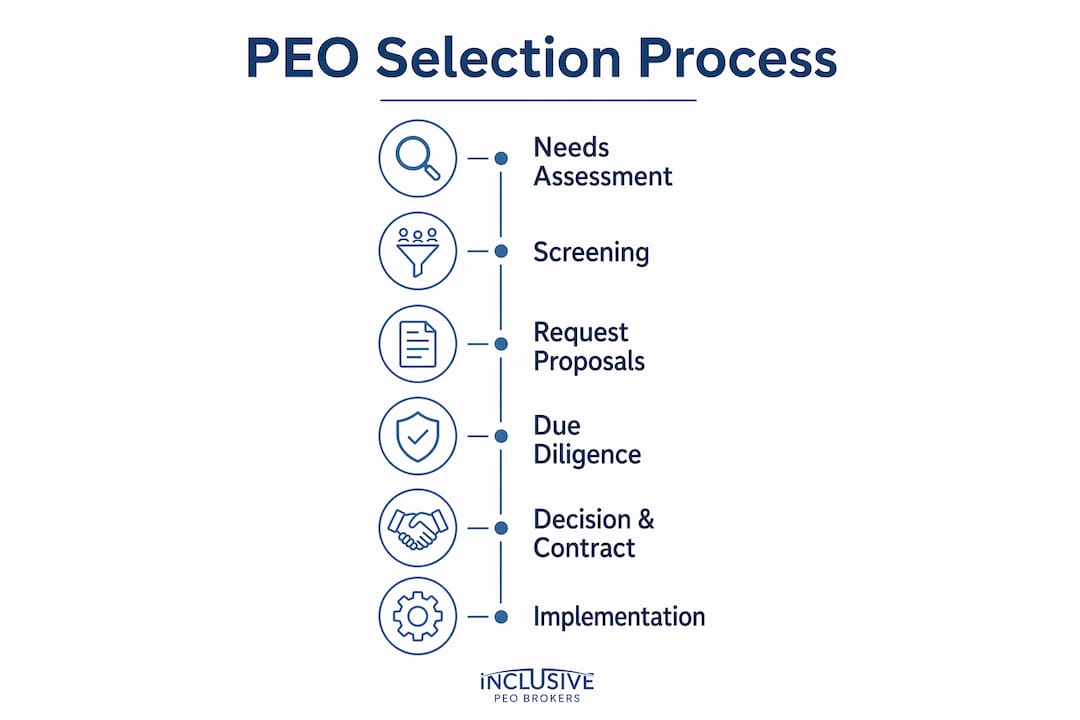
Here is how the five phases break down in practice:
- Needs assessment (Week 1): Define your headcount, industry, compliance requirements, benefits goals, and technology expectations before contacting any vendor.
- Initial screening (Weeks 1 to 2): Filter a long list of PEO candidates down to three to five based on industry fit, geographic coverage, and service model.
- Proposal requests (Week 3): Send a structured RFP to shortlisted candidates so you can compare pricing and service scope on equal terms.
- Due diligence (Weeks 4 to 6): Verify claims through reference calls, contract reviews, compliance audits, and technology demonstrations.
- Negotiation and final decision (Weeks 7 to 8): Use competing proposals as leverage, negotiate contract terms, and confirm your choice.
The full timeline runs 6 to 8 weeks when executed properly. That timeline is not bureaucratic padding. It reflects the minimum time needed to verify operational capability, not just pricing. Businesses that compress this process into two weeks almost always miss critical contract terms or compliance gaps that surface later.
What criteria should you use to evaluate PEO candidates?
The most reliable framework for PEO evaluation is the 12-point Due Diligence Dozen, a scoring system that rates each candidate on a 1 to 5 scale across operational, contractual, and strategic factors. A total score of 50 or above indicates a strong candidate. Scores below 40 signal a poor fit that warrants serious reconsideration. This quantitative approach removes gut-feel bias from a decision that directly affects your employees and your compliance standing.

The table below covers the core criteria and what each one actually measures:
| Criterion | What to assess |
|---|---|
| Carrier diversity | Does the PEO offer multiple insurance carriers, or are you locked into one? |
| Renewal guarantees | Are benefit renewal rates capped or predictable year over year? |
| Service model | Dedicated account manager vs. call-center support: which does your team get? |
| Technology platform | Does the HR software integrate with your payroll and time-tracking tools? |
| Compliance support | Does the PEO have in-house legal and compliance staff for your industry? |
| Contract flexibility | Can you exit without excessive penalties, and are auto-renewal clauses fair? |
| Price transparency | Are all fees itemized, or are ancillary charges buried in the contract? |
Industry specialization is one criterion that SMBs consistently underweight. A PEO with deep expertise in manufacturing safety programs or tech-startup onboarding systems will outperform a generalist provider on the metrics that matter most to your workforce. The same logic applies to international hiring contexts, where regulatory compliance expertise becomes a direct operational risk factor.
Pro Tip: Most businesses spend 80% of their evaluation time comparing price and only 20% reviewing contract terms. Flip that ratio. A fair exit clause and clear liability language protect you far more than saving $10 per employee per month.
How to manage the PEO selection timeline effectively
Managing the timeline well is less about speed and more about sequencing. Each phase produces outputs that feed the next one. Your needs assessment defines the RFP questions. Your RFP responses determine which vendors advance to due diligence. Your due diligence findings shape your negotiation position. Disrupting that sequence creates gaps.
Here are the most practical tips for keeping each phase on track:
- Assign a single internal owner. PEO selection stalls when it becomes a committee project with no clear decision-maker. One person should own the process, gather input from HR and finance, and drive deadlines.
- Use a standardized RFP template. Sending different questions to different vendors makes comparison nearly impossible. A structured proposal request forces apples-to-apples responses on pricing, service scope, and technology.
- Conduct at least two reference calls per finalist. Ask references specifically about onboarding speed, compliance incident handling, and account manager responsiveness. Sales references are pre-screened. Ask for a client in your industry and size range.
- Review the contract before the final presentation. Most businesses read the contract after they have emotionally committed to a vendor. Read it during due diligence, while you still have leverage.
Effective negotiation means using competing proposals as direct leverage. If Vendor A offers better exit terms and Vendor B offers better pricing, tell both. Mid-market clients have more negotiating power than they typically use. You can request modifications on bundling requirements, auto-renewal clauses, and termination fees. Vendors expect it.
Pro Tip: Ask every finalist vendor for a sample client invoice from their first three months of service. Hidden fees almost always appear in the first billing cycle, not in the proposal. Seeing a real invoice before you sign is the fastest due diligence shortcut available.
How does PEO pricing work and what hidden fees should you watch for?
PEO pricing structures fall into two primary models: a per-employee-per-month administrative fee, typically ranging from $80 to $200 depending on service scope, and a percentage-of-payroll model, usually between 2% and 12%. Both models can be fair or exploitative depending on what is included and what is not. Pricing transparency is the variable that separates trustworthy vendors from problematic ones.
The following fees are the most common sources of unexpected costs in PEO contracts:
- Onboarding and implementation fees: Some PEOs charge $500 to $2,000 per client to set up the account, a cost rarely mentioned in the initial proposal.
- Ancillary service fees: Workers’ compensation audits, COBRA administration, and ACA reporting are sometimes billed separately even when the sales pitch implied they were included.
- Mid-year rate adjustments: Vague language around “market adjustments” can allow a PEO to raise your administrative fee without triggering a contract breach.
- Early termination penalties: Some contracts require 60 to 90 days notice and charge a fee equal to several months of service if you exit early.
Clear contract terms covering service scope, liability, data ownership, termination conditions, auto-renewal, and pricing changes are the single best protection against these exposures. The PEO selection guide principle here is straightforward: the lowest headline price is meaningless if ancillary fees push your total cost 30% above the next competitor. Always calculate total cost of ownership, not just the per-employee rate.
Key takeaways
Choosing the right PEO requires a structured 6 to 8 week process, a 12-point evaluation framework, and a contract review that prioritizes exit terms and fee transparency over headline pricing.
| Point | Details |
|---|---|
| Follow the five-phase process | Needs assessment, screening, proposals, due diligence, and negotiation each build on the last. |
| Use the Due Diligence Dozen | Score candidates 1 to 5 across 12 criteria; 50+ is a strong fit, below 40 means reconsider. |
| Prioritize compliance and industry fit | A PEO with relevant industry expertise reduces operational risk more than a lower price does. |
| Read the contract during due diligence | Review exit terms, auto-renewal clauses, and ancillary fees before you are emotionally committed. |
| Calculate total cost of ownership | Per-employee rate is just the starting point; onboarding, termination, and ancillary fees change the real number. |
What SMBs consistently get wrong about PEO selection
After working through dozens of PEO evaluations, the pattern I see most often is this: business owners treat PEO selection like a procurement exercise when it is actually a partnership decision. Procurement thinking optimizes for price. Partnership thinking optimizes for fit, reliability, and what happens when something goes wrong.
The businesses that regret their PEO choice almost always made the same two mistakes. They chose the lowest bidder without verifying operational capability, and they signed a contract without reading the exit terms. Those two errors compound each other. A poor-fit PEO is painful to work with. A poor-fit PEO with a punishing exit clause is a trap.
Scoring your current or prospective PEO periodically is a habit that most SMBs skip entirely. Scores below 40 on the Due Diligence Dozen suggest it is time to explore alternatives. Scores between 40 and 50 warrant a direct conversation with your provider about service gaps. That kind of proactive assessment prevents the slow drift into a relationship that no longer serves your business.
My honest advice: slow down the timeline deliberately. The pressure to finalize a PEO before open enrollment or a new hire surge is real, but a rushed decision made in week two will cost you far more than a careful decision made in week eight. The PEO selection process rewards patience and penalizes shortcuts.
— John
How Inclusive PEO Brokers simplifies your search
Finding the right PEO on your own means managing vendor outreach, comparing proposals, reviewing contracts, and negotiating terms, all while running your business. Inclusive PEO Brokers handles that entire process for you.

Inclusive PEO Brokers has completed 133 successful PEO implementations for small and medium-sized businesses, saving each client an average of 80 hours and $634 in the selection process alone. The firm’s approach matches your specific business needs, including industry, headcount, benefits goals, and compliance requirements, to PEO candidates that are genuinely qualified to serve you. You get expert guidance, a proven framework, and a negotiated contract, without spending weeks in vendor calls. Start your PEO search with a team that has done this more than a hundred times before.
FAQ
What is the PEO selection process?
The PEO selection process is a structured evaluation method that helps businesses identify, compare, and choose a Professional Employer Organization based on HR needs, compliance requirements, and operational fit. It typically runs 6 to 8 weeks across five phases: needs assessment, screening, proposals, due diligence, and negotiation.
How long does it take to select a PEO?
A thorough PEO selection process takes 6 to 8 weeks, with initial screening running 1 to 2 weeks, due diligence taking 2 to 3 weeks, and negotiation requiring approximately 2 weeks. Compressing this timeline increases the risk of missing contract issues or compliance gaps.
What are the most important PEO selection criteria?
The most critical criteria are compliance expertise, service model, contract flexibility, pricing transparency, and industry specialization. The 12-point Due Diligence Dozen framework scores these factors on a 1 to 5 scale, with a total score above 50 indicating a strong candidate.
What hidden fees should I watch for in a PEO contract?
Watch for onboarding and implementation fees, ancillary service charges for COBRA or ACA reporting, mid-year rate adjustment clauses, and early termination penalties. Reviewing a sample client invoice before signing is the fastest way to surface costs that do not appear in the proposal.
Should I use a PEO broker to help with selection?
A PEO broker like Inclusive PEO Brokers manages vendor outreach, proposal comparison, contract review, and negotiation on your behalf, typically saving 80 hours of internal time. For SMBs without a dedicated HR team, broker-assisted selection reduces both the time burden and the risk of a poor-fit decision.
Recommended
.svg)
Seeking a different solution? Meet Your Business Needs