.png)

What Is a PEO? A Small Business Owner's Guide
A Professional Employer Organization, or PEO, is a human-resources outsourcing firm that administers payroll, benefits, and compliance through a co-employment model, letting you retain full operational control of your team. Think of it as an off-site HR department that shares legal employer responsibilities with your business. The PEO handles the administrative weight while you stay focused on running your company. About 500 PEOs currently operate in the U.S., serving over 200,000 small and mid-sized businesses and covering 4.5 million workers. That scale tells you this is not a niche workaround. It is a proven model used by businesses just like yours.
What is a PEO and how does co-employment work?
Co-employment is the legal and operational foundation of every PEO relationship. Under this model, both you and the PEO are recognized as employers of your workers, each with distinct responsibilities. The PEO becomes the employer of record for tax and benefits purposes. You remain the worksite employer, meaning you control hiring, firing, day-to-day management, and all business decisions.
The division of duties is governed by a Client Service Agreement (CSA). This contract is the single most important document in your PEO relationship. The CSA defines which party handles payroll tax withholding, workers’ compensation filings, benefits enrollment, and regulatory compliance. What gets outsourced and what stays in-house depends entirely on what that agreement spells out.
Here is how responsibilities typically split between the two parties:
- PEO handles: Payroll processing, federal and state tax withholding, W-2 issuance, workers’ compensation coverage, benefits administration, and HR compliance filings
- You handle: Hiring and termination decisions, employee performance management, day-to-day supervision, and setting compensation levels
- Shared: Onboarding workflows, workplace safety programs, and HR policy development
One detail many business owners miss: employee discipline and termination always stay with the client. The PEO does not manage your people. It manages the paperwork and legal obligations surrounding them.
Pro Tip: Before signing a CSA, map every HR task your business currently handles and confirm each one is explicitly assigned in the agreement. Vague or unassigned duties are the most common source of disputes after a PEO contract is signed.

What services does a PEO typically offer?
PEO services cover a broad range of HR functions, but the exact package varies by provider. No two PEOs are identical, and service levels vary significantly across the market. Comparing providers on scope, not just price, is the right approach.
Standard services offered by most PEOs include:
- Payroll processing and tax filing: The PEO runs payroll on your schedule, withholds federal and state taxes, and files all required returns. This removes one of the most time-consuming administrative tasks from your plate.
- Employee benefits administration: PEOs pool workers from multiple client companies to negotiate group rates on health, dental, vision, and retirement plans. Small businesses often access Fortune 500-level benefits through this arrangement.
- Workers’ compensation management: The PEO secures coverage, manages claims, and handles audits. This is especially valuable for businesses in industries with higher injury risk.
- HR compliance and risk management: PEO risk management support includes keeping your policies current with federal and state employment law, managing OSHA requirements, and reducing your exposure to wage-and-hour violations.
- Employee onboarding and training: Many PEOs provide digital onboarding tools, employee handbooks, and access to training platforms that would cost significantly more to build independently.
Providers like ADP TotalSource, Insperity, and TriNet each offer these core services but differ in technology platforms, industry specialization, and the depth of HR advisory support included. A manufacturing company has different compliance needs than a tech startup, and the right PEO reflects that.
Pro Tip: Ask each PEO you evaluate for a sample CSA before any sales conversation goes too far. The contract reveals far more about actual service scope than any marketing brochure will.
What is a certified PEO (CPEO) and why does it matter?
A Certified Professional Employer Organization, or CPEO, is a PEO that has earned voluntary IRS certification under IRC section 7705(a). This designation signals that the PEO meets specific federal standards for financial health, tax compliance, and reporting accuracy. Not every PEO pursues this certification, and the distinction carries real consequences for your business.
The most practical benefit of working with a CPEO involves payroll tax liability. With a standard PEO, both parties may share exposure if payroll taxes are not remitted correctly. A CPEO assumes sole liability for federal employment tax obligations during the certified period. That is a meaningful risk transfer for a small business owner.
PEO accreditation from industry bodies like ESAC (Employer Services Assurance Corporation) is a separate designation. IRS CPEO certification and ESAC accreditation each cover different compliance areas. Verifying both, and understanding what each covers, gives you a clearer picture of a provider’s overall reliability.
| Feature | Standard PEO | Certified PEO (CPEO) |
|---|---|---|
| IRS federal certification | No | Yes, under IRC 7705(a) |
| Payroll tax liability | Shared with client | Assumed by CPEO |
| Financial reporting standards | Varies by provider | Required by IRS program |
| Industry accreditation (ESAC) | Optional | Optional, separate from IRS |
| Compliance assurance level | Provider-dependent | Federal oversight applied |
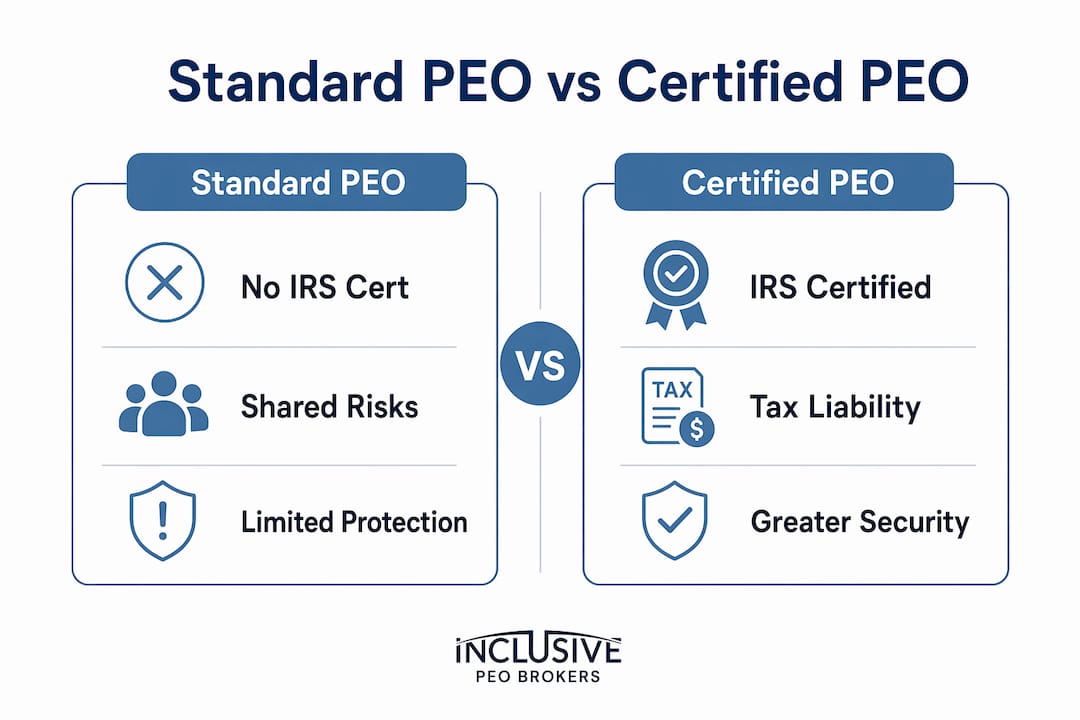
For small businesses with limited internal tax expertise, a CPEO offers a measurable layer of protection that a standard PEO cannot guarantee.
PEO vs. ASO, EOR, and staffing agencies: key differences
The HR outsourcing market includes several models that can look similar on the surface. Understanding the legal and operational distinctions helps you choose the right fit.
| Model | Co-Employment? | Who Is Legal Employer? | Best For |
|---|---|---|---|
| PEO | Yes | Shared (client + PEO) | SMBs wanting HR support while retaining control |
| ASO (Administrative Services Org.) | No | Client only | Businesses wanting admin help without co-employment |
| EOR (Employer of Record) | No | EOR only | Hiring workers in new states or countries quickly |
| Staffing Agency | No | Agency (for placed workers) | Short-term or project-based workforce needs |
Only PEOs use the co-employment model, and that distinction drives every other difference in the table above. An ASO handles HR administration but leaves all legal employer obligations with you. An EOR becomes the sole employer of record, which is useful for international hiring but removes your direct employment relationship with the worker. A staffing agency supplies temporary labor under its own employment umbrella.
The right choice depends on your situation. If you want to offload payroll and compliance while keeping your team directly employed by your business, a PEO is the correct model. If you are hiring a contractor in Germany for six months, an EOR makes more sense.
What to consider before signing a PEO contract
Choosing a PEO is not a commodity purchase. The CSA defines your entire relationship, and a vague agreement creates operational risk from day one. Before you sign anything, work through these considerations:
- Map your current HR workflows. List every task your team handles today, from payroll runs to benefits enrollment to termination paperwork. Confirm each one is explicitly covered or excluded in the CSA.
- Check for hidden fees. PEO pricing models vary. Some charge a flat per-employee-per-month fee. Others charge a percentage of payroll. Understand exactly what triggers additional costs.
- Verify compliance coverage by state. If your business operates across multiple states, confirm the PEO is registered and compliant in each one. Coverage gaps create legal exposure.
- Understand the exit process. Transitioning away from a PEO requires careful planning. Review termination clauses, data portability rights, and transition timelines before you commit.
- Evaluate technology fit. The PEO’s HR platform becomes your team’s daily tool. A poor user experience drives adoption problems and reduces the value of the partnership.
Comprehensive evaluation of each provider’s service package before engagement is the single most reliable way to avoid regret. About 14% of employers with 20–499 employees currently use PEOs, which means most small businesses are still making this decision for the first time. Getting it right matters.
Pro Tip: Use the PEO selection guide from Inclusive PEO Brokers to build a structured comparison framework before you speak with any provider. It saves significant time and prevents common contract oversights.
Key takeaways
A PEO is the most effective HR outsourcing model for small businesses that want to offload payroll, benefits, and compliance while keeping direct control over their workforce.
| Point | Details |
|---|---|
| Co-employment is the core model | The PEO shares legal employer status with you, splitting administrative and operational responsibilities. |
| The CSA governs everything | Every outsourced duty must be explicitly defined in the Client Service Agreement to avoid disputes. |
| CPEO certification reduces tax risk | IRS-certified PEOs assume sole federal payroll tax liability, a protection standard PEOs do not provide. |
| PEOs differ from ASOs and EORs | Only PEOs use co-employment; ASOs and EORs serve different legal and operational needs. |
| Provider comparison is non-negotiable | Service scope, pricing models, and compliance coverage vary widely across the roughly 500 U.S. PEOs. |
What i have learned after watching hundreds of PEO partnerships
Most small business owners approach PEO selection the same way they approach buying software. They look at the feature list, compare prices, and pick the one that sounds most complete. That approach works fine for a project management tool. It creates real problems with a PEO.
The co-employment model is a legal relationship, not just a service subscription. When something goes wrong, whether it is a misclassified worker, a missed tax filing, or a disputed termination, the CSA determines who is responsible. I have seen businesses assume their PEO covered a specific compliance obligation, only to discover the agreement was silent on that point. The cost of that assumption was not just financial. It was months of legal back-and-forth that pulled the owner away from running the business.
The other misconception I see constantly is that signing with a PEO means HR is handled. Your internal HR practices still matter. Employee discipline and performance management stay with you regardless of what the PEO administers. A PEO does not replace good management. It removes the administrative burden so you can focus on it.
My honest recommendation: treat the CSA review as seriously as you would a lease or a financing agreement. Get a clear picture of the PEO exit strategy before you enter the relationship. And work with someone who has seen enough contracts to know where the gaps typically appear.
— John
Find the right PEO for your business with inclusive PEO brokers
Selecting a PEO is one of the most consequential HR decisions a small business makes. The wrong fit costs time, money, and operational stability. Inclusive PEO Brokers specializes in matching small and mid-sized businesses with PEO providers that fit their specific needs, not just the largest or most heavily marketed options.

Inclusive PEO Brokers has completed 133 successful PEO implementations and saves clients an average of 80 hours in the selection process, along with an average cost saving of $634. Their process filters the market so you evaluate only the providers that genuinely match your workforce size, industry, and compliance requirements. If you are ready to offload HR complexity and focus on growth, explore your PEO options with a team that has done this before.
FAQ
What does PEO stand for?
PEO stands for Professional Employer Organization. It is a firm that co-employs your workers to administer payroll, benefits, and HR compliance on your behalf.
How does a PEO differ from an ASO?
A PEO uses a co-employment model, sharing legal employer status with your business. An ASO provides HR administrative support without entering a co-employment relationship, leaving all legal employer obligations with you.
What is a certified PEO (CPEO)?
A CPEO is a PEO that has earned voluntary IRS certification under IRC 7705(a), meeting federal standards for tax compliance and financial reporting. CPEOs assume sole liability for federal payroll taxes, which standard PEOs do not.
Does a PEO take control of my employees?
No. Under the co-employment model, you retain full authority over hiring, firing, compensation, and day-to-day management. The PEO manages administrative and compliance functions only.
How do i know if a PEO is right for my business?
A PEO is the right fit if your business has 5–500 employees and you want to offload payroll, benefits, and compliance without giving up control of your workforce. Businesses with complex multi-state operations or limited internal HR capacity benefit most.
.svg)
Seeking a different solution? Meet Your Business Needs