.png)


The Comprehensive Guide to PEO Selection Services in 2026

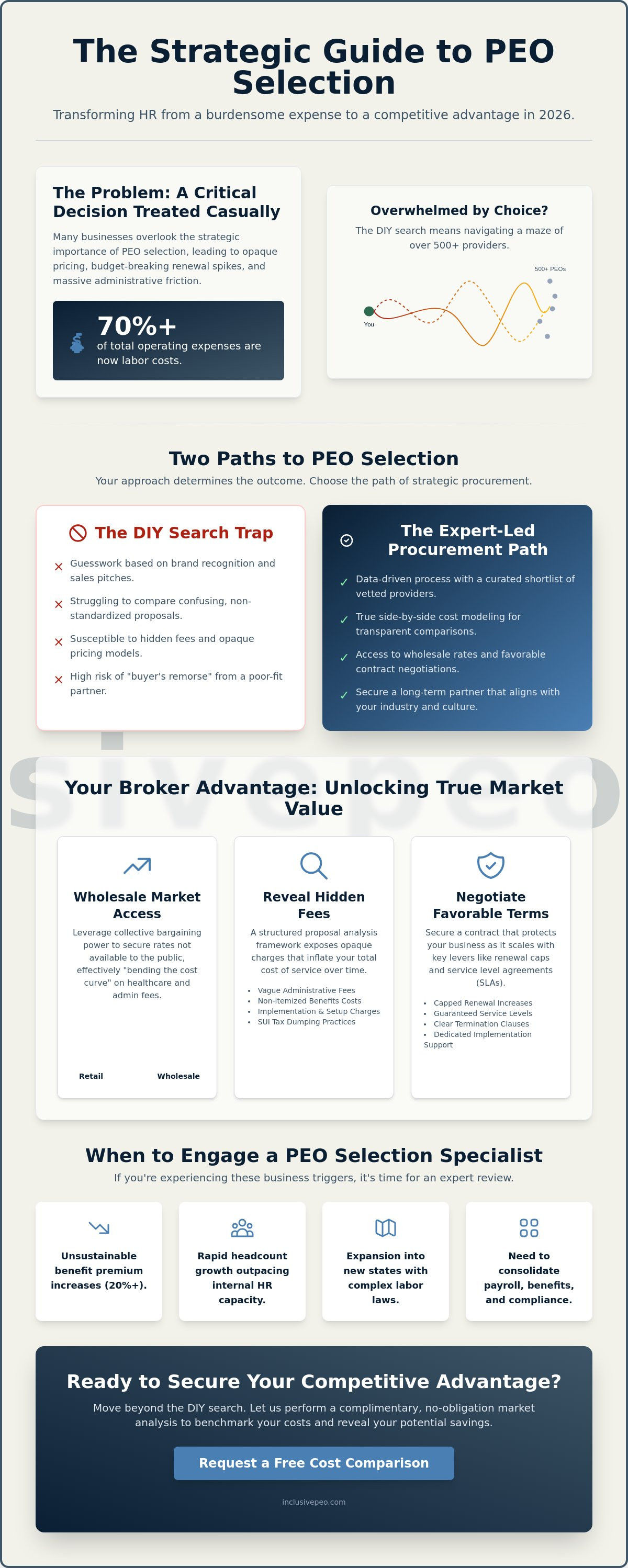
Did you know that labor costs now represent over 70% of total operating expenses for many businesses in 2026? Despite this massive financial weight, many organizations still treat their choice of a partner as a minor administrative task rather than a critical procurement exercise. This oversight often leads to opaque pricing models and the inevitable sting of healthcare renewal spikes that can derail your annual budget. Finding the right fit requires more than a cursory search; it demands professional peo selection services that can peel back the curtain on hidden fees and provide true wholesale market access.
You've probably felt the frustration of comparing quotes that feel like they're written in a different language. It's exhausting to manage the administrative burden of switching providers while trying to keep your benefits competitive. We're here to help you move past the confusion. This guide will show you how to navigate the complex marketplace, secure wholesale insurance rates, and negotiate a contract that actually protects your bottom line. We'll explore transparent cost modeling and industry-specific scaling strategies that turn your HR infrastructure into a genuine competitive advantage.
Key Takeaways
• Move beyond the DIY search by treating PEO selection as a professional procurement process that aligns with your specific industry needs.
• Discover how wholesale market access allows you to leverage collective bargaining and effectively bend the cost curve on healthcare expenses.
• Use structured peo selection services to perform side-by-side proposal comparisons that reveal hidden fees and clarify complex pricing models.
• Identify key negotiation levers like renewal caps and service level agreements to ensure your contract remains favorable as your business scales.
• Learn how expert implementation support prevents administrative friction during data migration and secures a seamless transition for your employees.
Understanding PEO Selection Services: Why Your Search Strategy Matters
Choosing a professional employer organization (PEO) is one of the most significant financial decisions your business will make. It's far more than a simple software purchase or a vendor swap. Professional peo selection services treat this transition as a rigorous procurement and matchmaking process. While a DIY search might seem cost-effective at first, it often leaves leaders drowning in a sea of over 500 national and regional providers. Without a structured strategy, you're likely to choose a partner based on brand recognition alone. This often leads to "buyer's remorse" when you discover the service model doesn't align with your industry's specific compliance needs or your team's culture.
Expert-led brokerage replaces the guesswork with a methodical framework. Instead of sitting through dozens of repetitive sales pitches, you gain access to a curated shortlist of providers that have already been vetted for your specific size and sector. This approach ensures that you aren't just finding a provider, but securing a partner that can actually protect your bottom line. By shifting from a reactive search to a proactive procurement strategy, you position your business to secure better terms and avoid the common pitfalls of opaque pricing.
The Role of an Independent PEO Broker
An independent broker acts as a knowledgeable guide and a bridge between your business and the complex marketplace. Their primary value lies in providing carrier-agnostic advice. Unlike a direct sales representative who is incentivized to sell their specific platform, a broker focuses on your unique benefits requirements. They remove the intense sales pressure from the evaluation phase, allowing you to focus on data and service levels. This partnership ensures that the final selection is based on merit and cost-efficiency rather than the most aggressive marketing campaign.
When to Engage a PEO Selection Specialist
Specific business triggers often signal the need for peo selection services. If you're facing healthcare renewal spikes of 20% or more, it's time for an expert review. Rapid headcount growth and multi-state expansion also create complex compliance layers that are difficult to manage in-house. We begin with a strategic assessment to benchmark your current administrative and benefits costs against the broader PEO market. Whether you're a venture-backed startup needing to attract top talent or an established firm looking to "bend the cost curve" on insurance, this benchmarking phase provides the clarity needed for an informed decision.
• Rapid headcount growth that outpaces your internal HR capacity.
• Expanding into new states with unfamiliar labor laws and tax requirements.
• Facing unsustainable increases in employee benefit premiums.
• Seeking to consolidate payroll, benefits, and compliance into a single, streamlined infrastructure.
Wholesale Market Access: The Secret to Competitive PEO Rates
Why do two identical companies often pay wildly different rates for the same platform? The answer usually comes down to market access. When you approach a provider directly, you're entering the retail market. You're subject to standard pricing tiers and the individual representative's sales targets. In contrast, using professional PEO selection services grants you entry into the wholesale market. This side of the industry relies on collective bargaining and high-volume relationships to secure rates that aren't available to the general public. By aggregating the buying power of many firms, a specialist can effectively bend the cost curve on your behalf.
Many of the most effective partners aren't household names. While national giants spend millions on advertising, dozens of regional and niche providers operate primarily through broker channels. These boutique firms often specialize in specific sectors like tech or professional services, offering more tailored compliance support and higher service levels. Accessing these hidden options is a core benefit of a curated search. If you want to see how these specialized models compare to the big names, you can request a side-by-side cost comparison from Inclusive PEO Brokers to see the real-world difference in administrative fees and benefits pricing.
Bending the Healthcare Cost Curve
Healthcare remains the largest variable in any PEO budget. Wholesale access allows your business to bypass standard small-group rating pools, which are often volatile and subject to massive annual spikes. Instead, you can leverage master policy options where your risk is blended with a larger, more stable population. We use advanced cost modeling to predict multi-year spends. This helps you choose between master policies and client-based policies based on your specific claims history and growth trajectory, ensuring you secure Tier 1 health insurance rates that protect your long-term budget.
National vs. Regional vs. Niche Providers
The National Giants offer robust technology and name recognition, but they might lack the personalized touch required by smaller, high-growth firms. Regional providers often have deeper expertise in local labor laws, which is vital if your workforce is concentrated in a specific area. Niche providers take this a step further by tailoring their entire service suite to a single industry. A selection service filters these hundreds of options based on your headcount and geography. This ensures you only evaluate partners that actually fit your operational DNA and industry-specific compliance needs.
The Proposal Comparison Framework: Uncovering Hidden Fees
Comparing PEO quotes often feels like comparing apples to spaceships. To bring clarity to this chaos, we utilize a side-by-side proposal comparison. This is the gold standard for any business seeking peo selection services because it strips away marketing fluff and exposes the raw numbers that impact your cash flow. Without a structured framework, it's nearly impossible to tell if a lower premium is actually a better deal or simply a "teaser rate" designed to get you through the door before a massive year-two renewal.
You'll typically encounter two primary pricing models: a percentage of total payroll or a flat fee per employee per month (PEPM). The percentage model can be deceptive. As you give raises or pay out performance bonuses, your administrative costs automatically rise, even though the workload for the provider hasn't changed. PEPM models offer more predictability for your budget, but they require careful auditing to ensure the base fee covers the specific support your team needs. We help you deconstruct these models to see which one aligns with your long-term growth plans.
Watch out for "below the line" expenses that stay hidden until the final contract is signed. Implementation fees, technology surcharges, and steep termination penalties can quickly erase any perceived savings from a lower administrative rate. We recommend a rigorous audit of these specific items in every proposal:
Workers' Compensation Codes
Ensure your employees are classified correctly; misclassification can lead to significant overpayment for insurance.
SUTA Rates
Verify the state unemployment tax act (SUTA) rates match your actual company experience rating rather than a generic PEO average.
Fringe Benefit Markups
Check if the provider is adding a hidden margin to the actual cost of voluntary benefits or life insurance.
Deconstructing Administrative Fees
Administrative fees come in two flavors: bundled and unbundled. A bundled fee hides various service costs under one umbrella, making it difficult to see what you're actually paying for HR support versus payroll technology. Unbundled fees break down costs for payroll, compliance, and employee relations separately. Be wary of ancillary fees for things like background checks, COBRA administration, or delivery charges that aren't mentioned in the initial pitch. Administrative fee transparency is the absolute baseline for a healthy PEO partnership.
Benefits Benchmarking and Optimization
To truly "bend the cost curve," you must look beyond the monthly premium. We perform an apples-to-apples analysis of plan designs, comparing deductibles, out-of-pocket maximums, and pharmacy tiers across different platforms. It's not enough to find a lower price today. You need to understand how that price will behave tomorrow. Inclusive PEO Brokers uses historical data to project future renewal stability, ensuring your benefits package remains a powerful recruiting tool without becoming a financial liability.
Strategic Negotiation: Securing Favorable PEO Contract Terms
A signed proposal is not a final contract. Many business owners assume the first quote they receive is a fixed offer, but this stage is actually the beginning of a critical procurement phase. Strategic negotiation allows you to transform a standard vendor agreement into a partnership that protects your interests. Expert peo selection services identify the specific levers that can be adjusted to favor the client. While administrative fees and setup costs are obvious targets, the most valuable concessions often lie in Service Level Agreements (SLAs). These clauses define the provider's accountability for payroll accuracy and response times, ensuring you receive the high-level support you're paying for.
You also have the power to negotiate "carve-outs" for your existing infrastructure. If your current 401(k) plan or a specific niche benefit is performing well, you don't have to abandon it just to join a PEO. A skilled advocate can secure terms that allow you to integrate your preferred plans into the new framework. Throughout this process, your broker acts as a tireless advocate. They scrutinize every line of the final review to ensure the co-employment relationship is clearly defined and that your business isn't assuming unnecessary risk through vague language.
Negotiating the Renewal Rate
The first-year "teaser rate" is a common industry trap. Providers often offer aggressive pricing to win your business, only to hit you with a double-digit increase at your first renewal. We prevent this by building "renewal caps" directly into the initial service agreement. These caps limit how much the administrative fee can rise year-over-year, providing long-term budget predictability. Because we maintain your "portability," the PEO understands you have the data and support to switch if they don't remain competitive. If you want to secure these protections before you sign, contact us for a comprehensive contract review.
Finding Contract Loopholes
A "termination for convenience" clause is essential for any scaling business. It allows you to exit the relationship with a standard notice period, usually 30 to 90 days, without paying massive penalties. You should also watch for "exclusivity" traps that might prevent you from using specific third-party software or vendors that are vital to your operations. Finally, pay close attention to the indemnification language. This section should clearly outline how the PEO protects you from liability related to their specific administrative errors, ensuring the co-employment model actually reduces your corporate risk.
Implementation Support: Ensuring a Seamless PEO Transition
Signing the contract is a major milestone, but it's only the halfway point of your journey. The transition phase is where the theoretical savings and efficiency gains meet real-world operations. This is the "make or break" moment for your organization. Poorly managed rollouts lead to payroll errors, lost benefits data, and frustrated employees. Comprehensive peo selection services don't stop at the signature; they provide dedicated implementation support to ensure every piece of your HR infrastructure migrates correctly. An implementation consultant acts as your project manager, overseeing the complex data migration from your legacy systems to the new platform.
Communication is the final piece of the puzzle. Your team needs to understand how to use the new benefits portal and where to find resources like mental health support or personalized learning platforms. We help you draft clear, empathetic internal communications that explain the "why" behind the change. High adoption rates are essential for realizing the full ROI of your new partnership. By positioning the PEO as a resource rather than a hurdle, you ensure your workforce feels supported from day one.
The PEO Implementation Checklist
A successful rollout typically follows a 30, 60, 90 day timeline. During the first 30 days, we focus on technical setup and mapping your existing payroll codes. The second phase involves the heavy lifting of data migration, where we ensure years of payroll and benefits history remain intact and accessible. One of the most critical steps in this process is "Shadow Payroll" testing. We run your payroll in the new system alongside your old one to verify that every tax calculation and benefit deduction is perfect before the final go-live date. This methodical approach eliminates the risk of missing a paycheck or a healthcare premium payment.
Building Scalable HR Infrastructure
Once the system is live, your PEO becomes a foundational part of your broader HR strategy. It's not just about processing checks; it's about leveraging the platform for recruiting, performance management, and cultural development. We transition from matchmaking into long-term HR strategy consulting, helping you manage the PEO relationship to ensure they deliver on every promise made during the sales cycle. If they fail to meet a Service Level Agreement, we're there to hold them accountable. You can optimize your HR infrastructure with Inclusive PEO Brokers to ensure your business remains agile as you scale.
Our role evolves into an ongoing partnership. We help you interpret the AI-driven predictive analytics provided by modern PEOs to identify trends in employee turnover or engagement. This data allows you to make informed decisions about workforce planning and organizational design. By treating the PEO as a strategic asset rather than a simple vendor, you turn administrative necessity into a genuine competitive advantage.
Secure Your Competitive Edge for 2026
The roadmap for 2026 is clear: businesses that treat their HR infrastructure as a strategic asset will outperform those that view it as a mere expense. You've explored how a methodical procurement strategy, backed by professional peo selection services, removes the guesswork from the complex marketplace. By identifying hidden fees and securing renewal caps early, you don't just save money today; you protect your future growth from the volatility of healthcare spikes and administrative creep.
Inclusive PEO Brokers provides the specialized expertise needed to execute this vision. Our team leverages wholesale market access and veteran-led negotiation to ensure your contract actually serves your bottom line. We move beyond simple matchmaking to provide the side-by-side modeling and benefits benchmarking necessary to bend the cost curve permanently. It's about finding a partner that fits your culture and scales with your specific industry needs.
Taking control of your HR strategy doesn't have to be overwhelming. With the right guide, you can simplify the complex and focus on what you do best: growing your business. We're ready to help you turn these insights into action. Get a Side-by-Side PEO Proposal Comparison from Inclusive PEO Brokers and secure the partnership your team deserves.
Frequently Asked Questions
What is the difference between a PEO broker and a PEO selection service?
A PEO selection service provides a comprehensive procurement framework that goes far beyond the simple transaction of a broker. While a traditional broker might focus solely on gathering quotes, selection services include implementation support, side-by-side cost modeling, and long-term HR strategy. This holistic approach ensures the partnership remains effective long after the initial contract is signed.
How do PEO selection services make money?
Most selection specialists are compensated through a commission paid by the PEO provider, which is built into the provider's standard marketing budget. This means you gain access to expert consulting and wholesale market rates without paying a direct fee for the matchmaking process. It's a model that aligns our success with finding you the most efficient and cost-effective partner.
Can a PEO broker help me negotiate a lower renewal rate if I already have a PEO?
Yes, a broker can use current market data and your "portability" as leverage to secure better renewal terms with your existing provider. By performing a fresh benchmarking analysis, they demonstrate to the incumbent PEO that you're aware of other competitive options. This often leads to administrative fee reductions or the addition of renewal caps that protect your future budget.
Is there a minimum employee count required to use PEO selection services?
While most providers look for at least five to ten employees, peo selection services are available to businesses of almost any size. We help small startups build a scalable HR foundation and assist larger firms in optimizing complex benefits packages. The specific strategy we use shifts based on your headcount, but the focus on a curated fit remains the same.
How long does the PEO selection and implementation process typically take?
The entire process from the initial strategic assessment to your go-live date usually takes between 60 and 90 days. We typically spend the first 30 days on evaluation and selection, followed by a 30 to 60 day implementation window. This structured timeline allows for thorough data migration, shadow payroll testing, and clear employee communication to ensure a seamless transition.
What are the red flags to look for in a PEO proposal?
The biggest red flags include bundled administrative fees that lack transparency and a lack of specific Service Level Agreements. You should also be wary of proposals that don't clearly break down your SUTA rates or workers' compensation codes. If a provider is vague about how they handle annual renewals or termination penalties, it's a sign they may not be a stable long-term partner.
Do PEO selection services only look at the largest national providers?
No, we evaluate a diverse mix of national giants, regional experts, and niche boutique providers to find your best match. While national brands offer robust technology, regional peo selection services often uncover providers with deeper local compliance knowledge. Niche PEOs may offer specialized service models for sectors like tech or healthcare that a generalist platform simply can't match.
Can I keep my current health insurance carrier when switching to a PEO?
You can often stay with the same carrier, though you'll typically transition to the PEO's master policy or a different plan design. While the name on the insurance card might not change, the underlying rating structure and deductibles will be updated to reflect the PEO's collective bargaining power. We perform a detailed analysis to ensure your employees keep access to their preferred doctors and networks.
.svg)
Partner with us for expert HR support compliance, and personalized solutions.






.png)