.png)

Co-Employment Risks: What HR Leaders Must Know

Co-employment risk means two entities share legal liability for the same worker. The single most important control is preventing operational drift — the gradual accumulation of supervisory behaviors that courts and agencies treat as proof of joint employment. Before anything else, take these three steps:
- Run an operational controls check. Review whether your managers are directing temps or contractors on scheduling, discipline, or daily tasks. That conduct, not your contract language, is what the U.S. Department of Labor (DOL) and NLRB weigh when determining joint employer status.
- Verify partner credentials. Confirm your PEO or staffing firm holds CPEO certification from the IRS, ESAC accreditation, and current workers’ compensation and EPLI coverage. Gaps here transfer liability back to you.
- Update your Client Service Agreement (CSA) clauses. Outdated or boilerplate CSAs leave wage, tax, and benefits obligations unallocated. Revise indemnity, insurance, and responsibility language now.
Inclusive PEO Brokers helps businesses navigate exactly this process, matching you with vetted PEO partners and guiding you through contract and compliance review.
Table of Contents
- What does co-employment mean under U.S. law?
- What are the most common co-employment risks HR leaders face?
- How does co-employment liability develop in practice?
- What are the financial and legal consequences of a co-employment finding?
- How do you reduce co-employment risk through contracts, controls, and governance?
- How do you evaluate a PEO, EOR, or staffing firm for co-employment risk?
- PEO vs. EOR vs. joint employer: what is the practical difference?
- Key Takeaways
- What most HR leaders get wrong about co-employment
- Inclusive PEO Brokers reduces your co-employment exposure from day one
- Authoritative sources and recommended reading
What does co-employment mean under U.S. law?
Co-employment, also called joint employment, describes a situation where two separate entities both exercise enough control over a worker that both are treated as employers under federal law. The formal industry term is “joint employer,” and it carries real legal weight across multiple federal statutes.
The key enforcement bodies and their legal hooks:
- DOL / FLSA: The Fair Labor Standards Act applies a broad economic-reality test. When a client company controls hours, sets pay rates, or supervises daily work alongside a staffing firm or PEO, both entities can be held fully liable for unpaid wages, overtime, and related penalties.
- IRS / Payroll Taxes: — The IRS holds both employers responsible for federal employment tax remittance. CPEO certification shifts certain payroll tax obligations to the certified provider, but it does not eliminate the client’s exposure entirely.
- OSHA / Workplace Safety: OSHA holds controlling employers responsible for hazards at a worksite even when the exposed workers are employed by a subcontractor or staffing agency.
The practical implication is straightforward: joint employer status means full, concurrent liability. You cannot contract your way out of it by adding a disclaimer. Both entities can be on the hook for wages, payroll taxes, benefits obligations, and safety violations simultaneously.
What are the most common co-employment risks HR leaders face?
PEO arrangements create intentional co-employment by design, and staffing agency relationships can create it unintentionally. Either way, the liability categories are the same.
- Payroll tax liability (IRS) — If your PEO or staffing firm fails to remit federal employment taxes, the IRS can pursue the Trust Fund Recovery Penalty against responsible individuals at your company. CPEO status reduces this exposure but does not eliminate it for all tax categories.
State law adds another layer. California, New Jersey, Massachusetts, and New York impose stricter joint-liability standards than federal law, including statutory provisions that create automatic shared liability for unpaid wages and workers’ compensation. If your operations touch any of these states, apply their standards across your entire program, not just locally.
How does co-employment liability develop in practice?
Operational conduct drives joint employer findings, not contract language. Courts and agencies look at what actually happens on the ground. A clause in your staffing agreement saying “no co-employment exists” carries almost no weight when your operations tell a different story.

Operational drift is the term practitioners use for the gradual accumulation of control behaviors that convert a clean contractual design into legal exposure. It rarely happens all at once. A manager starts approving a temp’s time-off requests. Then the same temp gets added to the company Slack workspace. Then they receive the same safety training as direct employees. Then someone includes them in the annual benefits enrollment email by mistake. Each act seems minor. Together, they build a paper trail that agencies and plaintiffs’ attorneys use to establish joint employment.
Common drift behaviors to watch:
- Client managers directing temps on scheduling, daily assignments, or disciplinary matters
- Contingent workers receiving company-issued badges, email addresses, or system access identical to direct employees
- Client HR staff handling onboarding, performance reviews, or termination decisions for staffing agency workers
- Reimbursing or supplementing wages paid by the vendor
- Including contingent workers in internal benefit communications or company events
Pro Tip: During your next internal audit, ask managers to describe how they interact with contingent workers on a typical day. If the answer includes approving time off, setting daily priorities, or handling complaints directly, you have drift. Document the finding and retrain before it becomes a claim.
The cost of ignoring drift is concrete. Co-employment exposure commonly arises from staffing agency engagements and contractor misclassification, and when liability is found, it often surprises companies because it includes aggregated overtime across employers and statutory remedies that can multiply damages. Tracking hours across all engagements is therefore one of the most critical controls you can implement.
What are the financial and legal consequences of a co-employment finding?
Enforcement can come from multiple directions at once, and the costs compound quickly.
- DOL wage audits: — The Wage and Hour Division can assess back wages, liquidated damages equal to the back-wage amount, and civil money penalties for willful violations. A single audit covering a multi-year period across a large contingent workforce can reach seven figures.
- IRS tax assessments: — Unpaid federal employment taxes trigger interest, penalties, and the Trust Fund Recovery Penalty, which holds individual officers and HR leaders personally liable for the employee portion of FICA taxes.
One practical note on indemnification: if your staffing vendor is insolvent, indemnity clauses become unenforceable. Statutory liability often stays with the client when the vendor fails to maintain payroll tax remittances or workers’ comp coverage. That is why insurance verification and financial vetting of vendors matter more than contract language alone.
How do you reduce co-employment risk through contracts, controls, and governance?
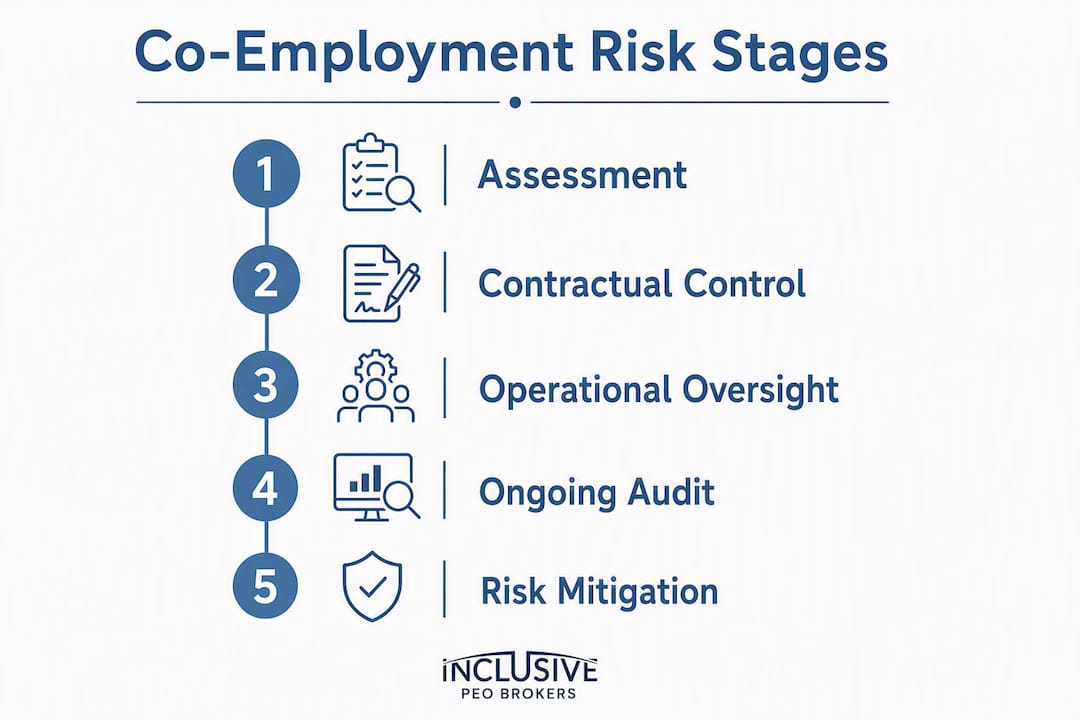
Treat co-employment as a managed risk, not an all-or-nothing condition. The goal is to allocate responsibilities clearly, enforce those allocations operationally, and audit regularly.

Contract design: what actually matters in your CSA
Your Client Service Agreement or Statement of Work should do more than disclaim co-employment. Clauses that carry real weight:
- Responsibility allocation: Specify which party handles hiring, firing, discipline, payroll, tax remittance, and benefits enrollment. Vague language defaults to shared liability.
- Indemnification with teeth: Require the vendor to indemnify you for claims arising from their employment decisions, but verify they have the financial capacity to honor it. An indemnity from an undercapitalized vendor is a false comfort.
- Insurance requirements: Require certificates of insurance naming your company as an additional insured on workers’ comp and EPLI policies. Specify minimum coverage limits and require 30-day notice of cancellation.
- Audit rights: Include the right to inspect payroll records, tax remittance confirmations, and insurance certificates at least annually.
- Transition and exit clauses: Address what happens to worker records, benefits continuity, and tax filings if the relationship ends.
Pro Tip: When reviewing indemnity clauses, require “primary and non-contributory” wording on the vendor’s insurance, not just “additional insured.” This means their policy pays first, before yours. Also request a current financial statement or ESAC bond verification before signing — indemnity from an insolvent vendor is worth nothing.
Operational controls: what managers must do differently
Validated mitigation practices from case reviews show that when staffing agencies make personnel decisions independently and clients limit their involvement to task-level direction, courts are significantly less likely to find joint employment. Translate that into daily practice:
- Train managers to give work assignments, not performance evaluations, to contingent workers
- Route discipline and termination requests through the staffing agency, not your HR team
- Keep contingent workers out of internal benefit communications, company-wide meetings, and performance management systems
- Maintain separate timekeeping systems for contingent and direct workers
- Restrict system access to what the specific engagement requires, not blanket employee-level access
90-day governance checklist
- [ ] Audit all active CSAs for responsibility allocation, indemnity, and insurance clauses
- [ ] Collect current certificates of insurance from every staffing and PEO vendor
- [ ] Verify CPEO certification status and ESAC accreditation for PEO partners
- [ ] Conduct manager training on contingent worker interaction boundaries
- [ ] Implement a separate timekeeping process for contingent workers
- [ ] Review system access and badge policies for all non-direct employees
- [ ] Schedule a payroll tax remittance verification with your PEO or payroll provider
- [ ] Document an incident response protocol for potential joint employer claims
Small businesses are particularly vulnerable to these liabilities but can reduce exposure meaningfully through clear contracts, separate supervision, and routine audits.
How do you evaluate a PEO, EOR, or staffing firm for co-employment risk?
Choosing the right partner is itself a risk control. A poorly vetted vendor can transfer liability back to you the moment their compliance breaks down.
Due diligence checklist
- CPEO certification: — Confirm the PEO holds current IRS CPEO status. CPEO certification shifts certain federal payroll tax responsibilities to the provider and allows clients to change PEOs without restarting wage-base calculations. It does not, however, protect you from FLSA, EEOC, or OSHA liability.
Comparison: PEO vs. EOR vs. staffing agency
| Evaluation dimension | PEO | EOR | Staffing agency |
|---|---|---|---|
| Who holds payroll tax liability | Shared (CPEO shifts more to PEO) | EOR holds primary liability | Typically agency, but client exposure exists |
| Operational control | Client retains day-to-day direction | EOR retains formal employment; client directs work | Client often directs work; highest drift risk |
| Contractual allocation (CSA/SOW) | CSA allocates HR/payroll vs. operational duties | EOR agreement covers full employment obligations | Staffing agreement; often thinner on allocations |
| Certification/financial assurance | CPEO (IRS), ESAC available | No equivalent federal certification | No standard certification; ESAC not applicable |
| Insurance coverage | Workers’ comp, EPLI typically included | Workers’ comp, EPLI typically included | Varies widely; verify every engagement |
| Integration risk | Moderate; client retains workforce | Lower; EOR is formal employer | Highest; contingent workers often deeply integrated |
When your priority is reducing payroll tax and benefits liability, a CPEO-certified PEO is the strongest structural protection. When you need to hire in a state or country where you lack an entity, an EOR is the practical choice. Staffing agencies carry the highest integration risk and require the most rigorous operational controls on your side.
The Inclusive PEO Brokers selection process includes credential verification, side-by-side comparisons, and contract clause guidance so you are not navigating this checklist alone.
PEO vs. EOR vs. joint employer: what is the practical difference?
These terms get conflated regularly, and the confusion creates real compliance gaps.
- Misclassification: — Treating an employee as an independent contractor. This is a separate but related exposure that triggers IRS, DOL, and state labor department scrutiny, often alongside joint employer claims.
| Model | Who is the formal employer | Who directs daily work | Primary liability risk |
|---|---|---|---|
| PEO | PEO (co-employer) | Client | Shared; allocated by CSA |
| EOR | EOR | Client | EOR holds employment liability |
| Staffing agency | Agency | Client (in practice) | Agency primary; client if drift occurs |
| Joint employer (finding) | Both entities | Both entities | Full concurrent liability |
| Misclassification | Neither (incorrectly) | Client | Client bears full employment liability |
From a compliance standpoint, a CPEO-certified PEO with a well-drafted CSA offers the most structured liability allocation for most small and mid-sized businesses. An EOR suits situations where you need a formal employer in a jurisdiction where you have no entity. Staffing arrangements require the most active operational governance because the integration risk is highest and the contractual protections are typically thinnest.
Key Takeaways
Managing co-employment risk requires three things working together: clear contractual allocation, disciplined operational controls, and verified vendor credentials.
| Point | Details |
|---|---|
| Stop operational drift first | Audit manager behavior now; daily supervision of contingent workers is the primary trigger for joint employer findings. |
| Verify CPEO and ESAC status | CPEO certification shifts federal payroll tax obligations to the provider; ESAC accreditation adds financial assurance. |
| Update your CSA clauses | Include responsibility allocation, primary-and-non-contributory insurance, audit rights, and indemnity with solvency verification. |
| Apply the strictest state standard | California, New Jersey, Massachusetts, and New York impose higher joint-liability thresholds; design your controls to meet those standards across all operations. |
| Use Inclusive PEO Brokers for vendor selection | Inclusive PEO Brokers verifies CPEO/ESAC credentials, guides contract clause review, and has completed numerous PEO implementations delivering substantial time savings per client. |
What most HR leaders get wrong about co-employment
The conventional wisdom treats co-employment risk as a contract problem. Get the right language in the CSA, add a “no co-employment” disclaimer, and you are covered. That framing is wrong, and it is the reason so many companies get surprised by enforcement.
Courts and agencies have been consistent on this point for decades: operational reality overrides contract language. A disclaimer clause has never won a DOL wage audit. What wins is documented evidence that your managers did not supervise, discipline, or integrate contingent workers as if they were your own employees. The paper trail that matters is timekeeping records, access logs, and manager training documentation, not the boilerplate in your staffing agreement.
The second thing HR leaders underestimate is the aggregation problem. A worker who logs 30 hours at your site and 15 hours at the staffing agency’s other client may have crossed the FLSA overtime threshold in aggregate. Neither company tracked it. Both companies are now liable. This is not a theoretical scenario; it is a documented enforcement pattern that shows up in DOL investigations regularly.
The practical implication is that co-employment risk management is an operational discipline, not a legal exercise. The legal team drafts the CSA. HR and operations have to enforce it every day through manager behavior, access controls, and timekeeping discipline. When those two functions are not aligned, the contract becomes irrelevant.
Inclusive PEO Brokers reduces your co-employment exposure from day one
Sorting through PEO credentials, insurance certificates, and contract clauses on your own takes time most HR teams do not have. Inclusive PEO Brokers cuts that process down to what matters: matching your business with a vetted, compliant PEO partner and making sure the contract terms actually protect you.

Every engagement includes CPEO and ESAC verification, side-by-side provider comparisons, and contract clause guidance covering indemnity, insurance, and responsibility allocation. Clients save significant time in the selection process and reduce costs effectively. Across 133 completed implementations, the pattern holds: businesses that go through a structured selection process end up with stronger protections and fewer compliance surprises down the road.
If you are managing contingent workers, evaluating a new PEO, or renewing a staffing agreement, the right time to review your co-employment controls is before a claim, not after. Book a PEO scoping consultation with Inclusive PEO Brokers to get matched with a provider that fits your workforce, your industry, and your risk profile.
This article provides general information about co-employment and joint employer concepts under U.S. law. It is not legal advice. Confirm current rules and your specific obligations with qualified legal counsel or the relevant federal and state agencies.
Authoritative sources and recommended reading
- U.S. Department of Labor — Wage and Hour Division (FLSA): Primary source for FLSA enforcement standards, joint employer guidance, and wage-and-hour compliance requirements.
- IRS — CPEO Guidance and Third-Party Payer Arrangements: Official IRS resource on CPEO certification requirements, payroll tax responsibilities, and wage-base rules.
- U.S. Department of Labor — ERISA: DOL guidance on employee benefit plan obligations, including COBRA and ACA compliance.
- OSHA — Multi-Employer Worksite Policy: OSHA’s framework for holding controlling employers responsible for worksite safety, including staffing agency and contractor scenarios.
- Inclusive PEO Brokers — PEO Selection Process: How Inclusive PEO Brokers verifies provider credentials and guides businesses through PEO selection and contract review.
- Inclusive PEO Brokers — First-Time PEO Selection: Service details and expected savings for businesses selecting a PEO for the first time.
- Inclusive PEO Brokers — Business Insurance Package: Insurance options relevant to indemnity structuring and workers’ comp verification in co-employment arrangements.
Recommended
.svg)
Seeking a different solution? Meet Your Business Needs