.png)


PEO Administrative Fees Explained: A Guide to Transparent Pricing in 2026

Is that line item on your monthly invoice a fixed cost of doing business, or is it a hidden leak in your company's bottom line? You aren't alone if you feel frustrated while staring at a PEO proposal, trying to decipher if a bundled rate is saving you money or masking a significant markup on health premiums. It's exhausting to compare apples to oranges when every provider uses different terminology for their services. This guide ensures you have peo administrative fees explained with total clarity, helping you identify where you have the leverage to protect your margins and eliminate unpredictable fee increases.
You deserve a transparent partnership where costs are predictable and value is measurable. We'll show you how to master the complexities of modern pricing models, from per-employee monthly structures to percentage-of-payroll setups. This article provides a clear framework for comparing side-by-side proposals and gives you the confidence to negotiate a better deal during your next renewal. We're breaking down exactly what you're paying for, how to benchmark those fees against the 2026 market, and how to finally bend the cost curve on your HR infrastructure.
Key Takeaways
• Identify the core components of your PEO invoice to separate essential service costs from pass-through taxes and insurance premiums.
• Evaluate the financial impact of flat-fee versus percentage-of-payroll models to choose the structure that best fits your specific industry.
• Learn to spot hidden markups in workers' compensation and state unemployment taxes that often complicate having peo administrative fees explained with transparency.
• Master the process of benchmarking your rates against national averages and using unbundled data to negotiate more favorable contract terms.
• Utilize side-by-side comparison modeling to visualize the true total cost of ownership across multiple PEO providers before you commit.
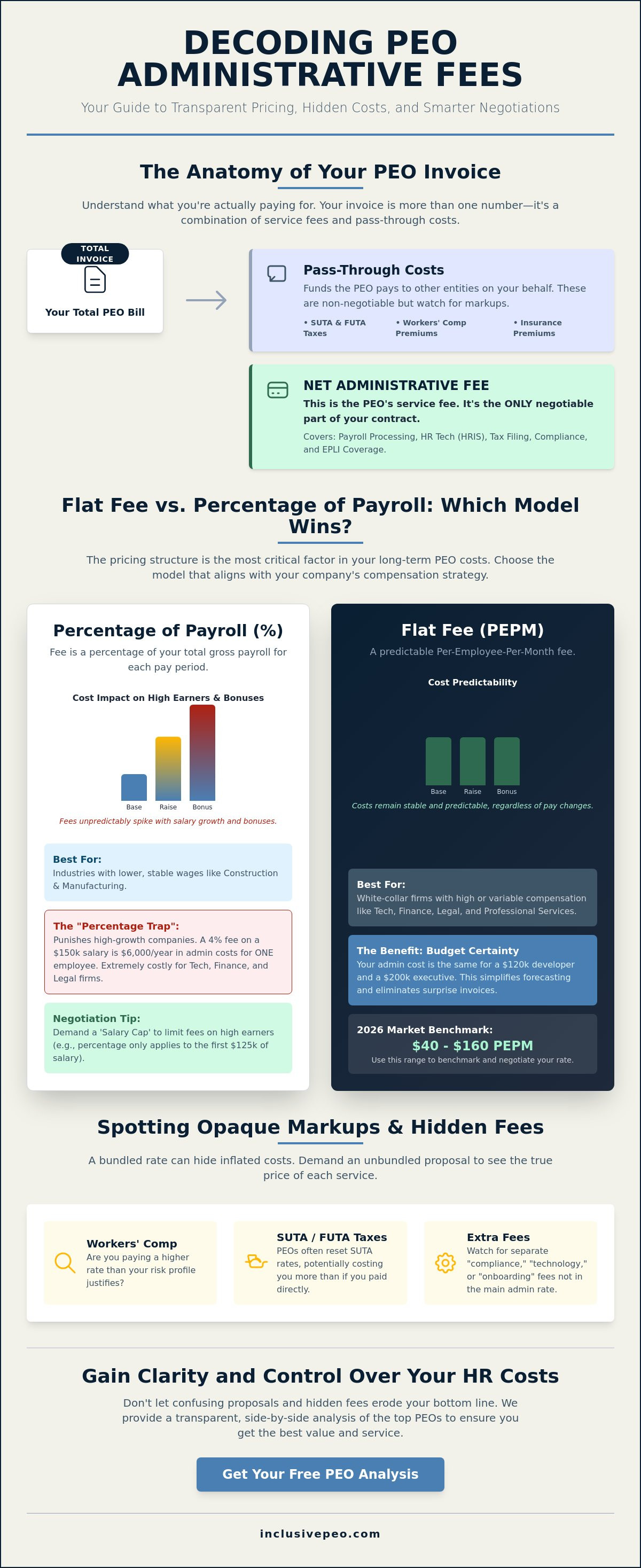
What Are PEO Administrative Fees? The Anatomy of Your Invoice
When you partner with a What is a Professional Employer Organization (PEO)?, your monthly invoice contains several distinct layers. The administrative fee is the specific amount you pay the provider to handle your human resources, payroll, and compliance burdens. While insurance premiums and payroll taxes are often lumped together in a single bill, the administrative fee represents the service based portion of the cost. Understanding these distinctions is the first step in having peo administrative fees explained so you can protect your company's profitability.
Unlike government mandated taxes or market rate insurance premiums, the administrative fee is the only part of your contract that is truly negotiable. This is where you have the power to influence your bottom line. PEOs generally offer two ways to view these costs: bundled or unbundled. A bundled proposal gives you one comprehensive rate that covers everything, which can feel simpler but often hides the true cost of individual services. An unbundled structure itemizes every charge, providing the transparency needed to see where your money is actually going.
Admin Fees vs. Pass-Through Costs
It's vital to distinguish between the money the PEO keeps and the money they pass through to third parties. SUTA (State Unemployment Tax Act), FUTA (Federal Unemployment Tax Act), and workers' compensation premiums are pass-through costs that the PEO pays on your behalf. You should watch for fee creep, which happens when a PEO charges a separate compliance fee or technology fee on top of a supposedly all inclusive administrative rate. The Net Admin Fee is the final, true cost of the PEO's services after removing all statutory taxes and insurance premiums.
What Your Admin Fee Actually Covers
Your fee funds the engine of your HR department. This includes payroll processing, tax filing, and compliance indemnity, ensuring you stay on the right side of labor laws. You also gain access to a sophisticated technology stack and HRIS portal that would be expensive to license independently. One of the most significant hidden values is Employment Practices Liability Insurance (EPLI) coverage. This protects you against claims of wrongful termination or discrimination. This integrated protection is a core benefit of having peo administrative fees explained through a transparent lens.
Flat Fee vs. Percentage of Payroll: Which Model Wins?
Choosing the right pricing model is often the most critical decision in your PEO journey. While providers offer various structures, most fall into two categories: a percentage of total payroll or a flat per-employee-per-month (PEPM) fee. Deciding between them requires more than a surface level glance at your budget. It requires a deep dive into your specific workforce demographics and compensation strategy. Having these peo administrative fees explained through a comparative lens helps you avoid overpaying as your company grows.
The percentage of payroll model is frequently found in blue-collar sectors like construction or manufacturing. Because wages in these industries can be lower, a small percentage often results in a lower total cost than a flat fee. However, the math changes quickly when you move into skilled labor or professional services. When weighing PEO pros and cons, the pricing model is often the deciding factor for long term sustainability.
The Percentage of Payroll Trap
High-salary industries like tech, finance, and legal often find themselves in a 'percentage trap.' If you pay a 4% administrative fee on a $150,000 salary, you're paying $6,000 per year for that one employee. This model becomes even more volatile when you issue performance bonuses or commissions. Since the fee is tied to the total gross payroll, a successful quarter for your sales team translates into an immediate, unexpected fee spike for the PEO. To mitigate this, savvy employers negotiate a 'salary cap.' This ensures you only pay the percentage on the first $100,000 or $125,000 of an individual's earnings, protecting you from overpaying on your top talent.
The Predictability of Per-Employee-Per-Month (PEPM)
The PEPM model is the preferred choice for white-collar firms because it offers total budget transparency. Whether your lead developer earns $120,000 or $200,000, your administrative cost remains exactly the same. In 2026, market data shows that standard PEPM fees typically range from $40 to $160 per employee. This structure is particularly beneficial during rapid scaling, as you can forecast your HR costs with pinpoint accuracy. If you utilize seasonal or part-time staff, check if the PEO pro-rates these fees or charges the full amount for any active head. If you are unsure which model aligns with your growth strategy, a side-by-side PEO proposal comparison can reveal the hidden impact on your cash flow.
The Hidden Layer: Identifying Opaque Markups and Fees
Why do so many PEO contracts feel like they were written to be misunderstood? While the previous sections covered the base pricing models, the real profit for many providers lies in the margins of pass-through costs. Having peo administrative fees explained means looking beyond the base PEPM rate and scrutinizing the "loaded" costs that quietly inflate your total spend. These hidden layers often turn a seemingly competitive proposal into an expensive burden over time.
Beyond the monthly service fee, you should watch for "innovation" or technology fees that charge you for software features your team may never use. State Unemployment Tax (SUTA) is another area where "shell games" occur. If a PEO's master tax rate is lower than your company's individual rate, they might still charge you the higher rate and pocket the difference. In a competitive 2026 market, these items are points of leverage. You can often negotiate onboarding and implementation costs down to zero by positioning them as a barrier to your partnership.
The Workers' Compensation 'Load'
PEOs often leverage their massive scale to secure lower workers' comp rates, but those savings don't always reach your balance sheet. You need to distinguish between the Cost of Insurance (COI) and the administrative load the PEO adds on top. A common tactic is to charge you the NCCI manual rate while the PEO pays a much lower net rate due to their volume. Transparent providers will separate the actual premium from their service fee, allowing you to see exactly how much you're paying for coverage versus administration. If these numbers are bundled, you're likely paying a silent markup.
Renewal Spikes and 'Fee Creep'
The most frustrating part of a PEO relationship is the unexpected renewal jump, which can often reach 15% to 20% without a clear explanation. This is frequently driven by "fee creep," where small charges for background checks, COBRA administration, or delivery fees start to accumulate. To prevent this, you should identify all ancillary fees during the proposal phase. A professional strategy is to negotiate a multi-year rate guarantee or a strict cap on administrative fee increases. This ensures your HR costs remain predictable even as your company scales. Identifying these risks early allows you to protect your margins before you sign a long term agreement.
Benchmarking and Negotiating Your PEO Admin Fees
Mastering your HR budget requires a proactive approach to procurement. You can't negotiate what you can't see. By having peo administrative fees explained as an itemized list, you strip away the ambiguity that sales representatives often rely on during the bidding process. This transparency allows you to treat HR administration as a manageable service cost rather than a mysterious tax on your growth. To secure the best possible terms, follow this five step framework during your next evaluation cycle.
Request a full unbundled breakdown
Demand that the provider separates the core administrative fee from taxes, workers' comp, and health premiums.
Benchmark against the 2026 market
For mid-sized businesses with 25 to 200 employees, the common administrative range is $80 to $120 per employee per month.
Leverage a three-way comparison
Never settle for a single quote. Comparing at least three providers forces them to compete on both service and price.
Access wholesale market rates
Partner with a broker to bypass retail pricing and tap into pre-negotiated volume discounts.
Negotiate the admin line item separately
Don't let a PEO hide a high service fee behind a slightly lower health insurance premium; keep these negotiations distinct.
If you find that your current provider is unwilling to provide this level of detail, it may be time for a professional benchmarking of administrative fees and hidden costs to see what you're truly paying compared to your peers.
How to Perform a Side-by-Side Comparison
Standardizing proposals is the only way to compare apples to apples. PEOs use different fiscal calendars and naming conventions for their fees, which makes a surface level glance dangerous. You must perform a "Gross to Net" calculation. This involves subtracting all statutory taxes and insurance premiums from the total invoice to find the true service cost. You should never look at the "Total Cost" as a single number. Doing so allows the provider to mask an uncompetitive administrative fee within a complex benefits package. Focus on the net service fee to identify the most efficient partner.
The Power of Wholesale Market Access
There is a significant difference between retail and wholesale pricing in the PEO world. Direct sales reps are often restricted by corporate price floors and commission structures that favor the house. In contrast, brokers who specialize in PEO matchmaking have access to wholesale rates that aren't available to the general public. You can use your company's "Risk Profile" as a bargaining chip if you have a clean safety record or low employee turnover. Volume discounts apply even to small groups when your broker aggregates your buying power with their entire client base. This insider access is often the difference between a standard deal and a market leading one.
The Inclusive PEO Brokers Advantage: Solving the Fee Puzzle
Why try to solve the pricing puzzle alone when you can leverage an advocate who has already seen behind the curtain? Inclusive PEO Brokers acts as your expert matchmaker, performing the heavy lifting required to find the perfect fit among national, regional, and niche providers. We don't just present options; we deconstruct complex proposals to ensure you have peo administrative fees explained with absolute precision. Our process moves you from a state of uncertainty to one of informed decision making by revealing the hidden costs that direct sales representatives often gloss over.
Our side-by-side modeling is the cornerstone of this transparency. We standardize every quote, adjusting for different fee structures and naming conventions to ensure a true comparison. This allows you to see the impact of wholesale market access, where our volume and industry relationships secure rates typically reserved for much larger corporations. We speak the language of the PEO industry, negotiating on your behalf to remove unnecessary markups and lock in favorable contract terms. Our support doesn't end at the signature; we provide implementation support to ensure those transparent fees remain consistent post-launch.
Bending the Cost Curve
We focus on more than just the immediate invoice. Our approach involves deep benefits benchmarking and optimization to help you reduce the long term cost of healthcare and employee benefits. Research from the National Association of Professional Employer Organizations indicates that businesses using a PEO see an average ROI of 27.2% based on cost savings alone. We help you capture that value by acting as a veteran HR executive in your corner, ensuring your infrastructure is built for efficiency rather than just compliance. This strategic oversight helps you bend the cost curve and protect your margins as you scale.
Ready for a Transparent PEO Experience?
Our matchmaking and selection service is provided at no cost to employers, as we are compensated by the providers in our wholesale network. During your first consultation, we'll identify your specific pain points and outline a clear path toward a more efficient HR model. You'll receive a curated list of providers that meet your specific risk profile and service needs. You don't have to settle for the first retail quote you receive. Get Your Side-by-Side PEO Comparison Now and see the difference that expert advocacy makes for your business.
Secure Your Bottom Line with Transparent Pricing
You now have the tools to look past complex jargon and see your HR costs for what they actually are: a negotiable variable. By having peo administrative fees explained through the lens of unbundled pricing and market benchmarks, you've moved from reactive paying to proactive planning. You understand how to identify silent markups in workers' comp and why a flat fee often beats a percentage model for your high-salary talent.
Don't leave your margins to chance during your next renewal or selection process. Our team provides expert contract negotiation and wholesale market access to ensure you never pay retail rates again. We simplify the entire marketplace through detailed cost comparison modeling that highlights every hidden expense before you sign.
Get a Side-by-Side PEO Proposal Comparison today and start bending the cost curve on your benefits and administration. You have the power to transform your HR department into a lean, transparent asset that supports your long-term growth.
Frequently Asked Questions
Is a PEO administrative fee tax-deductible for my business?
Yes, PEO administrative fees are generally considered ordinary and necessary business expenses under IRS guidelines. This means you can typically deduct these costs from your company's gross income. You should consult with a qualified tax professional to ensure proper classification on your filings, but most employers see these fees as a fully deductible service expense similar to legal or accounting costs.
Can I negotiate my PEO administrative fees during a mid-year renewal?
You can certainly negotiate your fees outside of the standard annual renewal cycle if your business undergoes significant changes. If you double your head count or significantly improve your safety record, you have fresh leverage to request a rate review. PEOs often prefer to adjust their pricing rather than risk losing a growing client to a competitor's mid-year proposal.
What is a 'fair' PEO administrative fee for a small business in 2026?
A fair fee is one that aligns with your specific service requirements and industry risk profile. For a small business, this often depends on whether you require basic payroll support or comprehensive strategic HR consulting. Since market rates fluctuate, the best way to determine fairness is through a side-by-side comparison that has peo administrative fees explained across multiple providers to ensure you aren't paying a retail markup.
Why do PEOs charge an implementation fee if I am already doing payroll?
PEOs charge implementation fees to cover the technical labor of migrating your historical employee data and configuring their HRIS platform to your specific workflows. This process involves setting up tax accounts across multiple states and conducting training for your internal managers. While these costs are standard, they are often negotiable or can be waived entirely depending on the size of your group and the length of your contract.
Does a higher administrative fee always mean better HR service?
A higher price tag does not guarantee superior HR support or better technology. In many cases, elevated fees simply reflect a provider's high marketing spend or aggressive sales commission structures. You should evaluate a PEO based on their service level agreement (SLA) and the specific expertise of their HR consultants rather than assuming that a premium price equals a premium experience.
How do I know if my PEO is hiding markups in my workers' compensation rates?
You can identify hidden markups by requesting a certificate of insurance (COI) and comparing the premium listed to the amount billed on your invoice. If the PEO refuses to provide an unbundled breakdown of your workers' compensation costs, it's a strong indicator that they are pocketing the difference between the manual rate and their discounted net rate. Transparency is the hallmark of a high quality provider.
Can a PEO broker really get me a better deal than going direct?
PEO brokers often secure better terms because they have access to wholesale pricing models that aren't available to the general public. Because brokers manage high volumes of business, they carry significant leverage that a single small business cannot replicate. This expertise ensures you avoid the "retail" trap while having peo administrative fees explained by an advocate who understands the provider's internal margin requirements.
What happens to my admin fees if I lay off employees or scale down?
If you scale down your workforce, your total administrative spend should decrease proportionally under both PEPM and percentage models. However, you must check your contract for "minimum monthly fees" or "base platform fees" that may remain fixed regardless of your head count. Understanding these floor limits is essential for maintaining budget flexibility during seasonal shifts or economic transitions.
.svg)
Partner with us for expert HR support compliance, and personalized solutions.






.png)