.png)

Switching PEO Providers: Your 90-Day Transition Plan

Switching PEO providers is entirely feasible without major disruption, provided you start with one action: pull your Client Service Agreement (CSA) and read the termination clause today. Most U.S. PEO contracts require 30–60 days written notice for termination, and many include automatic renewal windows that can lock you in for another year if you miss the deadline. Routine transitions generally complete within several weeks for smaller businesses and over a few months for complex, multi-state operations.
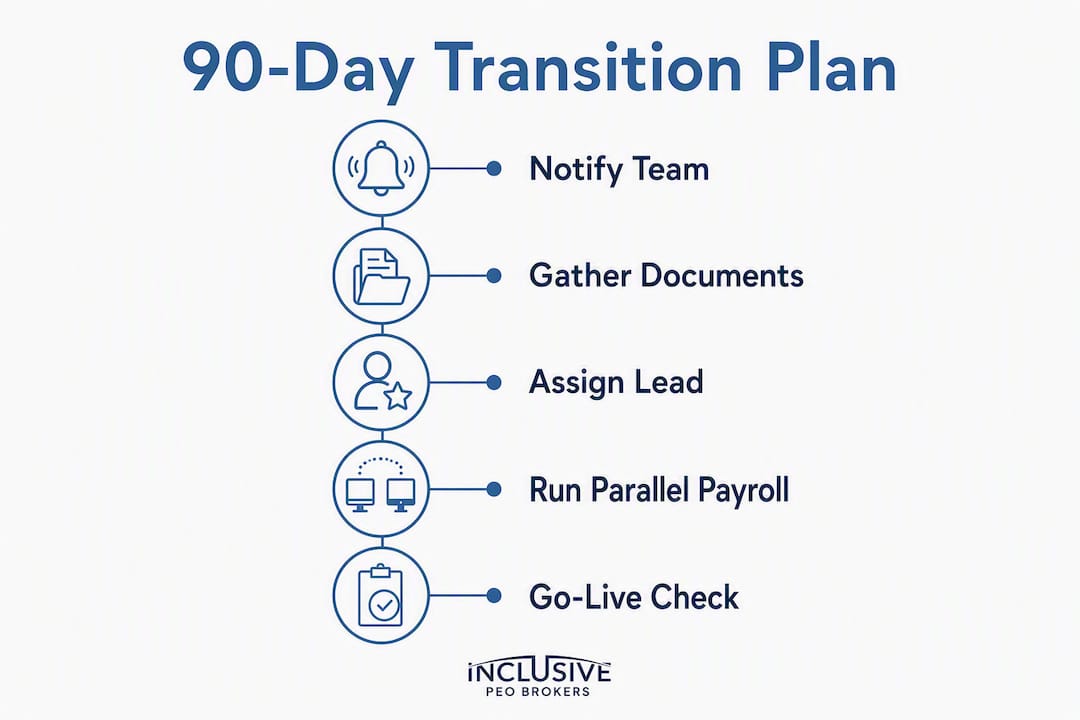
Before you do anything else, notify your finance lead, HR manager, and a senior stakeholder. Then gather three documents: your current CSA, your most recent benefits census, and your latest payroll summary. Those three items drive every decision that follows.
Table of Contents
- What signs tell you it’s time to change PEO services?
- What to do first when you decide to switch
- How long does a PEO provider transition actually take?
- Your prioritized 90-day pre-exit checklist
- Technical payroll and data issues to resolve before cutover
- How do you choose the right new PEO?
- What does switching PEOs actually cost, and what traps should you avoid?
- What to validate in your first 30, 60, and 90 days after go-live
- Key Takeaways
- Why a broker-led switch reduces your transition risk
- Ready to review your CSA and plan your PEO transition?
- Useful sources and templates
What signs tell you it’s time to change PEO services?
The obvious triggers are missed payroll runs and repeated tax filing errors, especially if your operations are expanding and might require a PEO in South Africa to manage non-U.S. employment solutions. Those warrant an immediate review. But the subtler signs are often what push a business past the tipping point.
Watch for these indicators:
- Support latency: Tickets taking more than 48 hours to get a first response, especially for payroll or compliance questions
- Weak integrations: Your HRIS, ATS, or 401(k) platform doesn’t connect cleanly, forcing manual data entry
- Deteriorating benefits value: Premium trends rising faster than your headcount or industry benchmarks
- Scalability gaps: The PEO can’t support new states, new entity types, or rapid headcount growth
- Compliance blind spots: No proactive alerts on state-level regulatory changes that affect your workforce
Pro Tip: Prioritize issues that touch payroll accuracy, compliance exposure, or total cost of ownership. Those justify a switch faster than any convenience feature. A slow dashboard is annoying; a missed state tax filing is a liability.
What to do first when you decide to switch
Two actions set a compliant, low-risk transition in motion before anything else.
Step 1: Review your CSA thoroughly. Locate these specific clauses:
- Termination notice requirement (typically 30–60 days, in writing)
- Automatic renewal language and the opt-out window
- Early-termination fees and any holdback provisions
- Final tax filing responsibilities (who files the W-2s and W-3?)
- COBRA administration handoff terms
Step 2: Run a data audit. Export and verify:
- Employee identifiers (SSNs, addresses, hire dates)
- Current pay rates and pay schedules
- YTD payroll history and W-2/W-3 records
- EIN usage and state tax account registrations
- Benefits census (carrier names, plan codes, enrollment elections)
- Open workers’ comp claims and policy effective dates
- PTO balances and accrual rules
Assign an internal implementation lead who owns the project end-to-end. A simple RACI (Responsible, Accountable, Consulted, Informed) covering finance, HR, legal, and your new PEO’s onboarding team prevents tasks from falling through the cracks. Map your target exit date backward: set your notice deadline first, then your benefits selection deadline, then your parallel payroll test date.

How long does a PEO provider transition actually take?
Switching to a new PEO is typically faster than exiting to an in-house or ASO model, which can take four to six months. The two common bands for a PEO-to-PEO move:
| Scenario | Timeline | Primary Drivers |
|---|---|---|
| Small business, single state | 3–6 weeks | Smaller businesses, simple benefits, no open claims |
| Multi-state or complex benefits | 2–4 months | Multiple state registrations, self-funded plans, active workers’ comp claims |
The process follows six predictable phases, as outlined by structured PEO transition guidance:
- Discovery and proposal (Weeks 1–2): New PEO reviews your census and proposes a plan; you evaluate fit.
- Notice and contract execution (Weeks 2–3): Serve written notice to your current PEO; sign the new agreement.
- Data transfer and system setup (Weeks 3–6): Employee records, tax accounts, and benefits configurations migrate.
- Parallel payroll run (1–2 pay cycles before go-live): Both systems process the same payroll for comparison.
- Go-live: New PEO takes over payroll and benefits administration.
- Reconciliation (30 days post-go-live): Final invoices, tax filings, and COBRA handoffs confirmed.
Many advisors recommend aligning your go-live date with January 1 or a benefits renewal date to avoid mid-year payroll tax complications. When a mid-year move is unavoidable, using an IRS-certified PEO (CPEO) can preserve wage-base continuity, since a CPEO can act as a successor employer and prevent employees from restarting their annual tax wage-base calculations.
Your prioritized 90-day pre-exit checklist
Starting at least 90 days before your exit date is the single most effective way to prevent benefits gaps and payroll errors.
90+ days out:
- Serve written notice to your current PEO (confirm receipt in writing).
- Issue an RFP or begin broker-assisted vendor selection.
- Audit your benefits census and identify any open enrollment windows.
- Confirm your new PEO’s implementation team and assign your internal lead.
60–90 days out:
- Execute your new PEO agreement.
- Begin benefits carrier negotiations; confirm plan-level equivalence.
- Export all payroll history, tax accounts, and employee records.
- Notify your benefits broker of the carrier transition timeline.
45–60 days out:
- Lock carrier effective dates and confirm workers’ comp policy handoff.
- Send employees a preliminary announcement: what’s changing, what stays the same, and when open enrollment opens.
- Configure HRIS integrations and test data feeds.
Final 30 days:
- Run at least one parallel payroll cycle; reconcile every line item before go-live.
- Distribute enrollment materials and open the new benefits enrollment window.
- Confirm COBRA administration transfer and notify affected employees.
- Verify new carrier ID cards will arrive before the effective date.
Technical payroll and data issues to resolve before cutover
Data mapping is where transitions break. Before your first live payroll run, validate every one of these elements:
| Data Element | What to Verify |
|---|---|
| Employee tax withholdings | Federal and state elections match current W-4s |
| Direct deposit accounts | Routing and account numbers confirmed with employees |
| Benefit deductions | Pre-tax and post-tax amounts match new carrier elections |
| PTO balances | Accrual balances transferred and confirmed in new system |
| State tax accounts | All state unemployment and withholding accounts registered |
| Workers’ comp codes | Class codes and rates confirmed with new carrier |
For multi-state operations, confirm that each state unemployment tax account has been opened or transferred under the new PEO’s FEIN. Missing a state registration delays your first payroll in that jurisdiction.
Pro Tip: Demand a signed parallel payroll reconciliation report before go-live. Run the same pay period through both systems and compare every deduction, net pay, and employer contribution line by line. This single step catches the majority of mapping errors before they affect employees.
A CPEO’s successor-employer status under IRS rules means mid-year switchers can avoid restarting FICA and FUTA wage bases, which is a meaningful cost protection for higher-earning employees.
How do you choose the right new PEO?
Evaluate every prospective PEO against six dimensions. Use this as your scoring framework:
- Implementation timeline and PM support: Does the PEO assign a dedicated implementation manager? What’s their average go-live timeline for businesses your size?
- Total cost: What are the per-employee-per-month fees, setup fees, and any termination costs if you leave again?
- Benefits continuity: Can they match your current plan designs, or will employees face a downgrade?
- Payroll accuracy and multi-state capability: How many states do they currently process? What’s their error-rate SLA?
- Software integrations: Do they connect natively with your HRIS, ATS, and 401(k) provider?
- Service levels: What’s the guaranteed response time for payroll and compliance questions?
Questions to ask every candidate:
- Who is my dedicated implementation contact, and what is their caseload?
- Do you hold CPEO certification from the IRS?
- Can you provide a SOC 2 Type II report or equivalent security documentation?
- Which benefits carriers do you work with, and can you match our current plan designs?
- Will you run a parallel payroll before go-live, and who signs off on the reconciliation?
Red flags that should disqualify a vendor quickly: no dedicated implementation manager, inability to provide CPEO status documentation, vague answers on parallel payroll, or refusal to put service-level commitments in writing.
For deeper selection guidance and negotiation tactics, PEO selection and negotiation resources can help you build a defensible scorecard before you sign anything.
What does switching PEOs actually cost, and what traps should you avoid?
Budget for these real costs before you commit to a timeline:
- Termination fees: Some contracts charge a flat fee or a percentage of annual fees; confirm the exact amount in your CSA.
- Overlap payroll runs: You may pay both PEOs during the parallel period, typically one to two pay cycles.
- Implementation fees: New PEOs often charge a setup fee; negotiate to waive or reduce it.
- Benefits carrier fees: Mid-year plan changes can trigger administrative fees from carriers.
- Workers’ comp timing costs: Overlapping policy periods may require a short-rate cancellation fee.
Contract traps to flag immediately:
- Automatic renewal clauses with opt-out windows as short as 60 days before the anniversary date
- Data access holdbacks: Some PEOs restrict access to payroll history or W-2 files after termination
- Ambiguous final-filing language: Confirm in writing who files your Q4 941s and annual W-2s
- COBRA handoff gaps: Verify the exact date COBRA administration transfers and who sends the required notices
Pro Tip: Build contingency for one full payroll cycle plus 30 days of overlap costs into your transition budget. Get written confirmation of final tax-filing ownership before you serve notice. Verbal agreements on this point are not enforceable.
What to validate in your first 30, 60, and 90 days after go-live
The transition isn’t finished at go-live. Structured post-implementation checkpoints catch residual issues before they become compliance problems.
Days 1–30:
- Confirm first payroll ran accurately: verify net pay, deductions, and employer contributions.
- Check that all employees have activated benefits portal access and received new carrier ID cards.
- Reconcile the final invoice from your former PEO and confirm COBRA notices were sent.
Days 31–60:
- Verify first quarterly 941 filing was submitted correctly by the new PEO.
- Confirm workers’ comp claims in progress have been transferred and are being managed.
- Review any employee-reported payroll or benefits discrepancies; log them in a shared issue tracker.
Days 61–90:
- Conduct a formal vendor review: compare SLA commitments against actual response times.
- Complete final accounting with your former PEO; file all documentation internally.
- Confirm state tax accounts are active and deposits are posting correctly in each jurisdiction.
Keep a simple issue-tracking log with columns for: issue description, date reported, owner, target resolution date, and status. Share it with your new PEO’s account manager weekly for the first 90 days.
Key Takeaways
Switching PEO providers is low-risk when you serve notice on time, run a parallel payroll before go-live, and start benefits procurement at least 90 days before your exit date.
| Point | Details |
|---|---|
| Check your CSA first | Most U.S. PEO contracts require 30–60 days written notice for termination; missing the window can trigger auto-renewal. |
| Plan for 3–6 weeks or 2–4 months | Small single-state moves usually take a few weeks; complex multi-state transitions often require a few months. |
| Start 90 days before exit | Lock carrier effective dates, run parallel payroll, and confirm COBRA handoffs within this window. |
| Validate data before go-live | Export and reconcile tax withholdings, direct deposit info, PTO balances, and state registrations before cutover. |
| Inclusive PEO Brokers guides the process | With 133 successful implementations, Inclusive PEO Brokers handles CSA review, vendor selection, and implementation oversight to reduce transition risk. |
Why a broker-led switch reduces your transition risk
Most business owners underestimate how much the 90-day pre-exit window compresses once you factor in benefits procurement, carrier negotiations, and parallel payroll coordination. Doing it without a guide is possible, but the margin for error is thin.
Inclusive PEO Brokers has guided 133 successful PEO implementations. Clients save an average of 80 hours in the selection process and $634 in direct costs compared to managing the search independently. Those numbers reflect something specific: a broker who already knows which PEOs can match your benefits designs, which ones have the multi-state payroll infrastructure you need, and which ones will assign a real implementation manager rather than a shared inbox.
During the 90-day window, a broker’s role is concrete: reviewing your CSA for termination traps, running a side-by-side cost model across qualified vendors, coordinating the data audit, and staying on the critical path through parallel payroll. That oversight is what keeps benefits coverage continuous and payroll accurate on day one.
If you’re considering this move, a PEO broker review of your current agreement is the lowest-risk starting point.
Ready to review your CSA and plan your PEO transition?
Inclusive PEO Brokers gives you 133 implementations’ worth of pattern recognition before you serve a single notice. The process starts with a CSA review that surfaces termination fees, auto-renewal traps, and final-filing gaps you might otherwise miss, then moves into a structured vendor search with side-by-side cost modeling and negotiation support.

What you get: a dedicated transition plan, benefits market audit, parallel payroll coordination, and post-go-live validation, all without the 80 hours of vendor research most businesses spend on their own. Clients save an average of $634 in the process.
Request a CSA review or book a consultation to get your transition plan started today.
Useful sources and templates
- IRS guidance on Certified Professional Employer Organizations (CPEO): Primary authority on CPEO successor-employer status, wage-base continuity, and mid-year transition tax rules.
- U.S. Chamber of Commerce: How to switch PEOs: Overview of timeline differences between PEO-to-PEO switches and full PEO exits; useful for budgeting and planning.
- Ignition Benefits: PEO transition checklist: Detailed 90-day pre-exit task list covering benefits procurement, payroll reconciliation, and system configuration.
- GNA Partners: Switching PEOs without disrupting payroll: Guidance on timing your switch to January 1 or a benefits renewal date; parallel payroll best practices.
- Inclusive PEO Brokers: PEO exit strategy and transition support: Service page covering CSA review, exit planning, and post-implementation reconciliation support.
- Inclusive PEO Brokers: PEO selection services guide: In-depth selection framework with cost modeling and vendor comparison methodology.
This article provides general informational guidance on PEO transitions in the United States. It is not legal, tax, or HR compliance advice. Confirm current contract terms, tax rules, and regulatory requirements with your legal counsel, CPA, or a qualified PEO broker before taking action.
.svg)
Seeking a different solution? Meet Your Business Needs