.png)


Navigating PEO Options: A Strategic Guide to Selection and Negotiation in 2026

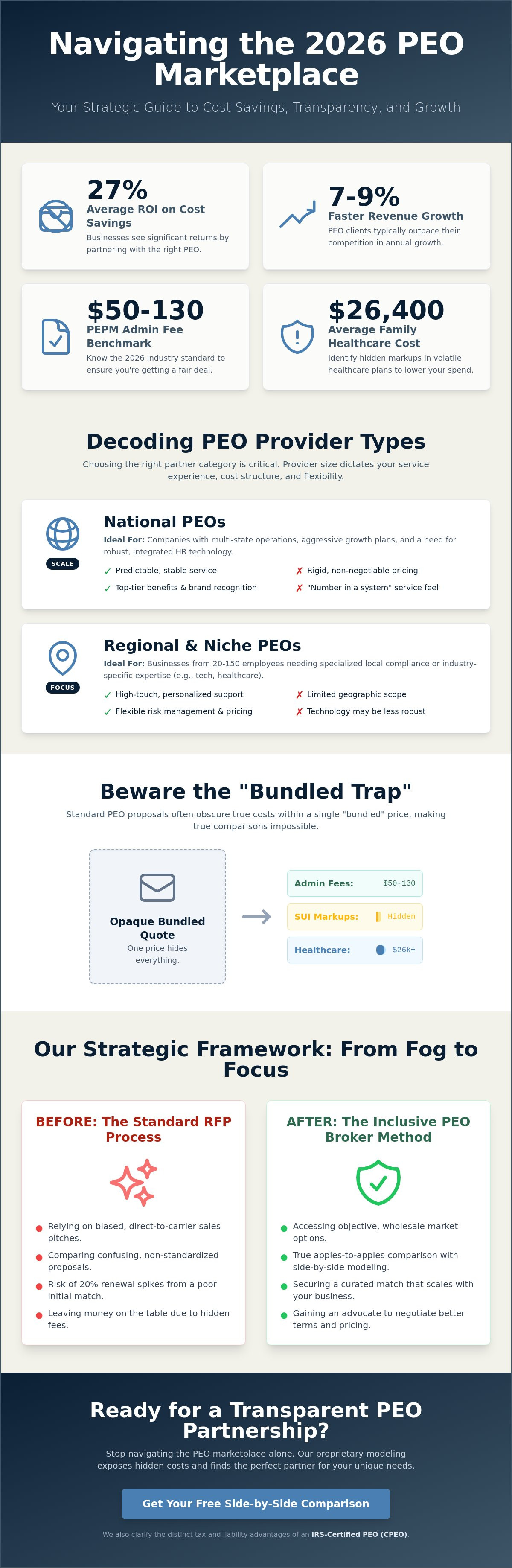
Did you know that businesses partnering with a Professional Employer Organization see an average return on investment of 27% in cost savings alone? While that figure is compelling, the process of navigating peo options often feels like walking through a financial fog. You have likely dealt with opaque pricing structures and hidden administrative fees that make a true comparison feel impossible. It is frustrating when you are trying to protect your margins but cannot get a straight answer on why one benefits package costs thousands more than another.
We understand that you need clarity, not more marketing fluff. This guide provides the framework you need to master the PEO marketplace through transparent side-by-side cost modeling and expert negotiation tactics. You will learn how to benchmark administrative fees against the 2026 industry standard of $50 to $130 per employee and how to identify markups in healthcare plans that now average $26,400 for families. We will walk through the specific steps to audit contract terms so you can lower your healthcare spend and secure a partnership that drives the 7% to 9% faster revenue growth typical of PEO clients.
Key Takeaways
• Identify the strategic differences between national giants and regional specialists to ensure your provider matches your company's scale and service expectations.
• Uncover the "bundled trap" by learning how to isolate administrative fees from hidden markups in state unemployment insurance rates.
• Master a structured framework for navigating peo options that normalizes data across multiple proposals for a true apples-to-apples comparison.
• Analyze medical plan designs through a lens of total value, comparing deductibles and out-of-pocket maximums alongside monthly premiums.
• Streamline your selection process by utilizing proprietary modeling that exposes the underlying costs carriers typically keep hidden from direct buyers.
The Complexity of Navigating PEO Options in 2026
The challenge of navigating peo options has increased significantly as the market matures. In 2026, the US market has expanded to over 500 providers, each claiming to be the perfect fit for your business. However, a Professional Employer Organization (PEO) is not a commodity. Treating it like one often leads to a "one-size-fits-all" selection that results in 20% renewal spikes just twelve months later. This financial volatility happens because generic providers don't account for your specific risk profile or industry requirements from the start.
We're seeing a significant shift toward specialized PEOs. Firms in tech, healthcare, and professional services no longer settle for generalist models. They need partners who understand their unique regulatory burdens and intense talent competition. Successfully navigating peo options requires an objective filter. An independent broker provides this by offering wholesale market access that a single carrier's sales representative won't disclose. It's about finding a curated match rather than a generic solution that might fail you as you scale.
Why the Standard RFP Process Often Fails
Most standard RFP cycles are designed by PEO sales teams to hide specific cost drivers. They focus on flashy technology while burying the details of administrative fee structures. If you rely on direct-to-carrier inquiries, you're only seeing a fraction of the market. This often leads to "incumbent bias," where employers stay with a subpar provider because the effort to switch seems too high. We break this cycle by providing side-by-side proposal comparisons that expose what carriers try to hide. It's the only way to ensure you aren't leaving money on the table.
The Knowledge Gap in PEO Selection
Many HR leaders lack the internal data to benchmark administrative fees effectively. Without a baseline, it's impossible to know if you're getting a fair deal. In 2026, healthcare costs have reached approximately $9,300 for individuals and $26,400 for families. This volatility is putting immense pressure on PEO healthcare pools. You also need to understand the difference between standard providers and an IRS-Certified PEO (CPEO). A CPEO meets rigorous financial standards that offer you greater peace of mind and specific tax benefits. Closing this knowledge gap is essential to bending the cost curve on your benefits spend.
Decoding the Categories: National, Regional, and Niche PEOs
How do you distinguish between a massive national carrier and a boutique regional firm? Effectively navigating peo options requires understanding that provider size dictates your service experience. According to the National Association of Professional Employer Organizations, the industry supports businesses of all sizes, but the "sweet spot" for many growing companies is between 50 and 150 employees. Choosing the wrong category can leave you overpaying for technology you don't use or under-supported in complex local markets.
National giants offer impressive scale and "plug-and-play" technology. They provide a sense of security through brand recognition. However, the trade-off is often a "number in a system" service feel. If your 3-year growth plan involves aggressive multi-state expansion, the scale of a national player is hard to beat. Conversely, regional and niche providers specialize in specific geographies or industries, such as white-collar professional services. They provide higher-touch support and more flexible risk management. If you want to see how these categories stack up for your specific needs, our side-by-side PEO proposal comparisons can clarify the financial differences.
When to Choose a National Provider
National providers are ideal for companies with employees scattered across several states. They provide a high degree of predictability and robust HRIS technology that integrates well with other enterprise tools. These providers are the safe bet for stability and brand name benefits. The challenge lies in their rigid pricing models. You'll find significantly less room for negotiation on administrative fees, and their "bundled" packages can make it difficult to isolate specific cost drivers during your annual review.
The Advantage of Regional and Niche PEOs
For businesses with 20 to 150 employees, regional and niche providers offer a more tailored experience. They excel at local compliance, which is critical as state-specific leave laws and tax regulations continue to shift. These firms are generally more willing to negotiate administrative fee structures and contract terms. They also offer industry-specific risk management, such as specialized workers' compensation for construction or tailored benefits for tech startups. This allows you to build a benefits package that helps you compete for talent without the overhead of a one-size-fits-all national giant.
Identifying Hidden Costs and Administrative Fee Structures
Have you ever looked at a PEO proposal and wondered why the pricing feels so opaque? The "bundled" trap is one of the most common hurdles when navigating peo options. Many providers present a single per-employee-per-month fee that sounds simple but actually masks significant profit margins. This lack of transparency makes it nearly impossible to determine if you're getting a fair deal or if you're subsidizing the provider's bottom line through inflated administrative costs.
One area where PEOs often hide margins is in State Unemployment Insurance (SUI) rates. Because a PEO acts as the employer of record, they use their own experience rating to pay taxes. However, they may charge you a higher "client rate" than what they actually pay the state. The difference, known as "breakage," is kept by the PEO. In 2026, we're seeing more businesses move away from these bundled models in favor of transparent fee structures that separate actual tax costs from administrative service fees. This shift is essential for companies that want to maintain a lean operating budget while still providing top-tier HR support.
Unbundling the PEO Quote
To gain true clarity, you must request a "gross-to-net" cost breakdown. This report should itemize every dollar, showing exactly what goes toward taxes, workers' compensation, benefits, and the PEO's service fee. You should also look for one-time implementation fees or ongoing technology fees. In a competitive market, these are often negotiable or can be waived entirely. Unbundled pricing is the only way to achieve true cost clarity. By forcing each cost driver into the light, you can negotiate contract terms that favor your business rather than the provider's sales targets.
Benefits Benchmarking and Optimization
PEOs leverage "master policies" to secure lower premiums for healthcare, but they don't always pass 100% of those savings to the client. With family health coverage now costing approximately $26,400 per year, even a small markup can have a massive impact on your total spend. Our role is to help you perform benefits benchmarking to ensure the richness of the plan justifies the premium. We use cost comparison modeling to help you "bend the cost curve" on these expenses. This methodical approach ensures you aren't just buying a package, but are instead investing in a strategic benefits infrastructure that attracts talent without draining your reserves.
A Strategic Framework for Side-by-Side PEO Comparison
Comparing PEO proposals often feels like trying to solve a puzzle with missing pieces. Each provider uses different terminology and fee structures, making a direct comparison difficult. To succeed in navigating peo options, you must move beyond a simple features checklist and adopt a rigorous financial model. This framework ensures you aren't just choosing a vendor, but are instead selecting a partner that aligns with your long-term fiscal goals.
The process begins with five critical steps to ensure clarity and leverage:
Step 1: Normalize the data.
Strip away the marketing language and reformat every proposal into a standard spreadsheet. This ensures you are looking at apples-to-apples figures for taxes, workers' compensation, and administrative fees.
Step 2: Compare medical plan designs.
Do not look at premiums in a vacuum. Analyze deductibles and out-of-pocket maximums alongside those premiums to understand the true value for your employees.
Step 3: Evaluate HRIS technology.
Determine if the PEO's platform integrates with your existing tech stack. A disjointed system creates manual work that offsets any administrative time savings.
Step 4: Conduct blind SLA reviews.
Evaluate the service level agreements without looking at the brand names. This helps you focus on response times and support guarantees rather than brand reputation.
Step 5: Leverage wholesale market access.
Use your finalists to drive deeper negotiations. Bringing a clear comparison to the table forces providers to be more transparent with their final pricing.
If you are ready to see how your current quotes stack up against the market, our team can provide side-by-side PEO proposal comparisons to highlight the gaps in your current offers.
Modeling the Total Cost of Employment
Focusing only on the administrative fee is a mistake that can cost mid-sized firms over $50,000 annually. You must build a 3-year cost projection that accounts for projected renewal increases, which often average 5% to 10% in the second year. A provider might offer a low entry rate only to recoup those costs through significant hikes later. We also recommend checking the PEO's financial health and carrier backing. A PEO with a 27% average ROI for its clients is usually one that maintains stable, long-term relationships with strong insurance carriers.
The Power of Wholesale Market Access
Most employers only see retail rates when they approach a PEO directly. We utilize wholesale market access to secure pricing and terms that aren't available to the general public. This volume-based negotiation allows us to lower your entry price and secure favorable contract terms from the start. We use insider data to identify where carriers hide their profit margins, such as in SUI rates or benefits breakage. This level of transparency is the only way to ensure your business is the one benefiting from the co-employment model's economies of scale.
Inclusive PEO Brokers: Your Advocate in the PEO Marketplace
The process of navigating peo options shouldn't feel like a high-pressure sales pitch. At Inclusive PEO Brokers, we act as your expert matchmaker, removing the friction often found in direct carrier interactions. We perform the heavy lifting by filtering through the 500+ providers in the market to present only those that align with your specific industry and growth trajectory. Our goal is to transform a complex transaction into a strategic partnership that provides long-term stability.
Our proprietary side-by-side comparison modeling provides a level of transparency that carriers often hide. We don't just show you the premiums; we deconstruct the entire proposal to reveal the underlying cost drivers we've discussed. During the negotiation phase, Inclusive PEO Brokers leverages wholesale market access to reduce administrative fees and improve contract terms. Successfully navigating peo options requires this level of insider data to ensure you enter the partnership with favorable conditions that protect your margins as you scale.
Once you've selected a provider, our support doesn't end. We provide PEO implementation support to ensure a seamless transition for your team. This includes coordinating the HR strategy and infrastructure rollout so you can immediately begin seeing the 27% average return on investment that successful PEO partnerships offer. We act as your tireless advocate, ensuring the PEO delivers on every promise made during the RFP process and helping you bend the cost curve on benefits expenses.
Negotiating Your PEO Contract for Long-Term Savings
Entering a co-employment relationship requires a contract that protects your interests beyond the first year. We specialize in identifying "poison pills" in service agreements, such as excessive termination fees or restrictive auto-renewal clauses. By negotiating renewal caps, we prevent the "bait and switch" pricing spikes that often occur in year two. We also work to secure credits for implementation and data migration costs, ensuring your move to a new provider is as cost-effective as possible from day one.
Building Robust HR Infrastructure
A PEO is a powerful tool, but your HR strategy is the engine of your business growth. We help you scale your infrastructure and compliance to match the needs of the 230,000 U.S. companies currently leveraging this model. In one recent engagement, a mid-sized firm saved 15% on healthcare spend by using our matchmaking process to find a niche provider with better-aligned risk pools. These results are possible when you have a guide who understands the intricacies of the marketplace. If you're ready to take control of your costs, you can get your custom side-by-side PEO comparison today and start building a more resilient organization.
Securing Your Competitive Advantage in 2026
The landscape of human resources and employee benefits is shifting rapidly. Successfully navigating peo options requires more than a simple vendor search. It demands a commitment to financial transparency and a rigorous approach to contract negotiation. By unbundling administrative fees and normalizing proposal data, you move from a position of uncertainty to one of total control. You now have the tools to identify hidden markups and secure a partnership that actually supports your long-term growth.
You don't have to manage this complex transition alone. Inclusive PEO Brokers, led by HR veteran Chris Galy, provides the expert guidance needed to cut through market noise. We offer wholesale market access to over 50 national and regional providers, ensuring you see the options carriers often keep behind closed doors. Our team provides detailed side-by-side cost modeling at no cost to your business, giving you the clarity to make an informed decision without the sales pressure.
It's time to stop overpaying for generic solutions and start building a benefits strategy that attracts the best talent in your industry. Schedule a PEO Strategy Consultation today to see how we can help you bend the cost curve. We are ready to help you find the perfect fit for your organization's future.
Frequently Asked Questions
Is it better to use a national PEO giant or a regional provider?
The right choice depends on your geographic footprint and service expectations. National providers offer robust technology for multi-state teams, while regional specialists provide high-touch support for local compliance. Navigating peo options effectively means matching your three-year growth plan to the provider's specific strengths rather than just choosing the biggest name.
How much are typical PEO administrative fees in 2026?
Administrative fees in 2026 generally fall between $40 and $160 per employee per month. For businesses with 25 to 100 employees, the market average often sits between $50 and $130. Some providers use a percentage of payroll model, typically ranging from 2% to 12%, which can be more advantageous for companies with a lower average wage.
Can I negotiate my PEO contract at renewal time?
You absolutely can and should negotiate your contract during the renewal period. This is the best time to address "bait and switch" pricing by implementing renewal caps that limit year-over-year increases. We recommend starting this process at least 90 days before your contract expires to ensure you have enough leverage to secure favorable terms.
What is the difference between a PEO broker and a PEO sales rep?
A PEO sales representative only sells the products of a single carrier at retail rates. An independent broker provides wholesale market access to over 50 different providers and acts as an objective filter. We use side-by-side modeling to show you exactly where carriers are hiding profit margins in their proposals, which a direct rep will not disclose.
How long does the PEO implementation process typically take?
Most implementations take between 30 and 60 days to complete properly. This timeline allows for thorough data migration, benefits enrollment, and employee training on the new platform. Rushing this process often leads to payroll errors and employee frustration, so we advocate for a methodical rollout that ensures every system is tested before the first live payroll run.
What are the most common "hidden costs" in a PEO proposal?
Hidden costs frequently appear as markups on State Unemployment Insurance (SUI) rates and "breakage" in healthcare premiums. You might also encounter separate technology or implementation fees that aren't clearly disclosed in the initial quote. Unbundling your pricing is the only way to expose these secondary profit centers and ensure you aren't overpaying for basic administration.
Does a PEO handle all of my compliance and legal risks?
A PEO manages administrative compliance, such as tax filings and HR policy updates, but they don't remove all liability. You still maintain day-to-day control over employee supervision and workplace safety. Navigating peo options involves understanding this co-employment model, where responsibilities are shared between your firm and the provider to reduce your overall exposure to regulatory penalties.
What happens if I want to switch PEO providers later?
Switching providers is possible but requires careful planning to avoid mid-year tax resets. Unless you move to an IRS-Certified PEO (CPEO), you may have to restart wage bases for FICA and FUTA taxes. We help manage this transition by auditing potential termination fees and ensuring your data migrates accurately to the new system without disrupting your operations.
.svg)
Partner with us for expert HR support compliance, and personalized solutions.






.png)