.png)

PEO Contract Red Flags to Catch Before You Sign

If a PEO contract has opaque pricing, a termination fee worth more than three months of fees, no data portability language, or vague co-employment liability, stop signing and get it reviewed. These are the four issues that cause the most financial and legal pain for small and mid-size businesses after the ink dries. Each one hits differently: opaque pricing erodes your budget slowly, long lock-ins trap you with a provider that isn’t delivering, missing data rights leave you stranded during a transition, and unclear liability language can leave you holding the bag for a payroll or tax mistake you didn’t make.
Before you sign anything, pause. Document every verbal promise the sales team made, then ask for it in writing. Get a second set of eyes on the contract, whether that’s an employment attorney or a PEO broker who reads these agreements for a living.
Watch for these signs right now:
- Pricing that’s bundled without a per-employee breakdown
- Termination fees that are unusually high, or notice requirements longer than what is common in the industry
- No explicit language guaranteeing free, timely export of your payroll and employee data
- No measurable SLAs for payroll accuracy, tax filing, or support response times
- Vague co-employment liability that doesn’t specify who owns tax and compliance errors
- Sales pressure to sign quickly, before your attorney has reviewed the agreement
Pro Tip: Ask for the contract in editable format, not just a PDF for signature. A PEO that resists letting you redline the document is telling you something about how flexible they’ll be after you’re a customer.
Key Takeaways
Spotting PEO contract red flags before you sign protects your cash flow, your legal exposure, and your ability to exit a bad provider relationship cleanly.
| Point | Details |
|---|---|
| Watch termination terms | Flag notice periods over 90 days and termination fees that are unusually high. |
| Demand data portability | Require free, timely export of payroll and employee records specified in writing before signing. |
| Require enforceable SLAs | Insist on measurable payroll accuracy, tax filing deadlines, and response-time guarantees with remedies. |
| Get legal review on liability clauses | Have an attorney review indemnification, arbitration, and co-employment liability language. |
| Use a broker for leverage | Inclusive PEO Brokers benchmarks terms across providers and has completed 133 implementations for clients. |
Where to Verify PEO Contract Claims and Provider History
- COMPEO’s red flag guide for common warning signs during evaluation.
- PEO Marketplace’s negotiation guide for specific clause targets.
- The OIS Group’s question checklist for structuring vetting calls.
- BBB business profiles for complaint history and responsiveness records.
Table of Contents
- What Are the Biggest PEO Contract Red Flags to Watch For?
- What Questions Should You Ask a PEO Before Signing?
- Why Do Payroll and SLA Failures Sink PEO Relationships?
- What Should You Do If You Find a Red Flag?
- How Inclusive PEO Brokers Helps You Avoid a Bad PEO Contract
- Frequently Asked Questions
- Sources
What Are the Biggest PEO Contract Red Flags to Watch For?
Most PEO contract issues hide in plain sight, buried in sections most business owners skim. Reading these clauses closely, and knowing what numbers should make you pause, is the difference between a smooth HR partnership and a costly mess.
Termination clause. Look at the notice window required to exit and how the contract defines “cause.” A notice period beyond 90 days is a warning sign in a market where 30 to 60 days is standard. Also check whether you can exit mid-cycle if service quality collapses, or whether you’re locked in until a specific renewal date regardless of performance.
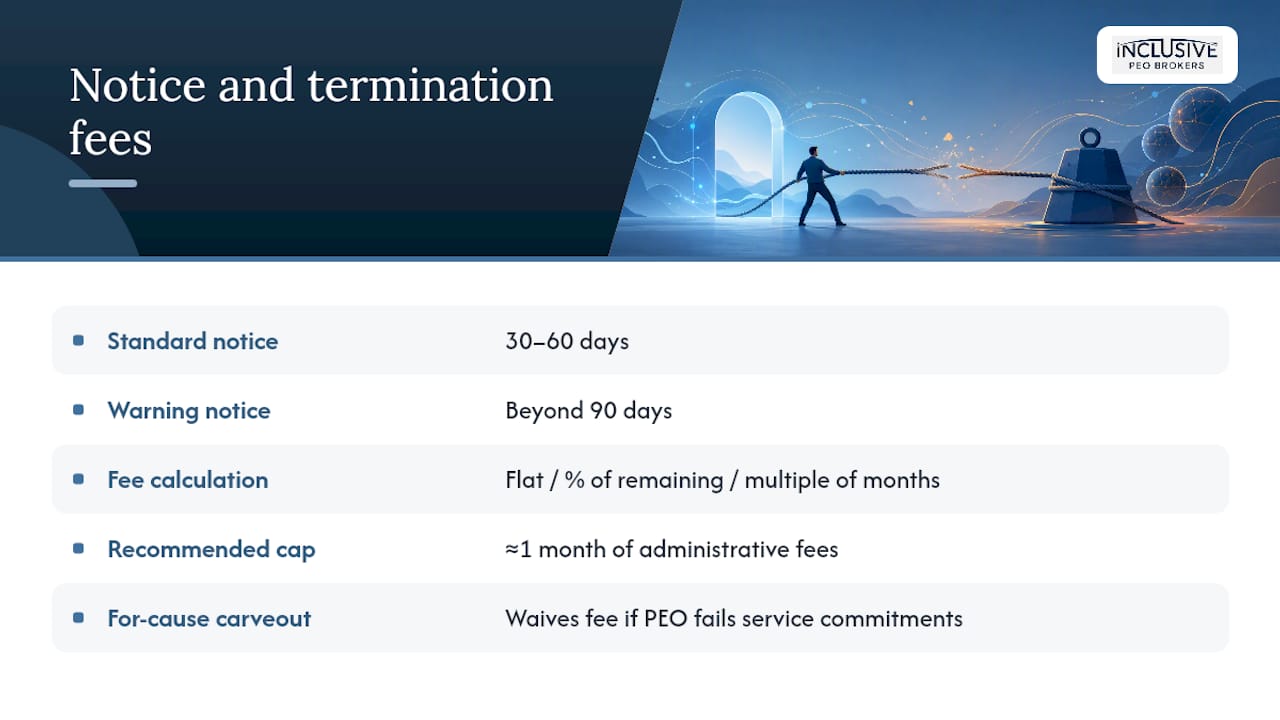
Early termination fees. These get calculated as a flat fee, a percentage of remaining contract value, or a multiple of monthly fees. PEO Marketplace recommends capping this at roughly one month of administrative fees and pushing for a for-cause carveout that waives the fee entirely if the PEO fails to meet its own service commitments.
Auto-renewal and renewal notice. Many agreements auto-renew for another full term unless you cancel within a narrow window, sometimes just 30 days before the anniversary date. Pair that with a rate increase that takes effect automatically at renewal, and you can end up stuck paying more with no real opportunity to shop around.
Pricing and rate-change provisions. Bundled pricing that mixes the administrative fee with pass-through benefits costs and workers’ comp premiums makes it nearly impossible to tell what you’re actually paying for HR services. Ask for the components broken out separately, and check how much notice you get before any rate change takes effect.
Co-employment and liability allocation. The whole PEO model rests on shared employer responsibilities, but the contract should spell out exactly who owns tax filing errors, payroll mistakes, and employment law claims. Watch for indemnification language that caps the PEO’s liability at a low dollar amount while leaving you exposed for anything above it.

Workers’ compensation control. Some PEOs retain unilateral control over claims handling and won’t share how your experience modification rate is calculated, which affects your future premiums even after you leave.
Data ownership and portability. The agreement should state explicitly that you own your employee records and can export them, free of charge, in a usable format on exit.
Service levels. No enforceable SLA for payroll accuracy, tax filing deadlines, or support response times means no contractual recourse when something goes wrong beyond terminating the relationship.
Confidentiality, dispute resolution, and hidden fees. Check for vague data security obligations, mandatory arbitration clauses that limit your legal options, unusual governing-law provisions, and add-on fees for onboarding or custom reports that never appeared in the original quote.
Pro Tip: Highlight every dollar figure and every date in the contract before your first read-through. If a number or deadline isn’t there, that absence is itself the red flag.
What Questions Should You Ask a PEO Before Signing?
The right questions during your PEO evaluation calls force the provider to commit to specifics instead of hiding behind marketing language. Twelve core questions tend to surface most hidden fees and unclear obligations, and these build on that foundation:
- Can you give me a per-employee pricing breakdown, including which items are pass-through and which are markup?
- Is there a cap on how much the administrative fee can increase at renewal, and how much notice will I get?
- What’s the exact notice window to terminate, and how is any termination fee calculated?
- What format will you deliver my payroll and employee data in if we part ways, and is there a charge for that export?
- Who owns our employee records if our company is acquired or if your business closes?
- What’s your remediation timeline if a payroll run has an error, and do you offer service credits for missed SLAs?
- Who leads workers’ comp claims, and will you share our claims history and EMR calculations with us directly?
- Can you show me an example of an incident where you accepted liability for a payroll or tax mistake?
- Will we have a dedicated account team, or are we routed through a shared service center?
Why Do Payroll and SLA Failures Sink PEO Relationships?
Operational failures, not contract fine print, are usually what convinces a business to fire its PEO. Missed payroll runs, tax filings submitted late, and workers’ comp claims handled with zero transparency all trace back to one root cause: a contract that never defined measurable standards in the first place.
Vague SLA language (“we strive for accuracy” instead of a stated error rate, or “prompt response” instead of a stated hour count) gives you no contractual footing when something breaks. Ask for specifics: a payroll accuracy rate, a tax filing deadline with named consequences for a missed one, and a support response-time guarantee tied to service credits, not just an apology.
- Vague promises with no remedy attached
- No published payroll cutoff and correction policy
- No indemnity clause covering PEO filing errors
- No commitment to share claims records or EMR data with you directly
A contract lacking enforceable SLAs is frequently the underlying reason operational hiccups escalate into legal disputes, because there’s no defined standard either side agreed to in the first place.
What Should You Do If You Find a Red Flag?
Finding a problem clause doesn’t mean walking away automatically. It means negotiating from a position of knowledge. Ask for a cap on termination fees, a for-cause exit option, a rate-increase guarantee tied to a fixed percentage, and explicit data portability language specifying formats and a delivery timeline, ideally within 30 days.
Get legal review for anything involving indemnification, liability carveouts, arbitration clauses, or data rights, regardless of your company’s size. These are the clauses where ambiguous wording costs the most later.
This is also where a broker earns its keep. PEO Marketplace notes that contract length, termination fees, rate guarantees, and portability are the areas most often successfully renegotiated, and a broker who benchmarks these terms across multiple providers brings leverage you don’t have shopping solo. One client working through Inclusive PEO Brokers’ negotiation process pushed a provider’s termination fee cap down and secured a guaranteed 30-day data export window before signing, protections that would have been far harder to win alone.
Pro Tip: Go into negotiations with a benchmark rate from at least one competing quote and a genuine willingness to walk. Leverage grows fast once you’re past 20 employees, but even smaller businesses can usually win a fee cap and a firm data export deadline.
A Broker’s View on Why These Clauses Matter Most
Sales teams lean on urgency and bundled pricing because both make it harder to see what you’re actually agreeing to. A limited-time rate or a quote that mixes admin fees with benefits pass-throughs isn’t a coincidence. It’s a way to compress your decision timeline before your attorney gets a look. Brokers push back on both, because a provider unwilling to hold a quote for two weeks while you review it is telling you how it’ll behave once you’re locked in.
Vetting a PEO’s operational claims means checking references, pulling third-party complaint histories, and confirming SLA language actually has teeth. Inclusive PEO Brokers builds that verification into every matchmaking engagement.
How Inclusive PEO Brokers Helps You Avoid a Bad PEO Contract
Reading a PEO contract clause by clause takes real hours you probably don’t have between payroll runs and everything else on your desk. Inclusive PEO Brokers handles the matchmaking, negotiation support, cost modeling, and exit planning so you’re not doing it solo, and comparing quotes against providers that actually fit your industry and headcount instead of guessing.

Clients working with Inclusive PEO Brokers save an average of 80 hours in the selection process and $634 in costs, backed by 133 completed implementations across small and mid-size businesses. That track record comes from knowing which clauses to push back on before a client signs, not after.
If you’re evaluating a PEO right now, or you’ve already got a proposal sitting on your desk that raises questions, request a consultation and bring your current quote or draft agreement to the call. Inclusive PEO Brokers will walk through the pricing structure, termination terms, and data rights with you and flag exactly what needs to change before you sign.
Frequently Asked Questions
What is the biggest PEO contract red flag? Opaque, bundled pricing that hides the true administrative fee inside benefits and workers’ comp costs tops most lists, because it makes real cost comparison across providers nearly impossible.
How long should a PEO termination notice period be? Most reasonable agreements require 30 to 60 days’ notice. Anything beyond 90 days, paired with a steep termination fee, should trigger a negotiation before you sign.
Can I negotiate a PEO contract, or is it take-it-or-leave-it? Contract length, termination fees, rate guarantees, and data portability are the terms most frequently negotiated successfully, especially when you bring a competing quote to the table.
Do I need a lawyer to review a PEO contract? For indemnification clauses, liability caps, arbitration provisions, and data rights, yes. These are the sections where vague wording creates the most expensive surprises later.
What should a PEO exit clause guarantee? It should specify a data export timeline (ideally 30 days or less), the file formats you’ll receive, and confirmation that the export is free of charge.
Sources
.svg)
Seeking a different solution? Meet Your Business Needs