.png)

12 PEO Demo Questions Every Small Business Should Ask

The 12 questions below are the ones that separate a well-matched PEO from a costly mistake. Bring them to every demo, and use the verification steps alongside each one to confirm what the vendor tells you on the call.
The 12 core PEO demo questions at a glance:
- Which industries and company sizes make up your current client base? Good answer: a specific breakdown by sector and headcount range, with named case studies. Red flag: “We work with all types of businesses.”
- What is your billing model, and can you provide a sample invoice today? Good answer: a clear per-employee-per-month (PEPM) or percentage-of-payroll rate plus a line-item invoice. Red flag: “We’ll send pricing after the demo.”
- Which payroll cadences do you support, and what triggers an off-cycle run? Good answer: weekly, bi-weekly, and semi-monthly options with a defined off-cycle fee schedule. Red flag: vague SLAs or no stated processing cutoff.
- Can you show us the employer and employee portals in a live sandbox today? Good answer: immediate sandbox access or a recorded walkthrough with real data fields. Red flag: “We’ll schedule a separate tech demo.”
- What benefits packages are available, and who are the underlying carriers? Good answer: named carriers, multiple plan tiers, and a sample Summary of Benefits and Coverage (SBC). Red flag: “We offer great rates” with no carrier documentation.
- How is workers’ compensation structured, and who manages claims? Good answer: a master policy with a named TPA or in-house claims team and a historical loss-run summary. Red flag: no claims process described.
- Which HR tasks are included in the base fee, and which cost extra? Good answer: a written scope of services listing employee relations, handbook updates, and compliance support. Red flag: “We handle everything” without a written list.
- Who will be our dedicated account rep, and what is their client-to-rep ratio? Good answer: a named contact, their background, and a ratio below 50:1. Red flag: a shared queue or no ratio disclosed.
- What are the contract term, auto-renewal window, and early-exit penalties? Good answer: a 12-month term with a 30-day termination window and no punitive exit fee. Red flag: multi-year lock-in or undisclosed penalties.
- Are you a Certified Professional Employer Organization (CPEO) or ESAC-accredited? Good answer: a CPEO listing number or ESAC certificate with a current date. Red flag: “We’re working on it” or no documentation offered.
- What does the onboarding timeline look like, and what do we own vs. what do you own? Good answer: a written project plan with milestones, client deliverables, and a go-live date. Red flag: “It usually takes a few weeks” with nothing in writing.
- Can you provide two references from businesses similar to ours in size and industry? Good answer: two live contacts offered immediately. Red flag: a delay, a testimonial page, or “we’ll check with legal.”
Two immediate post-demo actions: Request the sample invoice, sample contract excerpt, and any SBCs before you leave the call. Then score each answer against the rubric in the evaluation section below and compare totals across vendors before your next conversation.
Key Takeaways
Asking the right PEO demo questions, requesting verification documents during the call, and scoring answers against a consistent rubric are the three steps that separate a confident PEO selection from an expensive mistake.
| Point | Details |
|---|---|
| Request documents during the demo | Ask for a sample invoice, contract excerpt, SBCs, and two client references before the call ends. |
| Score every vendor on eight dimensions | Rate experience, pricing, payroll/tech, benefits, compliance, service model, onboarding, and accreditation on a 1–5 scale. |
| Verify accreditation independently | Confirm CPEO status at the IRS public listings and ESAC accreditation at ESAC.org before advancing any vendor. |
| Watch for contract red flags | Multi-year lock-ins, 90-day termination windows, and undisclosed exit penalties are the most common costly surprises. |
| Inclusive PEO Brokers | Clients save an average of 80 hours and $634 in the selection process, with 133 successful implementations completed. |
Table of Contents
- What do your best PEO demo questions reveal about industry and company-size fit?
- How do you uncover the full, all-in cost during a PEO demo?
- What should you validate about payroll, technology, and integrations in the demo?
- What questions confirm benefits quality and workers’ compensation handling?
- How do you clarify exactly what HR services and compliance support are included?
- Who will you actually talk to, and what service levels can you count on?
- What contract terms, liabilities, and financial checks should you demand?
- What onboarding questions reveal whether the transition will go smoothly?
- How do you score vendor answers and decide who makes the shortlist?
- Before the demo: what to prepare, request, and do immediately after
- How a PEO broker speeds selection and reduces your risk
- What the demo process taught us after 133 SMB implementations
- Inclusive PEO Brokers takes the guesswork out of PEO demos
- Sources
What do your best PEO demo questions reveal about industry and company-size fit?
NAPEO’s industry overview confirms that PEOs tailor HR, payroll, benefits, and compliance services to small and mid-sized employers, which means fit is not generic. A PEO that excels with 500-person professional services firms may be poorly equipped for a 20-person restaurant group navigating tip credit rules or a construction company managing certificate-of-insurance requirements.
The questions that surface real fit are specific. Ask the vendor to describe their three most common client profiles by industry and headcount. Ask what percentage of their book falls within your size band. Then ask for a case study or a reference from a business that matches your profile closely. A vendor with genuine experience in your sector will answer without hesitation and offer a contact name on the spot.
Scoring lens: A “proven fit” answer includes a named industry, a headcount range, and a verifiable reference. A vague answer (“we serve businesses of all sizes”) scores zero on fit and should trigger a follow-up or a pass.
Pro Tip: For regulation-heavy industries (healthcare, construction, staffing) or companies scaling headcount rapidly, ask specifically whether the PEO has a dedicated compliance team for your sector and whether that team is in-house or outsourced. The answer changes your risk profile significantly.
How do you uncover the full, all-in cost during a PEO demo?
Pricing transparency is the area where demos most commonly fall short. Most vendors lead with a headline PEPM rate or a percentage-of-payroll figure, then bury implementation fees, ACA reporting charges, and add-on service costs in the contract. Your job during the demo is to force the full picture into the open.
Ask these questions in sequence:
- Is your fee a flat PEPM rate or a percentage of gross payroll, and which payroll items are included in that base?
- What is excluded from the base fee and billed separately (benefits administration, COBRA, ACA filing, background checks, recruiting support)?
- Are there implementation or setup fees, and are they refundable if we exit within the first year?
- What are the termination or early-exit fees, and how are they calculated?
- Can you provide a sample invoice that reflects a company of our size and benefit elections?
The sample invoice is non-negotiable. A vendor unwilling to produce one during or immediately after the demo is signaling that the full cost picture is not favorable. Cost reduction modeling is one of the clearest ways a broker adds value here, because they can translate a vendor’s fee schedule into a true apples-to-apples comparison across multiple providers.
Common hidden fees to watch for:
- COBRA administration and notice fees
- ACA 1094/1095 filing charges
- Off-cycle payroll run fees
- Year-end W-2 or 1099 processing charges
- Benefits open enrollment support fees
- State unemployment insurance (SUI) rate management fees
Red flag: Any vendor that refuses to provide a written fee schedule or sample invoice before you sign a letter of intent is not operating transparently. Walk away or escalate to a broker for independent cost modeling.
What should you validate about payroll, technology, and integrations in the demo?
Payroll reliability is the foundation of the co-employment relationship. A missed payroll or a tax filing error creates immediate legal and reputational exposure, so the demo is the right moment to stress-test the vendor’s claims about processing windows, system integrations, and reporting access.

Start with cadence and cutoffs. Ask which payroll frequencies they support (weekly, bi-weekly, semi-monthly, monthly) and what the processing cutoff is for each. Ask what triggers an off-cycle run and whether there is a fee. Then move to integrations: confirm whether the platform connects natively with your accounting software (QuickBooks, Xero, Sage), your ATS, and your timekeeping system. Ask whether the integration is a native API connection or a manual SFTP file transfer, because the answer determines how much manual reconciliation your team will carry.
Pro Tip: Request a sandbox login or a recorded platform walkthrough during the call. A vendor confident in their technology will provide it without hesitation. Use the sandbox to verify that your employee count, pay groups, and reporting fields map correctly to your current setup before you commit.
The IRS holds employers jointly responsible for payroll tax accuracy even under a co-employment arrangement, so confirming that the PEO’s platform produces audit-ready payroll registers and tax filings is not optional.
Red flags in the payroll and tech demo:
- No sandbox or demo environment available
- Vague SLAs for payroll accuracy or tax filing deadlines
- Integrations described as “manual exports” rather than live API connections
- Reporting limited to pre-built templates with no custom export capability
- No named contact for payroll error resolution
What questions confirm benefits quality and workers’ compensation handling?
Benefits are often the primary reason an SMB considers a PEO in the first place. The co-employment model gives smaller employers access to large-group health, dental, vision, and retirement plans that would otherwise be out of reach. But “access” varies widely. Some PEOs offer a single carrier with two plan tiers; others offer a curated marketplace with a dozen options across multiple carriers.
Ask the vendor to name the underlying carriers for their medical, dental, and vision plans. Request a sample Summary of Benefits and Coverage (SBC) for their most popular medical plan. Ask about eligibility rules (waiting periods, dependent coverage, part-time employee inclusion) and whether benefits are portable if you exit the PEO. The U.S. Department of Labor’s guidance on fiduciary responsibilities for group health and retirement plans applies to PEOs administering benefits, so a vendor that cannot articulate their fiduciary role is a compliance risk.
Workers’ compensation questions deserve equal attention:
- Is workers’ comp included in the base fee or billed separately as a percentage of payroll?
- Is it a master policy or a guaranteed-cost program, and how are experience modifications handled?
- Who manages claims: an in-house team, a third-party administrator (TPA), or the carrier directly?
- Can you provide a historical premium trend and loss-run summary for a comparable client?
Red flags to note:
- Carrier names withheld until after signing
- No SBC available during the demo
- Workers’ comp claims managed by an unnamed third party with no described process
- Promises of “the best rates in the market” without documentation
- No explanation of how experience modifications transfer if you exit
How do you clarify exactly what HR services and compliance support are included?
“Full-service HR” is one of the most overused phrases in PEO sales. During the demo, your job is to convert that phrase into a written list. Ask the vendor to walk through their HR service catalog and confirm which items are included in the base fee and which require an upgrade or an add-on.
The compliance questions matter most for multi-state employers. Ask who is responsible for monitoring state and local law changes (minimum wage updates, paid leave mandates, ban-the-box ordinances) and how those changes are communicated to you. Ask whether the PEO is the employer of record for payroll tax purposes and what that means for your liability under the CPEO program. A CPEO designation shifts certain federal payroll tax liabilities to the PEO, which is a meaningful risk transfer for your business.
Pro Tip: Ask the vendor to share an example of a compliance notice or formal guidance document they issued to a client in the past 12 months. A vendor with a real compliance function will have these on file and will share a redacted version without hesitation.
Specific HR service questions to ask:
- Do you provide employee handbook creation and annual updates?
- Is employee relations support (disciplinary guidance, termination support) included?
- Do you offer recruiting or job posting support, and at what cost?
- Who handles EEOC charges or DOL audits, and what is the process?
Red flag: Any vendor that cannot produce a written scope of HR services or that describes compliance ownership as “shared” without defining the split is transferring risk back to you without disclosing it.
Who will you actually talk to, and what service levels can you count on?
The account management model is where PEO promises most often diverge from reality. During the demo, the sales rep is attentive and responsive. After signing, you may find yourself in a shared service queue with a 48-hour response window. The demo is your only opportunity to lock in the actual service model before you commit.
Ask directly:
- Will we have a dedicated account manager, or will we work with a shared service team?
- What is the current client-to-rep ratio for our account manager?
- What is the SLA for responding to a payroll error, a benefits enrollment issue, and a compliance question?
- Who is the escalation contact if our account manager is unavailable?
- What is the average tenure of your account management team?
Request the SLA document in writing during the demo. A vendor with a real service commitment will have it ready. A ratio above 75 clients per rep is a signal that your account will not receive meaningful attention during peak periods (open enrollment, year-end payroll).
Red flags:
- No dedicated rep; all support routed through a ticketing system
- SLAs described verbally but not available in writing
- High rep turnover disclosed or implied (“we’re growing fast”)
- Escalation path unclear or routed back to the sales team
What contract terms, liabilities, and financial checks should you demand?
The contract conversation is where many SMBs lose leverage because they wait until after the demo to ask. Raise these questions during the call so the vendor knows you will scrutinize the agreement before signing.
Ask about term length, auto-renewal windows, and the notice period required to exit without penalty. A 30-day termination window is reasonable; a 90-day window with a multi-month penalty is not. Ask who bears payroll tax liability if a filing error occurs and how indemnification is structured. Ask whether the PEO carries errors-and-omissions (E&O) insurance and what the coverage limit is.
Then verify accreditation. The IRS CPEO public listings let you confirm a vendor’s CPEO status in minutes. ESAC accreditation is a separate, independent signal of financial stability and operational soundness. A vendor that holds both has passed meaningful third-party scrutiny. One that holds neither should be asked why, and the answer should be documented.
Contract and financial checklist:
- Request a sample contract or statement of work during the demo
- Confirm the employer-of-record designation and what it covers
- Ask for audited financials or a financial assurance certificate
- Request two client references who have exited the PEO to understand the offboarding experience
- Confirm bonding and insurance coverage (fidelity bond, E&O, workers’ comp)
Red flag: A vendor that refuses to share a sample contract before you sign a letter of intent, or that cannot produce accreditation documentation on request, is not ready for serious diligence.
What onboarding questions reveal whether the transition will go smoothly?
A PEO transition involves migrating payroll data, re-enrolling employees in benefits, configuring integrations, and communicating changes to your team. Vendors that have done this well have a written project plan. Vendors that have not will describe the process in vague terms.
Ask for a sample onboarding timeline or project plan during the demo. A credible plan includes go-live milestones, a list of client deliverables (data files, signed authorizations, benefits elections), and a named implementation manager. Ask who owns data migration and PII handling, and what testing occurs before the first live payroll run.
Onboarding questions to ask:
- What is the typical implementation timeline from signed contract to first live payroll?
- What client deliverables are required, and by what deadlines?
- Who configures benefits and payroll settings: your team or ours?
- Is there a parallel payroll run before go-live, and how many cycles does it cover?
- Are there implementation fees, and are they included in the base contract?
If you are considering a future exit, the exit strategy and transition support process is equally worth raising during the demo. Ask how data is returned to you at offboarding and what the transition timeline looks like.
Red flags: A vendor with no written onboarding plan, unexplained setup fees, or no described testing process before go-live is signaling that implementations are ad hoc. That creates avoidable risk for your first payroll cycle.
How do you score vendor answers and decide who makes the shortlist?
A scoring rubric converts subjective demo impressions into a defensible, comparable decision. Rate each vendor on a 1–5 scale across eight dimensions immediately after the demo while the answers are fresh.
| Dimension | What a 5 looks like | What a 1 looks like |
|---|---|---|
| Experience and industry fit | Named case studies, live references offered | “We work with all types of businesses” |
| Pricing and fee structure | Sample invoice provided, all fees itemized | Headline rate only, no written schedule |
| Payroll and tech integration | Live sandbox shown, API integrations confirmed | Slide deck only, integrations “in progress” |
| Benefits and insurance | Named carriers, SBCs provided, claims process described | “Great rates” with no documentation |
| Compliance and HR services | Written scope of services, compliance examples shared | Verbal assurances, no written list |
| Account management and SLAs | Named rep, ratio disclosed, SLA document provided | Shared queue, no SLA |
| Onboarding and transition | Written project plan, milestones, parallel run confirmed | “A few weeks,” nothing in writing |
| Financial stability and accreditation | CPEO listing confirmed, ESAC accredited, audited financials | No accreditation, no financials offered |
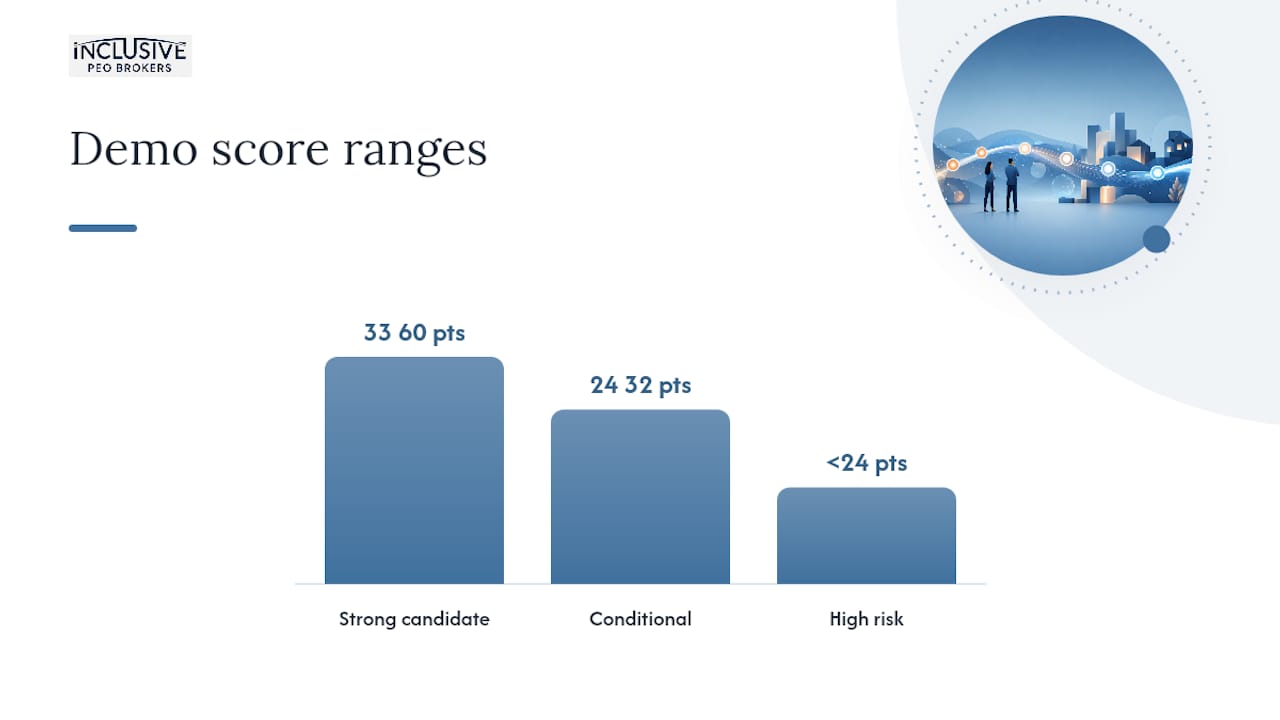
Interpreting your totals:
- 33–40: Strong shortlist candidate. Proceed to reference checks and contract review.
- 24–32: Conditional. Request the missing documents before advancing. Re-score after receipt.
- Below 24: High risk. Reject or require a second demo with a senior contact and written answers to every open item.
For structuring and scoring demo calls effectively, a consistent rubric applied across all vendors is the single most reliable way to remove bias from the decision.
Before the demo: what to prepare, request, and do immediately after
Walking into a PEO demo without preparation means the vendor controls the agenda. Thirty minutes of prep changes that dynamic entirely.
Pre-demo tasks:
- Collect your current payroll cadence, employee count by state, and a recent payroll register
- List your current benefits carriers, plan tiers, and renewal date
- Document your existing software integrations (accounting, ATS, timekeeping)
- Prepare your org chart and note any rapid headcount changes planned in the next 12 months
- Review the vendor’s website for any accreditation claims you want to verify live
During the demo, request these documents before the call ends:
- Sample invoice for a company of your size and benefit elections
- Sample contract or statement of work (even a redacted version)
- Sandbox login or a recorded platform walkthrough
- Two client references from businesses similar to yours
- Written scope of HR services included in the base fee
- SLA document for account management response times
Post-demo actions:
- Score the demo against the rubric within 24 hours
- Follow up in writing for any documents not received during the call
- Verify CPEO status at the IRS CPEO public listings and ESAC accreditation at ESAC.org
- Call both references with a prepared question list before advancing the vendor
- Compare total scores across all vendors before scheduling a second call
Pro Tip: Set a hard deadline of five business days for vendors to deliver all requested documents. A vendor that misses that window during the sales process will not improve after you sign.
How a PEO broker speeds selection and reduces your risk
Running parallel demos across three to five PEO vendors while managing your day-to-day business is a real time burden. A PEO broker compresses that process by pre-qualifying vendors against your profile before the first demo, facilitating the scoring rubric across all calls, and handling document collection on your behalf.
The concrete services a broker provides during the selection process include:
- Pre-screening vendors against your industry, headcount, state footprint, and budget
- Preparing your demo question list and scoring rubric before the first call
- Attending demos and capturing vendor answers for side-by-side comparison
- Reviewing contract terms, exit clauses, and indemnification language
- Negotiating pricing and implementation fees on your behalf
- Running references and verifying accreditation listings independently
When to engage a broker: if your business operates in multiple states, has complex benefits needs, or has limited internal HR bandwidth, a broker pays for itself in time savings alone. Inclusive PEO Brokers’ clients save significant time in the selection process, and many successful implementations demonstrate a repeatable process for matching SMBs with the right provider.
Pro Tip: Ask your broker to run all vendor demos on the same week using the same question list. Compressed, parallel demos make scoring differences more visible and prevent vendors from adjusting their pitch based on what they learn about your timeline.
The NAPEO white paper documents industry trends and recommended practices for evaluating PEO relationships, and a broker familiar with that research can translate it into specific contract protections and negotiation points you would not know to request on your own.
What the demo process taught us after 133 SMB implementations
The most common mistake SMBs make in PEO demos is treating the call as a product presentation rather than a structured interview. They let the vendor control the agenda, accept verbal assurances without requesting documentation, and leave without a sample invoice or a contract excerpt. That gap between what was promised in the demo and what appears in the contract is where most PEO dissatisfaction originates.
Two patterns show up repeatedly in high-risk PEO selections. First, buyers focus almost entirely on the monthly fee and skip the exit clause review. A low PEPM rate paired with a 90-day termination window and a multi-month penalty fee can cost more to exit than the savings delivered. Second, buyers accept “dedicated support” as a promise without asking for the rep’s name, their ratio, or the SLA in writing. Shared queues are common at scale, and discovering that after go-live is a frustrating experience.
The businesses that navigate this process well share one habit: they come to the demo with a written question list, they request documents during the call, and they score answers before the next vendor conversation. That discipline, applied consistently across three to five vendors, produces a defensible decision that holds up 12 months into the relationship.
Inclusive PEO Brokers takes the guesswork out of PEO demos
Preparing for multiple PEO demos, scoring vendor answers, reviewing contract language, and running references is a 40-to-80-hour project for most SMB owners. Inclusive PEO Brokers shortens that timeline by doing the heavy lifting: pre-screening vendors against your profile, facilitating demos with a structured question list, modeling all-in costs side by side, and reviewing exit clauses before you sign.

Clients who work with Inclusive PEO Brokers save an average of 80 hours in the selection process and an average of $634 in costs, backed by 133 successful implementations across industries and company sizes. The process is built for business owners who want a verified shortlist, not a longer vendor list to manage on their own.
Ready to enter your next PEO demo fully prepared? Book a free consultation with Inclusive PEO Brokers and get a custom question list, a scoring rubric, and a pre-screened vendor shortlist before your first call.
Sources
Use these authoritative resources to verify claims vendors make during the demo before you advance them to contract review.
.svg)
Seeking a different solution? Meet Your Business Needs