.png)

PEO Termination Clauses: What Every Employer Must Know

A PEO termination clause controls the notice window, effective termination date, early-exit fees, post-termination liabilities, and the cooperation obligations both parties owe each other when the co-employment relationship ends. Before you send a single email to your PEO, take these three steps: locate your client service agreement (CSA) and find the exact notice deadline; confirm that your planned exit date aligns with a payroll period end and a tax filing cutoff; and request a certified copy of all employee and payroll records in writing. Miss any one of these, and a manageable exit can turn into a costly, months-long dispute.
Three immediate actions:
- Pull your CSA and highlight the termination notice section, including the delivery method required (certified mail, portal submission, or email with read receipt).
- Map your exit date to the nearest payroll period end, and check whether a quarter-end or year-end alignment is feasible to avoid wage-base resets.
- Submit a written data-export request to your PEO now, even if your exit is months away, so the clock starts on their response obligation.
Go/no-go check: If your notice deadline is more than 30 days away and you have not yet sent written notice, you are still in a position to plan a clean exit. If the deadline has passed or an auto-renewal window has closed, get legal counsel before you do anything else.
Key Takeaways
A clean PEO exit depends on reading the termination clause before you act, negotiating fee caps before you sign, and aligning your exit date to a payroll period to avoid wage-base resets and double W-2s.
| Point | Details |
|---|---|
| Notice window is non-negotiable | Most CSAs require 30–90 days written notice; missing it can trigger auto-renewal for another full term. |
| Model exit costs before you act | Calculate early-termination fees, per-employee charges, and tail fees before delivering notice to avoid surprises. |
| Data request starts the clock | Submit a written data-export request early; confirm file formats are compatible with your new payroll system. |
| Year-end exits are cleanest | Exiting on December 31 eliminates wage-base resets and simplifies W-2 preparation for all employees. |
| Inclusive PEO Brokers reduces risk | Broker-led contract review and fee negotiation turns open-ended exit exposure into a predictable, capped cost. |
Table of Contents
- What a PEO termination clause actually covers
- Common exit costs and how to estimate your exposure
- Who stays liable after termination — and for how long
- How group benefits, COBRA, and retirement plans are handled at exit
- Data ownership, access, and portability — what to request before access ends
- Operational exit checklist and realistic timeline
- How to negotiate termination language before you sign or when you plan to exit
- When a PEO broker or consultant can reduce your exit risk
- Red flags in termination language that commonly trap employers
- Sample termination clauses you can propose to your PEO or counsel
- What you are required to tell your employees when you exit a PEO
- What most employers get wrong about PEO exits
- How Inclusive PEO Brokers helps you exit cleanly and find the right fit
- Sources
What a PEO termination clause actually covers
Most PEO contracts include termination clauses defining notice periods, run-off timelines, and potential early-termination fees, and those clauses are frequently negotiable before signing. Knowing the anatomy of the clause before you read your own CSA saves time and prevents surprises.
Core sub-clauses to locate and read
- Notice window: The number of days of written notice required before termination takes effect. Client service agreements commonly require 30–90 days of written notice, and the delivery method (certified mail, designated portal) is usually specified.
- Effective date / payment cutoff: The date on which the co-employment relationship legally ends and the PEO’s payroll-processing obligation stops. This is often tied to a payroll period end, not the calendar date of your notice.
- Auto-renewal trigger: Language that automatically extends the contract for another term if notice is not delivered within a specified window, typically 60–90 days before the contract anniversary.
- Early-termination fee structure: The formula or flat amount owed if you exit before the contract term ends. This may be a flat fee, a per-employee charge, or a percentage of the remaining contract value.
- Transition cooperation obligation: A clause requiring the PEO to assist with data exports, carrier handoffs, and final payroll runs for a defined period after notice.
- Data and records access: Language specifying which records the PEO must deliver, in what format, and within what timeframe after termination.
- Survival clauses: Provisions that remain in force after the contract ends, typically covering indemnification, confidentiality, and dispute resolution.
- Insurance continuation: Requirements around workers’ compensation tail coverage and group health plan continuation, including who administers COBRA notices.
Sub-clause checklist for your CSA review
Before you deliver notice, highlight and confirm each of the following in your own contract:
| Sub-clause | What to confirm |
|---|---|
| Notice window | Exact number of days and required delivery method |
| Effective date | Whether it ties to a payroll period or a calendar date |
| Auto-renewal trigger | The opt-out deadline and how to document cancellation |
| Early-termination fee | Formula, cap (if any), and what triggers the fee |
| Transition cooperation | Duration of PEO’s post-notice assistance obligation |
| Data delivery | File formats, delivery timeline, and access cutoff date |
| Survival provisions | Which obligations survive and for how long |
| Insurance continuation | Who administers COBRA and workers’ comp tail coverage |
Sample clause language to recognize: A typical notice provision reads: “Either party may terminate this Agreement upon not less than sixty (60) days’ prior written notice delivered by certified mail or overnight courier to the address set forth herein, with termination effective on the last day of the payroll period immediately following the expiration of such notice period.” If your CSA uses language like this, your effective date is not the day you send the letter. It is the last day of the payroll period that falls after the 60-day window closes.
Common exit costs and how to estimate your exposure
Exit costs fall into three broad categories, and understanding the formula behind each one lets you model your total exposure before you commit to a termination date.
- Flat early-termination fee: A fixed dollar amount owed if you exit before the contract term ends, regardless of how many employees you have or how much time remains. These fees can range from a few hundred dollars to several months of management fees.
- Per-employee charge: A fee calculated by multiplying a set dollar amount by your headcount at the time of termination. A contract might specify $150–$500 per employee, making a 40-person company’s exposure $6,000–$20,000.
- Percentage of remaining term value: The PEO calculates the monthly management fee, multiplies it by the months remaining in the contract, and charges a percentage (often 25%–50%) of that total.
- Administrative “tail” fees: Separate charges for final Form 941 and 940 filings, W-2 preparation, data exports, and reconciliation work performed after the termination date. These fees vary widely and may be capped or open-ended depending on your CSA language.
Simple exposure calculation:
Collect these four variables from your CSA and your payroll records:
- Monthly management fee (or per-employee rate × headcount)
- Months remaining in the current contract term
- Early-termination percentage stated in the CSA
- Estimated tail fees (ask the PEO for a written estimate)
Formula: (Monthly fee × months remaining × early-termination %) + estimated tail fees = total exit exposure
For a 35-person company paying $4,200/month with six months remaining and a 30% early-termination rate, the fee exposure on the remaining term alone is $7,560, before tail fees. That number is worth knowing before you decide whether to exit now or wait for the renewal window.
Red-flag fee language to watch for: Any provision that uses phrases like “reasonable administrative costs as determined by the PEO,” “all costs incurred in connection with termination,” or “fees at the PEO’s then-current rate schedule” without a dollar cap creates open-ended exposure. For more detail on how PEOs structure these charges, the PEO administrative fees guide at Inclusive PEO Brokers breaks down typical fee structures and what to push back on.
Who stays liable after termination — and for how long
Post-termination liability is the part of a PEO exit that surprises employers most. The co-employment model means both parties shared certain obligations during the relationship. Once it ends, those obligations do not disappear — they reallocate.
Payroll taxes and EIN wage bases
When a PEO processes payroll, it typically does so under its own Employer Identification Number (EIN). That means FICA wage bases (the $176,100 Social Security wage base for 2025) accumulate under the PEO’s EIN. When you exit, your EIN starts fresh, and employees may have FICA withheld again on wages already taxed under the PEO’s EIN for that calendar year. Leaving a PEO mid-year is feasible but commonly causes employees to receive two W-2s and may require wage-base resets under your EIN. Exiting at year-end eliminates this problem entirely.
Check whether your PEO is a certified professional employer organization (CPEO) before you exit. CPEOs have specific IRS-approved rules around wage-base continuation that can reduce the double-withholding risk for employees.
Workers’ compensation
Workers’ comp coverage under the PEO’s policy typically ends on the effective termination date. Any claims filed after that date, even for injuries that occurred during the co-employment period, may fall into a gray zone depending on your state’s rules and the CSA language. Confirm in writing with the PEO which open claims they will continue to manage and for how long. Ask specifically whether their policy provides tail coverage for claims reported after termination for incidents that occurred before it.
Employment claims
Discrimination, wage-and-hour, and wrongful termination claims filed after the termination date but arising from the co-employment period are governed by the indemnification and survival provisions in your CSA. Read those provisions carefully. If the PEO’s CSA assigns post-termination defense costs to you for claims arising from your own employment decisions, that is standard. If it assigns costs to you for the PEO’s own administrative errors, that is worth negotiating before you sign.
Pro Tip: Before delivering your termination notice, send the PEO a written request asking for a list of all open workers’ comp claims, any pending audits, and any outstanding vendor or carrier obligations tied to your account. Get their response in writing. This creates the paper trail you need if a dispute arises later about who knew what and when.
How group benefits, COBRA, and retirement plans are handled at exit
Benefits continuity is the most time-sensitive operational task in a PEO exit. Coverage gaps expose your employees to real financial harm and expose you to legal liability.
Benefits cutoff and COBRA
Group health coverage under the PEO’s master plan typically ends on the last day of the month in which the termination becomes effective, though some PEOs end coverage on the effective termination date itself. Confirm the exact cutoff date in writing. Under federal law, the PEO or the group health plan administrator must provide COBRA election notices to qualified beneficiaries within 14 days of receiving notice of a qualifying event. Confirm in your CSA and directly with the PEO which party is responsible for generating and mailing those notices.
Benefits continuity checklist:
- Identify every carrier (medical, dental, vision, life, disability) currently providing coverage under the PEO’s master plan.
- Request plan documents, summary plan descriptions, and current enrollment files from the PEO at least 60 days before the termination date.
- Contact each carrier directly to ask whether you can port the existing group policy to your own EIN or whether you need to apply for new coverage.
- Coordinate the new carrier’s effective date to begin the day after the PEO’s coverage ends, with no gap.
- Confirm in writing who will send COBRA notices and by what date.
- Notify employees of the coverage change at least 30 days before the cutoff, giving them time to enroll in the new plan or elect COBRA.
Retirement plan transitions
If your 401(k) or other retirement plan is sponsored by the PEO, you will need to either adopt your own plan document or transfer the plan to a new sponsor before the termination date. This process typically takes 60–90 days and requires IRS filings. Employees must receive a Summary of Material Modifications or a new Summary Plan Description when the plan sponsor changes. Work with a plan administrator or ERISA counsel to confirm the required notices and filing deadlines for your specific plan type.
Data ownership, access, and portability — what to request before access ends
Your payroll and employee records belong to you, but your practical access to them depends entirely on what your CSA says and how cooperative your PEO is during the transition. A PEO exit requires extracting payroll and HR data and coordinating a hard cutover date aligned to the payroll calendar. Start the data request process early, because some PEOs throttle export access after notice is delivered.
Critical records to request
| Record type | Why it matters |
|---|---|
| Payroll history by pay period | Required for wage-base calculations and W-2 reconciliation |
| Form 941 and 940 filings | Confirms federal tax deposits and liabilities under the PEO’s EIN |
| Year-to-date wage and tax summaries | Needed by your new payroll provider to set up accurate records |
| Benefit enrollment files | Required for carrier handoffs and COBRA administration |
| Workers’ comp loss runs | Documents open and closed claims; required by new carriers |
| HRIS and employee profile exports | Preserves job history, performance records, and I-9 documentation |
| Employee agreements and offer letters | Confirms existing obligations that survive the PEO relationship |
Sample data-request language
Send this in writing, via the delivery method your CSA specifies, at least 60 days before your planned termination date:
“Pursuant to Section [X] of the Client Service Agreement dated [date], we hereby request delivery of all employee payroll records, tax filings, benefit enrollment data, workers’ compensation loss runs, and HRIS exports for the period [start date] through [anticipated termination date]. Please confirm the file formats available (CSV, Excel, PDF), the estimated delivery date, and the access window during which we may retrieve these files from your portal. Please respond in writing within five (5) business days.”
Confirm that the file formats your PEO can deliver are compatible with your new payroll system before the termination date. A data export in a proprietary format that your new provider cannot import is functionally useless.
Operational exit checklist and realistic timeline
A clean PEO exit rarely happens in less than 60 days, and 90 days is a more realistic target for most small and mid-sized businesses. Practical exit guides recommend a 30–90 day phased plan starting with contract review, then data extraction, benefits replacement, and finally payroll and tax reconciliation.
| Days before exit | Tasks | Owner |
|---|---|---|
| 90–120 days | Review CSA; confirm notice deadline and auto-renewal window; engage broker or counsel; model exit costs | Owner / Legal / Broker |
| 60–90 days | Deliver written termination notice (certified mail or portal); submit data-export request; identify new payroll provider; contact benefit carriers | Owner / HR |
| 30–60 days | Confirm new carrier effective dates; set up new payroll system; transfer 401(k) plan sponsorship; notify employees of coverage changes | HR / Payroll vendor |
| — | Run final payroll under PEO; confirm COBRA notices sent; retrieve all data exports; confirm open workers’ comp claims in writing | HR / Payroll vendor / Broker |
| Post-exit | Reconcile wage bases; file any required IRS notices; confirm final 941/940 filings by PEO; close out PEO portal access | Owner / Accountant |
Step-by-step numbered sequence for your leadership brief:
- Confirm the notice deadline and auto-renewal window in the CSA.
- Deliver written termination notice in the exact format the CSA requires.
- Submit a written data-export request covering all record types listed above.
- Engage a new payroll provider and set the cutover date.
- Contact benefit carriers and confirm new effective dates.
- Notify employees at least 30 days before coverage changes take effect.
- Run the final payroll under the PEO and confirm all tax deposits are current.
- Retrieve all data exports and verify file compatibility with your new systems.
- Confirm COBRA notices have been sent and document receipt.
- Reconcile year-to-date wages and tax filings with your accountant.
Timing advice: Aligning your exit to December 31 eliminates the wage-base reset problem entirely and simplifies W-2 preparation. If a year-end exit is not feasible, a quarter-end exit (March 31, June 30, or September 30) at least simplifies 941 reconciliation.
How to negotiate termination language before you sign or when you plan to exit
The best time to negotiate a termination clause is before you sign the CSA. The second-best time is when you are 90–120 days from your planned exit and the PEO still wants to retain your business.
Negotiation tactics that work:
- Cap tail fees at a fixed dollar amount. Ask for language like: “Administrative tail fees shall not exceed $[X] in the aggregate.” Open-ended tail fee language is the single most common source of post-exit disputes.
- Cap per-employee charges. If the contract uses a per-employee exit fee, negotiate a ceiling: “Per-employee termination fees shall not exceed $[X] per employee, regardless of headcount at the time of termination.”
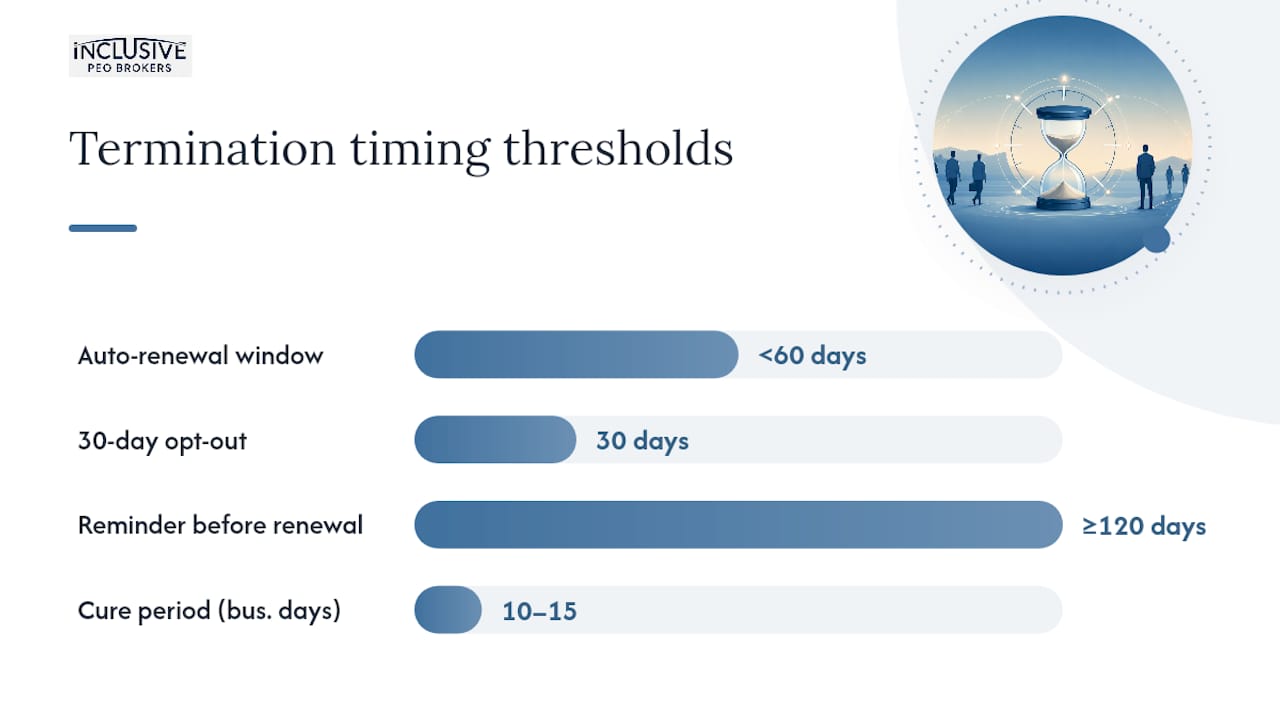
- Limit auto-renewal triggers. Ask for a longer opt-out window (90–120 days instead of 60) and require the PEO to send a written renewal reminder at least 30 days before the opt-out window opens.
- Require transition cooperation within a defined timeframe. Vague cooperation language is unenforceable. Ask for: “PEO shall provide transition cooperation, including data exports and carrier handoff coordination, for a period of not less than sixty (60) days following the effective termination date.”
- Require data export in portable formats. Specify CSV or Excel in the contract: “All employee and payroll data shall be delivered in CSV or Excel format within ten (10) business days of written request.”
Example clause rewrite you can propose:
“Either party may terminate this Agreement upon sixty (60) days’ prior written notice. Early termination fees, if any, shall not exceed [X]% of the remaining monthly management fees for the unexpired term, and in no event shall total termination-related fees exceed $[Y]. PEO shall deliver all employee records and payroll data in CSV format within ten (10) business days of the termination notice date.”
Pro Tip: If the PEO pushes back on fee caps, ask for a mutual termination-for-convenience right with no fee after the first contract year. Many PEOs will accept this because it signals a long-term relationship rather than a short-term exit. If the PEO refuses any cap at all, that is a signal worth flagging with counsel before you sign.
For California-based employers, employment contract and severance considerations add another layer of complexity to termination negotiations, particularly around at-will employment and wage-and-hour compliance.
When a PEO broker or consultant can reduce your exit risk
A broker’s value during a PEO exit is not just about finding a replacement provider. It is about turning an open-ended fee exposure into a predictable, capped cost and executing the operational handoff without gaps.
Core services a broker provides during an exit:
- Contract review and notice-deadline identification
- Exit cost modeling (fee formulas, tail fee estimates, and trade-off analysis)
- Fee negotiation directly with the PEO on your behalf
- Benefits carrier sourcing and handoff coordination
- New payroll provider selection and implementation support
- Employee communication templates and HR policy updates
When to hire a broker:
- At 90–120 days before your planned exit date, before you deliver notice
- Immediately upon discovering an auto-renewal window is approaching
- At contract signing, to negotiate termination language before it is locked in
- Any time the PEO’s proposed exit fees exceed what you modeled
Inclusive PEO Brokers has completed 133 successful PEO implementations and saves clients an average of 80 hours in the selection and transition process, with an average cost saving of $634. That track record reflects a repeatable process for managing the complexity of exits and new implementations — not just matchmaking.
The exit strategy and transition support services at Inclusive PEO Brokers cover the full scope of a PEO exit, from contract review through final payroll reconciliation. For small and mid-sized businesses without a dedicated HR team, that kind of end-to-end support is often the difference between a clean exit and a months-long dispute over fees and data access.
Red flags in termination language that commonly trap employers
Some termination clauses are written to protect the PEO, not you. Knowing what to look for before you sign, or before you deliver notice, can save you significant money and operational disruption.
- Narrow auto-renewal windows (fewer than 60 days): A 30-day opt-out window before the contract anniversary is nearly impossible to hit reliably. Set a calendar reminder at least 120 days before renewal and send written cancellation well before the window opens.
- Unlimited administrative fee language: Any clause that lets the PEO charge “reasonable costs” or “costs at the PEO’s discretion” without a cap is a blank check. Push for a fixed dollar ceiling before signing.
- Unilateral PEO termination with immediate effect: Some contracts allow the PEO to terminate immediately for a broad list of “material breach” triggers, including late payment by even a few days. This can leave you without payroll processing overnight. Ask for a cure period of at least 10–15 business days.
- Vague data-access language: Phrases like “records will be made available upon request” without a delivery timeline or format specification give the PEO no real obligation. Require specific timeframes and file formats in the contract.
- High per-employee post-termination fees: A per-employee fee above $300 for a company with 30+ employees creates a five-figure exit cost with no corresponding service. Negotiate a cap or a flat fee alternative.
Annotated “bad example” clause:
“Client may terminate this Agreement upon thirty (30) days’ notice. Upon termination, Client shall pay all administrative, reconciliation, and transition costs as determined by PEO in its sole discretion, including but not limited to costs for tax filings, data exports, and carrier notifications.”
What makes this dangerous: the 30-day notice window is short; “sole discretion” removes any cap on fees; “including but not limited to” opens the door to charges not listed. If you find language like this in your CSA, do not deliver notice until you have negotiated a fee cap or consulted counsel.
Immediate mitigation steps: Request a written fee estimate from the PEO before delivering notice. If the estimate is unreasonable, engage a broker or attorney to negotiate a cap before you trigger the termination clause. For post-termination payroll disputes, the payroll dispute resolution guidance from Glendale Payroll Inc. outlines practical steps for resolving outstanding obligations.
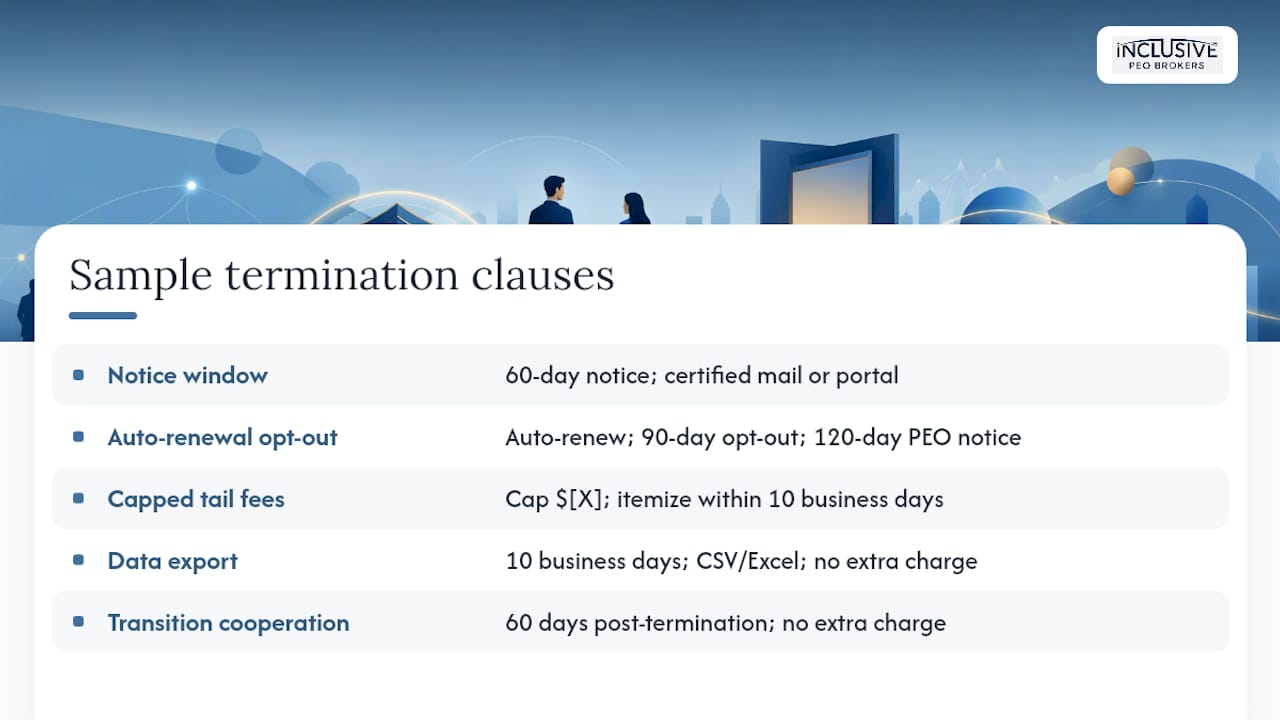
Sample termination clauses you can propose to your PEO or counsel
These snippets are starting points for negotiation, not final legal language. Have your attorney review any clause before you submit it.
1. Notice window with defined delivery method
“Either party may terminate this Agreement upon not less than sixty (60) days’ prior written notice, delivered by certified mail, return receipt requested, or via the PEO’s designated client portal with electronic confirmation of receipt.”
What it achieves: Locks in a 60-day window and specifies delivery so there is no dispute about when notice was received.
2. Auto-renewal opt-out with PEO reminder obligation
“This Agreement shall automatically renew for successive one-year terms unless either party delivers written notice of non-renewal at least ninety (90) days prior to the end of the then-current term. PEO shall provide written notice to Client of the upcoming renewal no later than one hundred twenty (120) days before the renewal date.”
What it achieves: Extends the opt-out window and puts the reminder obligation on the PEO.
3. Capped tail fees
“All administrative, reconciliation, and post-termination service fees shall not exceed $[X] in the aggregate, regardless of the scope of services required. PEO shall provide a written itemization of all such fees within ten (10) business days of the effective termination date.”
What it achieves: Creates a hard ceiling and requires transparency.
4. Mandatory data export in portable format
“Within ten (10) business days of the effective termination date, PEO shall deliver to Client all employee records, payroll history, tax filings, and benefit enrollment data in CSV or Microsoft Excel format, at no additional charge beyond the fees specified in this Agreement.”
What it achieves: Sets a deadline, specifies format, and removes ambiguity about cost.
5. Defined transition cooperation obligation
“For a period of sixty (60) days following the effective termination date, PEO shall cooperate with Client’s reasonable requests for transition assistance, including carrier handoff coordination, data verification, and final payroll reconciliation, at no additional charge.”
What it achieves: Gives you a defined window of PEO support after exit.
Usage notes: Preserve your contract’s existing jurisdiction and governing-law clause when proposing these snippets. Review the survival and indemnification provisions separately — they govern which obligations outlast the contract and should be reviewed by counsel before you agree to any changes.
What you are required to tell your employees when you exit a PEO
Employers often focus on the operational mechanics of a PEO exit and underestimate the employee communication requirements. Several of those requirements carry legal deadlines.
Benefits change notices: Under the Employee Retirement Income Security Act (ERISA), employees must receive a Summary of Material Modification (SMM) within 60 days of a material change to their benefit plan, which includes a change in plan sponsor or carrier. If your group health plan is changing because you are leaving the PEO’s master plan, that notice is required, not optional.
COBRA qualifying event notices: When group health coverage ends due to the PEO termination, the plan administrator must send COBRA election notices to qualified beneficiaries within 14 days of the qualifying event. Confirm in writing with your PEO which party will generate and send those notices, and get a copy of the notice for your records.
Payroll system changes: Employees should receive at least two to three pay cycles of advance notice that their payroll will be processed by a new provider. This gives them time to update direct deposit information and understand any changes to pay stub formats or pay dates.
Retirement plan changes: If the 401(k) plan sponsor is changing, employees must receive a new Summary Plan Description or an SMM describing the change. If the plan is being terminated and assets are being rolled over, additional IRS-required notices apply.
General best practice: Send a written communication to all employees at least 30 days before the PEO termination date. Cover the effective date of the change, what is changing (payroll provider, benefits carrier, HR system), what employees need to do (update direct deposit, re-enroll in benefits if required), and who to contact with questions. Keep a copy of the communication and a distribution list as part of your termination documentation.
What most employers get wrong about PEO exits
The conventional wisdom on PEO exits focuses almost entirely on the notice period. Get the notice right, the thinking goes, and the rest will follow. That framing misses the real risk.
The notice period is the easiest part. What actually derails exits are the provisions that survive termination: open-ended tail fees, vague data-access language, and indemnification clauses that assign post-exit liability in ways the employer never read carefully. Most small business owners sign a CSA without negotiating a single line of the termination section, because the relationship feels new and the exit feels hypothetical. By the time the exit is real, the leverage is gone.
The single best preventative step is to negotiate the termination clause before you sign the original contract, or at the first renewal. That is the moment when the PEO wants your business and you have maximum leverage. A broker-assisted review at that stage, with specific attention to fee caps, auto-renewal windows, and data portability language, can eliminate the most common exit traps before they are ever triggered. For small and mid-sized employers without in-house legal counsel, that kind of guided review through Inclusive PEO Brokers is one of the highest-value investments in the entire PEO relationship.
How Inclusive PEO Brokers helps you exit cleanly and find the right fit
Navigating a PEO exit without guidance means absorbing every fee, delay, and data gap yourself. Inclusive PEO Brokers gives small and mid-sized businesses a structured, broker-led alternative: expert contract review, fee negotiation, and full transition coordination, all in a process that has saved clients an average of 80 hours and $634 compared to going it alone.

The services most relevant to an exit include CSA review and notice-deadline identification, exit cost modeling, direct negotiation with the PEO on fee caps and data delivery timelines, benefits carrier sourcing, and new payroll provider coordination. After 133 successful implementations, the process is repeatable and the outcomes are predictable.
Whether you are planning an exit now or evaluating a new PEO after leaving your current one, Inclusive PEO Brokers can match you with the right provider and manage the transition from start to finish. Book a free consultation to get a clear picture of your exit costs and your options before you deliver notice.
Sources
This article provides general information about PEO contract termination and is not a substitute for legal or professional advice. Confirm current contract terms, tax rules, and compliance requirements with a qualified attorney or HR professional before taking action.
Recommended
.svg)
Seeking a different solution? Meet Your Business Needs