.png)

PEO vs Payroll: Which One Actually Fits Your Business

If you have between 10 and 100 employees, no dedicated HR department, and any exposure to multi-state compliance or rising benefits costs, a PEO usually delivers more value than a payroll-only provider. If you run a single-state operation with someone already handling HR, and your main need is accurate, on-time paychecks, a payroll service is probably the smarter, cheaper choice.
That’s the short version. The real answer depends on two things you can check right now:
- Headcount and complexity: How many states do you have employees in, and do you offer (or want to offer) group health insurance?
- Internal HR capacity: Does anyone on your team currently manage compliance, benefits administration, and workers’ comp claims, or is that falling through the cracks?
If those questions raised more doubt than clarity, run a side-by-side cost comparison before you sign anything. Inclusive PEO Brokers builds that comparison for you at no cost, matching your specific headcount and benefits needs against real PEO quotes.
Key Takeaways
Choosing between a PEO and a payroll provider comes down to whether your business needs shared compliance liability and bundled benefits access, or simply wants accurate, low-cost payroll processing under your own EIN.
| Point | Details |
|---|---|
| Match model to complexity | Businesses with 10 to 100 employees and multi-state exposure typically get the most value from a PEO. |
| EIN and liability differ sharply | PEOs file taxes under their own EIN and share liability; payroll providers file under your EIN and leave liability with you. |
| Run the total cost math | Compare your current payroll, benefits, and HR spend against an all-in PEO quote before assuming payroll-only is cheaper. |
| Verify certification before signing | Ask for CPEO status and ESAC accreditation to confirm tax protections and financial stability. |
| Brokered selection reduces risk | Inclusive PEO Brokers has completed 133 implementations, saving clients an average of 80 hours and $634 in the selection process. |
Table of Contents
- What Is a PEO, and How Does Co-Employment Work?
- What Do Payroll Service Providers Actually Do?
- PEO vs Payroll Service: The Core Differences
- How Much Do PEOs and Payroll Services Actually Cost?
- What Are the Pros, Cons, and Risks of Each Model?
- What Questions Should You Ask Before Choosing?
- How Does a PEO Broker Actually Help?
- Why the “Just Pick the Cheaper Option” Advice Falls Short
- How Inclusive PEO Brokers Simplifies This Decision
- Where to Verify These Details Yourself
- Frequently Asked Questions
- Sources
What Is a PEO, and How Does Co-Employment Work?
A Professional Employer Organization (PEO) is a company that enters a co-employment arrangement with you, becoming the employer of record for tax and benefits purposes while you keep control over hiring, firing, and day-to-day management. Under this model, the PEO and your business share specific employer responsibilities defined by contract, rather than you outsourcing a single task like payroll processing.
Co-employment sounds abstract until you see what it changes operationally. The PEO typically runs payroll, administers benefits, manages workers’ compensation coverage, and files employment taxes, often under its own Employer Identification Number rather than yours. That EIN detail matters more than it seems: it’s the mechanism that lets a PEO aggregate your employees with thousands of others to negotiate group health rates and workers’ comp master policies you couldn’t access alone, according to research on PEO benefits access.
Signing with a PEO involves more setup than switching payroll software. Expect these steps:
- A master service agreement outlining shared responsibilities, indemnification, and termination terms.
- Enrollment in the PEO’s master benefits and workers’ comp policies, which may require plan changes for current employees.
- Employee “rehire” or transfer paperwork, since co-employment technically restructures the employment relationship.
- Handbook and policy updates to align with the PEO’s compliance framework, including ACA and ADA obligations the PEO helps administer.
Statistic Callout: NAPEO’s industry research identifies businesses with roughly 10 to 100 employees and multi-state operations as the segment where PEOs typically deliver the strongest measurable value, particularly around benefits access and compliance risk reduction.
The legal implication worth understanding upfront: when you use a Certified PEO (CPEO), the IRS treats certain federal employment tax responsibilities as shifted to the CPEO, which can protect you if the PEO mishandles a tax deposit. That protection doesn’t exist with non-certified PEOs, which is exactly why certification status is the first thing to verify.
What Do Payroll Service Providers Actually Do?
A payroll service provider (PSP) processes paychecks, withholds and remits taxes, and generates year-end tax forms, all under your own EIN, with your business retaining full employer liability. Unlike a PEO, a PSP is a vendor, not a co-employer. It executes payroll instructions; you remain the legal employer for every compliance and tax purpose.
That distinction shows up clearly in how taxes get filed. Payroll providers typically act as a “reporting agent,” meaning they submit filings on your behalf using your tax accounts, but liability for errors or missed deposits stays with you, according to the US Chamber of Commerce’s comparison of the two models. If a PSP makes a mistake, you’re still the one the IRS contacts.
Onboarding with a payroll provider is faster and lighter than a PEO implementation. Typical touchpoints include:
- Software setup and integration with your existing timekeeping or accounting systems.
- Employee data import, direct deposit authorization, and W-4 collection.
- Configuration for multi-state tax withholding if you operate across state lines, often sold as an add-on tier.
- Optional HR modules (onboarding checklists, basic compliance alerts) bolted onto the core payroll product.
Payroll-only makes the most sense when you already have someone managing HR functions in-house, your workforce sits in one state, and your budget favors a lower, predictable monthly fee over bundled services you may not fully use.
PEO vs Payroll Service: The Core Differences
The single biggest structural difference comes down to this: a PEO shares your employer liability and files under its own EIN, while a payroll provider processes your payroll but leaves every ounce of employer liability with you. Everything else, cost, benefits access, contract complexity, flows from that one distinction.
| Comparison Dimension | PEO | Payroll Service Provider |
|---|---|---|
| Services included | Payroll, benefits administration, workers’ comp, HR compliance, risk management | Payroll processing, tax filing, optional basic HR add-ons |
| Who files taxes / EIN used | PEO’s EIN, shared employer responsibility | Client’s own EIN, client retains liability |
| Liability and compliance | Shared between PEO and client, stronger with CPEO status | Employer liability stays entirely with the client |
| Benefits and insurance | Master policy access to group health and workers’ comp at scale | Client sources and manages its own benefits and coverage separately |
| Pricing model | Percent of payroll or flat per-employee fee, often bundling benefits | Base monthly fee plus per-employee charges |
| Contract terms | Longer-term agreements, defined exit and transfer clauses | Typically month-to-month or short-term, easier to exit |
| Best fit | 10 to 100 employees, multi-state, limited in-house HR | Single-state, existing HR capacity, budget-conscious |
A few of these rows translate directly into decision signals. Multi-state payroll complexity almost always favors a PEO, since the compliance burden of tracking varying state tax and leave laws across jurisdictions is exactly what a PEO’s compliance team is built to absorb. Conversely, if your benefits needs are minimal and you’re not chasing group health rates, the bundled PEO fee often buys you services you won’t use.
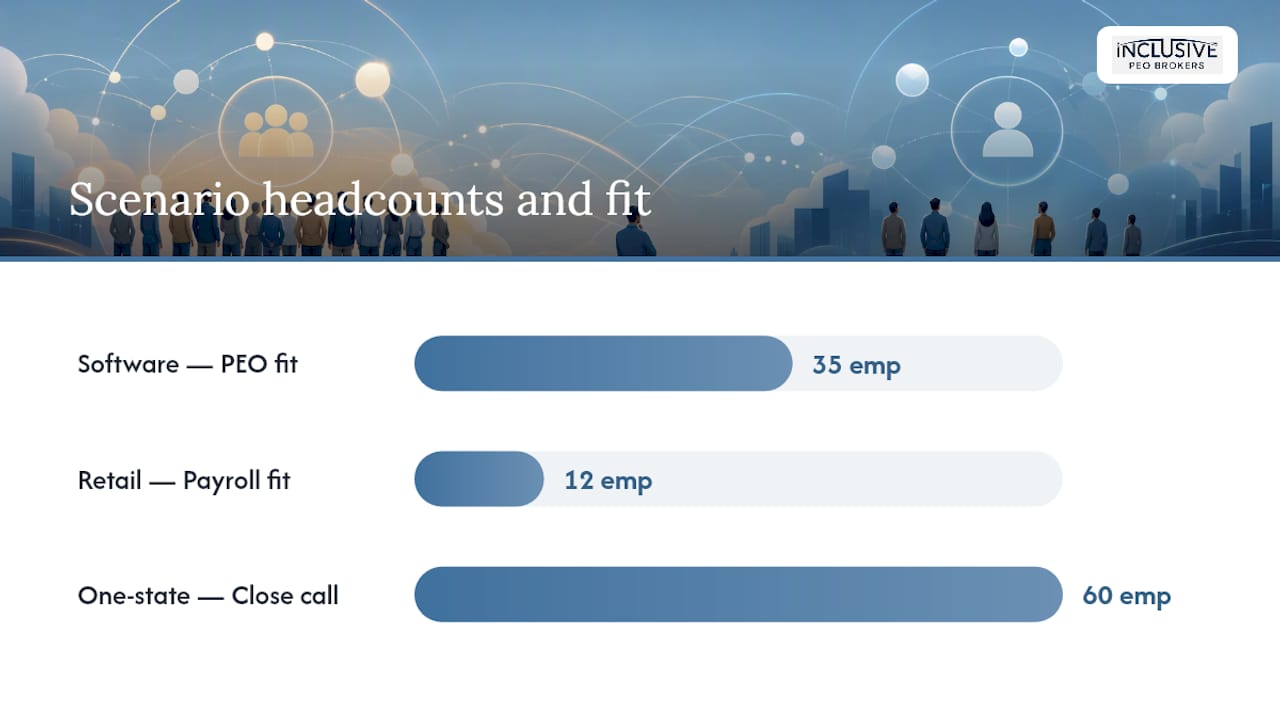
Three scenarios make this concrete. A 35-employee software company hiring across four states and offering competitive health insurance is a strong PEO candidate. A 12-person single-location retail business with an office manager already running payroll and simple benefits is better served by a payroll provider. A 60-employee firm in one state with no benefits plan and a lean administrative team sits in the close-call zone. It’s worth running numbers on both before deciding, since the BusinessNewsDaily comparison notes payroll-only tends to win on upfront cost even when a PEO might reduce risk long term.
How Much Do PEOs and Payroll Services Actually Cost?
Expect a PEO to charge either a percentage of total payroll (commonly cited in the 2% to 12% range depending on services bundled) or a flat monthly fee per employee that often runs higher than payroll-only pricing because it includes benefits administration and workers’ comp. Payroll providers typically charge a lower base monthly fee plus a smaller per-employee add-on, according to market pricing examples from WiseMonk.

| Model | Typical Pricing Structure | What’s Usually Included |
|---|---|---|
| PEO | Percent of payroll or higher flat per-employee fee | Payroll, benefits, workers’ comp, HR compliance support |
| Payroll-only | Base monthly fee plus lower per-employee fee | Payroll processing, tax filing, basic reporting |
These ranges assume a fairly standard wage mix and don’t account for add-ons like premium benefits tiers or high-risk workers’ comp classifications, which push PEO pricing higher. A construction company with elevated injury risk will pay more for workers’ comp coverage inside a PEO bundle than an office-based professional services firm of the same headcount.
Running a real comparison means looking past the sticker price. Add up what you currently spend on payroll software, a benefits broker, workers’ comp premiums, and any HR consulting, then compare that total against a PEO’s all-in quote. A 25-person company paying $8,000 a month combined for payroll, benefits administration, and a part-time HR contractor might find a PEO quote at $9,500 a month actually cheaper once you factor in the group health rate improvement and reduced compliance risk.
Watch for these red flags in vendor quotes:
- Ambiguous treatment of State Unemployment Tax Act (SUTA) rates, especially whether your experience modifier transfers cleanly.
- Benefits pricing quoted separately from the “base” PEO fee, making the bundle look cheaper than it is.
- Long or hidden setup fees buried in an implementation schedule.
- Vague language about what happens to your unemployment tax rate history if you switch providers later.
For a deeper breakdown of how PEO fee structures actually work, our guide to PEO administrative fees walks through common billing models line by line.
What Are the Pros, Cons, and Risks of Each Model?
The tradeoff at the center of this decision is control versus shared liability on one side, and bundled convenience versus modular simplicity on the other. Neither model is free of risk; the risks just show up in different places.
PEO advantages and drawbacks:
- Access to group health insurance rates and workers’ comp master policies you couldn’t negotiate alone.
- Compliance support for multi-state employment law, ACA reporting, and handbook maintenance.
- Less flexibility: switching PEOs later can mean restarting your unemployment insurance wage base, which raises your effective tax rate for a period.
- Co-employment means giving up some autonomy over benefits plan design and certain HR policies.
Payroll provider advantages and drawbacks:
- Lower upfront cost and simpler, shorter contract terms that are easy to exit.
- Full control over your own benefits, HR policies, and vendor relationships.
- You retain full employer tax liability, so a filing mistake lands on you, not the vendor.
- No built-in compliance support for multi-state complexity or bundled workers’ comp savings.
Beyond the pros and cons list, a few operational risks deserve specific mitigation tactics. Exiting a PEO contract mid-year can trigger a wage-base restart with your state unemployment agency, meaning you pay SUTA tax again from zero on wages already taxed that year. Benefits disruption during a PEO transition is another common issue: employees can lose continuity of care if the new plan year doesn’t align with your old one. And audit exposure rises with either model if you’re not verifying tax deposits are actually being made, not just promised.
Pro Tip: Before signing with any PEO, ask for a written exit clause that specifies how your experience modifier and unemployment wage base will be handled if you terminate the contract. This single question prevents the most expensive surprise in PEO transitions.
What Questions Should You Ask Before Choosing?
Three signals should push you toward a PEO conversation rather than a payroll-only quote: you operate in more than one state, you’re spending real money on benefits without leverage to improve rates, and nobody internally owns compliance today. If none of those apply, a payroll-only provider likely gets you what you need for less.
Work through this checklist before requesting proposals:
- Count your states. Multi-state operations increase the compliance value a PEO provides.
- Audit your benefits spend. If you’re already paying for group health, compare your current rates against what a PEO’s aggregated pool could offer.
- Assess in-house HR capacity. If no one owns compliance, handbook updates, or benefits administration, that gap is exactly what a PEO fills.
- Estimate your risk exposure. High workers’ comp classifications (construction, manufacturing, logistics) tend to benefit more from PEO master policies.
- Map your payroll complexity. Multiple pay schedules, contractor mixes, or tipped employees add complexity that either model needs to handle well.
- Consider culture impact. Co-employment changes who employees call with a benefits question, which can feel jarring if not communicated clearly.
When you get on a call with a prospective vendor, ask these directly:
- Whose EIN will payroll taxes be filed under, and are you a Certified PEO?
- How is State Unemployment Insurance (SUI) handled if we switch providers later?
- Is workers’ compensation coverage a master policy, and what happens to our experience modifier at exit?
- What data access and export rights do we retain if we terminate the contract?
- Does your platform integrate with our existing accounting or timekeeping software via API?
- What are the exact termination mechanics and notice period in the contract?
Red flags include vague answers about tax filing responsibility, reluctance to share a sample contract, and pressure to sign before you’ve compared at least two competing quotes. Trust signals to look for instead: CPEO certification from the IRS, ESAC accreditation verifying financial stability, and a willingness to walk you through contract language line by line.
Pro Tip: Ask every PEO finalist for their ESAC accreditation status in writing. It’s a five-minute question that filters out a meaningful share of higher-risk providers before you ever sign anything.
How Does a PEO Broker Actually Help?
A broker saves you the 40 to 80 hours it typically takes to research providers, request quotes, and compare contract terms, while reducing the risk of picking a PEO that doesn’t fit your actual headcount, industry, or benefits needs. That time savings compounds because most owners are comparing PEO quotes for the first time, without a baseline for what’s normal pricing versus a red flag.
A typical brokerage engagement moves through a few clear stages: an initial discovery call to map your headcount, states, and benefits goals; cost modeling that stacks your current spend against multiple PEO quotes side by side; negotiation support to push back on pricing or contract terms that don’t serve you; and implementation guidance once you’ve selected a provider, so onboarding doesn’t stall.
Businesses evaluating PEOs benefit from working with a broker specifically because custom cost modeling and side-by-side comparisons reveal how a PEO’s master plans and compliance support actually align with industry-specific needs, according to the US Chamber of Commerce.
Inclusive PEO Brokers has completed many successful PEO implementations for small and mid-sized businesses, with clients saving a significant amount of time in the selection process and notable cost savings. Those numbers reflect what happens when someone with market visibility handles vendor comparison instead of a business owner doing it cold. For a full breakdown of what a brokerage engagement actually includes, see our guide on what a PEO broker does.
Pro Tip: Engage a broker specifically when you’re facing multi-state payroll complexity, high workers’ comp exposure, or when competitive benefits have become a hiring lever you can’t afford to get wrong. Those are the scenarios where an outside comparison saves the most money.
Why the “Just Pick the Cheaper Option” Advice Falls Short
Most comparisons of PEO versus payroll services treat this as a pricing decision, and that’s where they go wrong. The cheaper quote on paper often loses money over 18 months once you count the cost of a compliance mistake, a benefits plan that can’t compete for hiring, or an HR person spending 15 hours a week on tasks a PEO would absorb for less than their hourly wage.
What gets underestimated is how much the decision hinges on your growth trajectory, not just your current headcount. A 15-person company planning to double within two years and expand into a second state should weigh a PEO’s scalability even if payroll-only looks cheaper today, because switching models mid-growth is more disruptive than choosing correctly upfront. Conversely, a stable 40-person business with no expansion plans and a competent office manager might be paying for PEO services it will never fully use.
The other overlooked factor is employee experience. Co-employment can feel impersonal if a business doesn’t communicate the change well. Employees suddenly calling an unfamiliar benefits line instead of their office manager need context, or the transition reads as a loss of personal service rather than an upgrade in coverage. That’s a culture cost that rarely appears in a pricing spreadsheet, but it shapes retention just as much as the numbers do.
If there’s one piece of contrarian advice worth taking from this, it’s that the “right” answer changes as your business changes. The payroll provider that served you well at 12 employees may become the wrong fit at 45. Revisiting this decision annually, rather than treating it as a one-time choice, is the habit that actually protects you from both overpaying and being underprepared.
How Inclusive PEO Brokers Simplifies This Decision
You don’t have to run this comparison alone or guess at which PEO quote is actually competitive. Inclusive PEO Brokers matches your specific headcount, state footprint, and benefits goals against real PEO offers, then builds a side-by-side cost model so you can see exactly where a PEO saves money and where payroll-only still wins.

The process is straightforward: a discovery call to understand your business, custom cost modeling against multiple PEO providers, a shortlist of options that actually fit your industry and size, negotiation support to secure better terms, and hands-on guidance through implementation once you choose. Clients working with Inclusive PEO Brokers have saved an average of 80 hours in the selection process and $634 in average cost savings, across 133 completed implementations. You can see how that played out for one client in this tech startup success story.
If you’re ready to see what a PEO would actually cost for your specific business, book a free cost-modeling assessment and get a side-by-side comparison built around your real numbers, not industry averages.
Where to Verify These Details Yourself
- The IRS page on CPEO customers explains exactly how tax-filing responsibility shifts when a Certified PEO is involved, which matters if you’re weighing liability protection.
- The IRS certified PEO overview lays out the certification criteria you should ask any PEO finalist to confirm in writing.
- NAPEO’s industry white paper offers benchmark data on typical PEO pricing and the client profiles where PEOs deliver the strongest measurable outcomes.
- The ESAC accreditation page explains what financial and operational standards a PEO must meet to earn accreditation, useful during vendor screening.
- The US Chamber of Commerce’s PEO comparison breaks down cost and service differences in plain business terms, good for a second opinion before you decide.
Frequently Asked Questions
Is a PEO more expensive than a payroll service? Usually yes on a headline basis, since PEO fees often bundle benefits administration and workers’ comp into either a percentage of payroll or a higher per-employee charge. Once you add up what you’re separately paying for benefits, workers’ comp, and HR support, the total cost gap often narrows or disappears.
Can I switch from a PEO back to running payroll in-house? Yes, but expect friction. Your unemployment insurance wage base may restart with your state agency, temporarily raising your effective SUTA rate, and you’ll need to rebuild benefits administration internally or through a new vendor.
Does a PEO change who my employees legally work for? Co-employment means the PEO becomes a joint employer for tax and benefits purposes, but you retain control over hiring, firing, and daily management decisions. Your employees still work for your business in every practical sense.
What size business benefits most from a PEO? Industry data points to companies with roughly 10 to 100 employees, especially those with multi-state operations or a need for competitive group health benefits, as the segment where PEOs typically deliver the clearest return.
Should I talk to a broker before contacting PEOs directly? If you’ve never compared PEO quotes before, a broker can save significant time and help you avoid contract terms that look standard but aren’t. It’s particularly worth it if your business has multi-state complexity or elevated workers’ comp exposure.
Sources
- PEO vs. Payroll Services: Comparing Costs and Services | CO- by US Chamber of Commerce
- Certified professional employer organization — IRS
- About ESAC — ESAC
Recommended
.svg)
Seeking a different solution? Meet Your Business Needs