.png)

PEO Cancellation Fees: What You'll Pay to Exit

Yes, most PEOs charge cancellation-related fees when you end the relationship, and the total cost on your final invoice can run well beyond a single termination line item. PEO cancellation fees typically include some combination of an early termination charge, per-employee offboarding fees, final payroll and tax reconciliation costs, workers’ compensation audit adjustments, COBRA administration fees, and data-export charges. For a small or mid-size business, the realistic exposure ranges from a few hundred dollars for a clean, end-of-term exit to several thousand dollars for a mid-contract departure with a large workforce. The key cost drivers are your notice window (most contracts require written notice prior to termination), whether you exit at renewal or mid-term, your headcount, and whether your PEO holds Certified Professional Employer Organization (CPEO) status with the IRS.
Here is what you should expect on a final invoice:
- Early termination fee: Triggered when you exit before the contract term ends, often calculated as a flat fee or a multiple of your monthly admin cost.
- Per-employee processing fees: A per-head charge for offboarding each employee from the PEO’s systems, commonly $50–$200 per employee.
- Final payroll and tax reconciliation: Charges to close out payroll accounts, reconcile tax filings, and issue final reports.
- Workers’ comp audit adjustment: A true-up charge based on actual payroll vs. estimated premiums, often billed 60–90 days after exit.
- COBRA/continuation administration fees: Costs to notify and administer continuation coverage for departing employees.
- Data-export and close-out fees: Charges to export HR records, payroll history, and tax documents from the PEO’s platform.
- Tail or administrative close-out fees: Ongoing admin charges that cover final tax filings and account reconciliation after the effective termination date.
NAPEO’s industry guidance consistently notes that termination clauses are the most overlooked part of a PEO contract. Most business owners focus on the monthly admin rate and never read the exit provisions until they need them. Understanding PEO service termination costs before you sign, or before you send that notice letter, is the difference between a planned transition and a costly surprise.
Key Takeaways
Most PEO exits cost more than the termination fee alone, and the businesses that plan 120 days ahead consistently pay less and transition more cleanly than those that don’t.
| Point | Details |
|---|---|
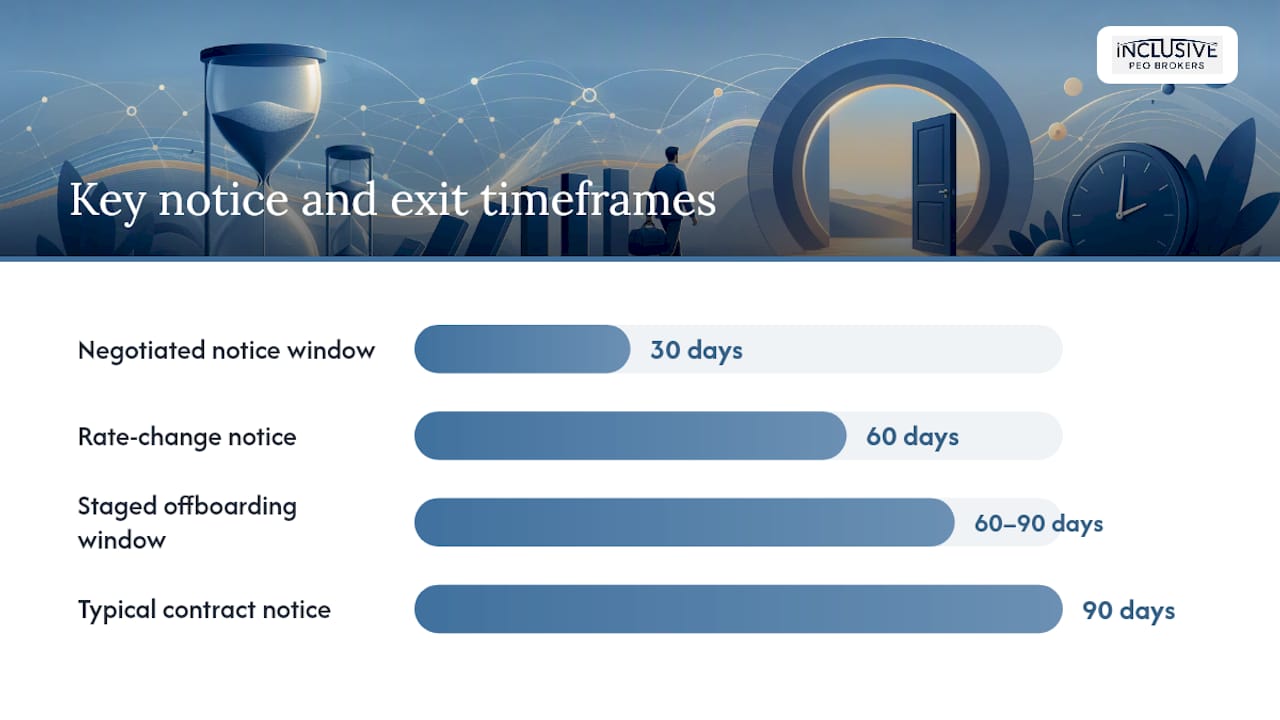
| Check your notice window now | Most PEO contracts require 30–90 days’ written notice; missing the window can lock you into another full term. |
| Budget beyond the termination fee | Exit costs include per-employee fees ($50–$200), workers’ comp deposits, payroll setup, and COBRA admin, often exceeding the termination charge itself. |
| Secure data before access ends | Export all payroll, tax, and employee records before the effective termination date; disputing charges without records is far harder. |
| Negotiate caps and for-cause exits | Request a capped termination fee (one month’s admin fee), opt-in renewal, and SLA-tied for-cause exit language before signing or renewing. |
| Inclusive PEO Brokers | Provides contract review, fee auditing, and negotiation support to reduce surprise costs and manage a clean PEO transition. |
Table of Contents
- How are PEO cancellation fees structured in the first place?
- What cancellation charges will appear on your final PEO invoice?
- When and how should you exit a PEO contract?
- How does leaving a PEO affect your payroll taxes and compliance?
- How are termination fees calculated, and how do you dispute them?
- How can you negotiate to reduce or cap your PEO exit fees?
- Your complete PEO exit checklist and budget plan
- Sample termination notice language and delivery steps
- How a PEO broker can reduce your exit costs and surprises
- What most business owners get wrong about PEO exits
- Inclusive PEO Brokers can review your fees and plan your exit
- Sources
How are PEO cancellation fees structured in the first place?
Before you can evaluate what you owe, you need to understand how your PEO’s base pricing works. Most PEOs use one of two models, and the model you’re on determines how exit charges are calculated.
Per Employee Per Month (PEPM) charges a flat dollar amount for each employee on the platform each month. This model is predictable and scales linearly with headcount. PEPM rates typically fall in a moderate range per employee per month for full-service PEOs, though entry-level arrangements can be lower. The advantage is that your admin cost doesn’t spike when you give employees raises.
Percentage of payroll charges a percentage of your total gross payroll each period. Analysis for SMBs shows these rates vary widely as a percentage of total payroll, which means the model compounds as your team grows or earns more. A company with $2 million in annual payroll at a 5% rate pays substantial fees per year in PEO fees alone. That math matters at exit, because some PEOs calculate early termination charges as a percentage of remaining-term fees.
Understanding your PEO administrative fees and which model you’re on is the first step in estimating your total exit cost.
What the base admin fee usually includes vs. excludes
| Category | Typically Included | Typically Excluded |
|---|---|---|
| Payroll processing | Payroll runs, direct deposit, pay stubs | Off-cycle payroll runs, manual check fees |
| HR support | Basic HR advisory, employee handbook templates | HR project work, custom policy drafting |
| Benefits administration | Benefits enrollment platform access | Benefits premiums, stop-loss insurance |
| Compliance | Standard federal/state filing support | Multi-state compliance for new states mid-term |
| Offboarding | Basic employee termination processing | Data exports, COBRA admin, final reconciliation |
| Workers’ comp | Policy access through PEO’s master policy | Audit adjustment true-ups at exit |
The items in the “excluded” column are exactly where exit costs accumulate. Your monthly invoice may look clean, but the final invoice pulls in all the deferred and contingent charges that weren’t part of your recurring rate.
What cancellation charges will appear on your final PEO invoice?
LegalClarity warns that tail fees and administrative close-out charges vary widely and often lack caps, making them the hardest line items to dispute after your access to the PEO’s systems ends. Here is a practical catalog of what to expect, how each fee is triggered, and the typical range.
| Fee Name | What Triggers It | Typical Range / Basis |
|---|---|---|
| Early termination fee | Exiting before contract end date | 1–3 months of admin fees, or flat fee per contract |
| Per-employee offboarding fee | Each employee removed from PEO platform | commonly charged on a per-employee basis |
| Final payroll reconciliation | Closing payroll accounts and issuing final reports | costs vary depending on complexity |
| Tail / administrative close-out fee | Final tax filings, W-2 processing, account closure | fees vary widely and may be charged per employee |
| COBRA administration fee | Notifying and administering continuation coverage | fees generally apply per qualifying event plus possible setup charges |
| Workers’ comp audit adjustment | True-up of actual vs. estimated payroll for premium | Varies; can be a credit or a charge |
| Data-export fee | Exporting HR records, payroll history, tax documents | fees vary and can be charged as flat or per-employee |
| Benefit plan transfer/reconciliation | Closing group plan and reconciling final premiums | costs depend on carrier and plan specifics |
| Invoice holdback / escrow | PEO retains a portion of final payment pending audit | Typically 5–15% of estimated annual workers’ comp premium |
High-risk items that commonly surprise SMBs:
- Workers’ comp audit adjustments can arrive 60–90 days after your exit date, long after you’ve assumed the transition is complete. Budget a contingency line for this.
- W-2 and year-end processing fees hit hardest when you exit mid-year, because the PEO must issue W-2s for the portion of the year employees were on its platform.
- Invoice holdbacks are sometimes buried in the workers’ comp section of your agreement. The PEO holds a percentage of your estimated annual premium until the audit closes, which can tie up cash for months.
The total cost of exiting a PEO goes well beyond the termination fee line. Exit cost checklists show that new workers’ comp deposits, benefit plan setup, payroll software implementation, COBRA administration, and possible attorney or broker fees can collectively exceed the termination charge itself.
Pro Tip: Request a written estimate of all close-out fees from your PEO account manager before you send a termination notice. Getting the number in writing gives you a baseline to dispute against if the final invoice differs.
When and how should you exit a PEO contract?
Timing your exit is as important as understanding the fees. Most PEO master service agreements require a notice period prior to termination, and many include auto-renewal provisions that lock you into another full term if you miss the window. Sample master service agreements confirm that 60–90 day notice requirements before renewal are common, and that missing the deadline can mean committing to another 12 months of fees.
The cleanest exit is always at the end of a contract term, ideally at calendar year-end. Exiting mid-term triggers early termination multipliers and complicates W-2 and tax filing responsibilities. Exiting at year-end lets the PEO issue a complete W-2 for the full year and simplifies the payroll tax handoff.
Your exit timeline: 120 days to close
- 120 days out: Pull your master service agreement and read the termination clause in full. Note the exact notice window, the required delivery method (certified mail, email, or both), and any auto-renewal date. Set a calendar reminder for the notice deadline.
- 90 days out: Audit your current service levels against the contract’s SLA commitments. Document any failures in writing. These records support a for-cause exit argument if the PEO has underperformed. Request a preliminary estimate of all close-out and exit fees.
- 60 days out: Begin benefits vendor conversations. Notify your benefits broker of the planned exit date so new carrier applications can be submitted in time for a seamless enrollment. Start evaluating standalone payroll software or a new PEO. Review the U.S. Chamber’s guidance on benefit enrollment dates and tax deadlines to avoid coverage gaps.
- 30 days out: Send your formal termination notice (see the sample template later in this guide). Confirm the effective termination date in writing with your account manager. Request a schedule for data exports, including payroll history, tax filings, employee records, and benefits enrollment data. Confirm your workers’ comp audit timeline.
- Day 0 (effective termination date): Confirm all data exports are complete before access is cut. Verify final payroll has been processed and employees have received their last pay under the PEO. Confirm COBRA notices have been issued. Retain all confirmation emails and delivery receipts.
Pro Tip: Set your internal reminder 120 days before the contract renewal date, not 90. The extra 30 days gives you time to evaluate alternatives and negotiate without the pressure of an imminent deadline.
How does leaving a PEO affect your payroll taxes and compliance?
The tax implications of a PEO exit are the area where most small business owners are least prepared, and where the financial consequences can be the most significant.
CPEO vs. non-CPEO: why the distinction matters
A Certified Professional Employer Organization (CPEO) holds a specific IRS certification that affects how payroll taxes are treated when you leave. With a CPEO, the successor-employer rules allow your new employer (whether that’s you operating independently or a new PEO) to pick up where the CPEO left off on wage bases for Social Security and FUTA. That means employees don’t restart their wage-base clock mid-year, and you avoid paying duplicate payroll taxes on wages already taxed under the CPEO.
With a non-certified PEO, the successor-employer treatment is not guaranteed. If you exit a non-CPEO mid-year, your new payroll arrangement may need to restart the Social Security wage base ($176,100 for 2025) for each employee from zero. For a team of 20 employees each earning above the wage base, that can mean tens of thousands of dollars in duplicate employer-side Social Security taxes. This is an illustrative example of the risk, not tax advice. Consult a qualified tax professional to assess your specific situation.
Timing your exit to January 1 eliminates the wage-base restart risk entirely because all employees begin the new year at zero regardless of which employer is processing payroll.
State unemployment and workers’ comp account transitions
When you leave a PEO, your state unemployment insurance (SUI) account history may not transfer automatically. Some states treat the PEO’s account as the employer of record, which means your business may need to establish a new SUI account and start building an experience rating from scratch. A fresh account often carries a higher initial rate than your PEO’s pooled rate.
Workers’ comp transitions require a new policy or a new carrier relationship. Expect to pay a deposit (often 25–30% of estimated annual premium) upfront when you establish a standalone policy. The PEO’s audit of your final payroll period will determine whether you receive a refund or owe an additional premium.
Pro Tip: For payroll tax planning during a PEO exit, work with a payroll specialist who understands successor-employer rules. The timing of your last PEO payroll run and your first independent run can affect which wages count toward which employer’s tax accounts.
How are termination fees calculated, and how do you dispute them?
PEOs use several different methods to calculate termination charges, and the method in your contract determines whether a charge is legitimate or inflated.
Common calculation methods:
- Flat fee: A fixed dollar amount stated in the contract, regardless of headcount or remaining term.
- Months of admin fees: A multiple (often 1–3 months) of your average monthly admin cost. This is the most common structure.
- Percentage of remaining term: The PEO calculates the fees you would have paid through the end of the contract and charges a percentage of that total.
- Per-employee penalty: A per-head charge for each employee on the platform at termination, sometimes in addition to a flat fee.
- Itemized close-out charges: A line-by-line invoice for actual hours, filings, and services performed during offboarding.
How to dispute vague or excessive charges
- Request a fully itemized invoice. Ask for a line-by-line breakdown of every charge, including the contract clause that authorizes each one. A legitimate PEO will provide this without resistance.
- Map each line item to your contract. Open your master service agreement and find the specific section that authorizes each charge. If a fee has no contractual basis, note it in writing.
- Request supporting documentation. For close-out fees billed by the hour, ask for timesheets. For workers’ comp adjustments, ask for the audit report. For data-export fees, ask for a log of what was exported and when.
- Escalate in writing. Send a formal dispute letter to your account manager and copy the PEO’s legal or compliance contact. State each disputed charge, the contract clause it references (or fails to reference), and the documentation you’ve requested.
- Preserve evidence of service failures. If you’re pursuing a for-cause exit based on SLA violations, gather all written records of complaints, unresolved tickets, and missed commitments before your access ends.
Documents to request before your exit date:
- Complete payroll history for all employees, by pay period
- All federal and state tax filings submitted on your behalf
- Workers’ comp audit report and premium reconciliation
- Benefits enrollment and termination records
- COBRA election notices and confirmation of delivery
- Final reconciliation statement showing all credits and debits
Pro Tip: Secure all data exports before the effective termination date. LegalClarity’s guidance is direct on this point: once your access to the PEO’s systems is removed, disputing vague charges becomes significantly harder because you no longer have the records to support your position.
How can you negotiate to reduce or cap your PEO exit fees?
The best time to negotiate cancellation terms is before you sign the original contract. The second-best time is now, before you send a termination notice.
Clauses to request when signing or renewing:
- Capped termination fee: Ask for a written cap, such as one month’s admin fee, regardless of remaining term. Many PEOs will accept this for clients with strong payment history.
- 30-day notice window: Push back on 90-day requirements. A 30-day window gives you flexibility without sacrificing the PEO’s ability to plan offboarding.
- Opt-in renewal: Replace auto-renewal language with a provision requiring both parties to affirmatively agree to renew. This eliminates the missed-window trap.
- Advance notice of rate changes: Require the PEO to notify you of any fee increases at least 60 days before they take effect, giving you time to evaluate alternatives.
- For-cause exit language: Negotiate the right to exit without penalty if the PEO fails to meet defined service-level commitments. Tie this to measurable SLA metrics, such as payroll error rates or response time standards.
NAPEO’s contract guidance and PEO Marketplace’s negotiation checklist both emphasize that opt-in renewal, shorter notice windows, and advance rate-change disclosure are practical controls that significantly reduce exit risk. These aren’t unusual asks. They’re standard negotiation points that experienced brokers secure routinely.
Mid-contract tactics if you’re already committed:
- Negotiate a buyout amount. Approach your account manager and ask what it would cost to exit cleanly today. A negotiated buyout is often lower than the full contractual penalty, especially if you offer to pay promptly.
- Trade notice length for a lower buyout. Offering to give 90 days’ notice in exchange for a reduced termination fee is a trade many PEOs will accept, because it gives them time to plan.
- Document service deficiencies. If the PEO has missed SLA commitments, compile the evidence and present it formally. This creates leverage for a for-cause exit or a reduced settlement.
- Request a staged exit. For large workforces, ask whether employees can be offboarded in batches over 60–90 days to reduce the immediate cash impact of per-employee fees.
Pro Tip: If your contract includes a for-cause exit provision, document every service failure in writing at the time it occurs, not retroactively. A contemporaneous paper trail is far more persuasive than a summary written after the fact.
Your complete PEO exit checklist and budget plan
A clean PEO exit is a project management exercise. Payroll, benefits, workers’ comp, and vendor migrations all run concurrently, and each has its own deadline. Here is a ready-to-use checklist organized by timeline.
120/90/60/30/0-day task list
- 120 days: Read termination clause; note notice window, delivery method, and auto-renewal date. Set calendar reminders.
- 120 days: Assign internal owners: HR lead for benefits and COBRA, CFO or controller for financial reconciliation, payroll lead for cutover planning.
- 90 days: Request preliminary close-out fee estimate in writing. Document any SLA failures.
- 90 days: Begin evaluating standalone payroll software (or a new PEO). Review the year-end payroll checklist to align your cutover with tax deadlines.
- 60 days: Submit new benefits carrier applications. Notify employees of upcoming changes.
- 60 days: Send formal termination notice (certified mail and tracked email). Confirm effective date in writing.
- 60 days: Request data export schedule from PEO: payroll history, tax filings, employee records, benefits data.
- 30 days: Confirm workers’ comp audit timeline and deposit requirements for new standalone policy.
- 30 days: Verify COBRA notices are scheduled. Confirm new payroll system is tested and ready.
- Day 0: Download and verify all data exports. Confirm final payroll processed. Retain all delivery receipts and confirmation emails.
Budget line-items to estimate before you exit
- Early termination fee (per contract terms)
- Per-employee offboarding fees ($50–$200 per employee)
- Final payroll and tax reconciliation ($200–$1,000+)
- Workers’ comp audit adjustment (contingency; can be a credit or a charge)
- Workers’ comp deposit for new standalone policy (25–30% of estimated annual premium)
- New benefits premiums and carrier setup fees (first month’s premiums often due upfront)
- Payroll software setup and implementation ($500–$2,500 depending on platform)
- COBRA administration setup ($25–$75 per qualifying event)
- Broker or consultant fees if you engage outside help
- Legal review if contract language is disputed
Exit cost checklists confirm that these line items collectively often exceed the termination fee itself. Building a full budget before you send the notice letter prevents cash-flow surprises during the transition.
Sample termination notice language and delivery steps
A termination notice doesn’t need to be long. It needs to be precise, contract-aware, and delivered in a way you can prove.
Sample termination notice template
[Your Company Letterhead]
Date:
To: [PEO Name], Attn: [Account Manager Name / Legal Department]
Re: Notice of Termination — Master Client Service Agreement dated [Agreement Date]
Pursuant to Section [X] of our Master Client Service Agreement, [Your Company Name] hereby provides written notice of its intent to terminate the Agreement, effective [Effective Termination Date — calculated per the notice window in your contract].
We request that you provide, within [10] business days of this notice:
- A fully itemized final invoice, including all close-out, tail, and administrative fees.
- A data export schedule for all payroll records, tax filings, employee records, and benefits enrollment data.
- Confirmation of the workers’ compensation audit timeline and any holdback or deposit requirements.
- Confirmation that COBRA notices will be issued to all qualifying employees by [date].
Please confirm receipt of this notice in writing to [your email address] and [your mailing address].
[Authorized Signature] [Name, Title] [Company Name] [Date]
Attachments and delivery steps
- Attach: Most recent payroll reconciliation statement, current employee roster, and benefits vendor contact list.
- Deliver via certified mail to the PEO’s legal address as stated in the contract.
- Send a simultaneous tracked email to your account manager and the PEO’s legal or compliance contact.
- Retain proof of delivery: Save the USPS certified mail receipt, the email delivery confirmation, and any read receipts.
- Follow up in writing if you do not receive written confirmation within five business days.
Pro Tip: Never rely on a phone call or verbal confirmation that your notice has been received. Written delivery with proof is the only record that holds up if a dispute arises over whether the notice window was properly triggered.
How a PEO broker can reduce your exit costs and surprises
A PEO broker’s value isn’t limited to helping you select a PEO. At exit, a broker who knows your contract can save you significant time and money by catching fee discrepancies before you pay them.
What a broker does during a PEO exit:
- Reviews your master service agreement and flags termination clauses, notice requirements, and fee caps (or the absence of them).
- Audits the PEO’s preliminary close-out fee estimate against your contract language and identifies charges that lack contractual support.
- Negotiates directly with the PEO on your behalf, whether that’s a reduced buyout, a waived data-export fee, or a staged offboarding schedule.
- Coordinates with your benefits broker and carriers to time new plan applications and avoid coverage gaps.
- Plans your payroll cutover to minimize wage-base restart risk and align with tax deadlines.
- Validates data exports to confirm completeness before your access ends.
- Provides post-exit support to resolve any tail fees or audit adjustments that arrive after the effective termination date.
Inclusive PEO Brokers has completed 133 successful PEO implementations and saves clients an average of 80 hours in the selection and transition process, with an average cost saving of $634. Those proof points reflect the value of having an experienced guide who has seen every exit scenario and knows where the hidden charges tend to appear. For complex exits, especially those involving mid-contract departures, CPEO transitions, or multi-state workforces, broker involvement typically pays for itself in avoided fees alone.
You can review Inclusive PEO Brokers’ exit strategy and transition support services to understand what a managed exit looks like in practice.
What most business owners get wrong about PEO exits
The most common mistake isn’t missing the notice window, though that’s expensive. The deeper mistake is treating a PEO exit as a billing event rather than a project. Business owners send a termination notice and then wait for a final invoice, assuming the PEO will handle the rest cleanly. They rarely do.
Auto-renewal windows are the single most reliable financial trap in PEO contracts. A 90-day notice requirement before a January 1 renewal means your deadline falls in early October, when most business owners are focused on Q4 operations, not HR contract management. Miss it by a week, and you’ve committed to another 12 months of fees.
The second trap is data access. Once your effective termination date passes, many PEOs restrict or remove your access to their platform. If you haven’t exported your payroll history, tax filings, and employee records before that date, you’re negotiating from a position of weakness. Disputing a $2,000 tail fee is much harder when the PEO holds the only copy of the records you’d need to challenge it.
The businesses that exit cleanly are the ones that treated the exit like a product launch: assigned owners, set deadlines, and confirmed deliverables before the go-live date. A broker who has managed dozens of exits brings that project discipline automatically, which is why engaging one early in the process consistently produces better outcomes than going it alone.
Inclusive PEO Brokers can review your fees and plan your exit
Exiting a PEO without a clear fee review and transition plan is one of the most avoidable ways to lose money in HR administration. Inclusive PEO Brokers offers a direct fee review and exit planning service: we audit your contract, identify every charge you’re likely to face, and negotiate with your PEO on your behalf to reduce or cap those costs before you pay them.

With 133 successful implementations and an average client savings of $634, Inclusive PEO Brokers brings a proven process to every exit, from contract review and fee negotiation to payroll cutover planning and data export validation. You get expert guidance without the guesswork of navigating a complex contract alone.
Ready to know exactly what your PEO exit will cost before you commit to it? Book a fee review consultation with Inclusive PEO Brokers and get a clear picture of your exit costs and options.
Sources
The following primary sources were used throughout this guide and are worth consulting directly for the most current guidance:
- IRS — CPEO public listings
- NAPEO — What is a PEO / industry resources
- How to Leave a PEO: Taxes, Records, and Compliance - LegalClarity
- Leaving a PEO: How to Exit Your PEO in 2026 (+ Checklist) › Warp
- How to Leave Your PEO Without Getting Burned (2026) — PEO Marketplace
This article is general information, not a substitute for advice from a qualified lawyer. Consult a qualified legal professional about your own circumstances before acting on anything here.
Recommended
.svg)
Seeking a different solution? Meet Your Business Needs