.png)

PEO Pricing Model Explained for Small Business Owners
A Professional Employer Organization (PEO) pricing model is defined as the fee structure a PEO uses to charge for co-employment services, primarily structured as either a flat per-employee-per-month (PEPM) fee or a percentage of your total gross payroll. PEO administration fees average around $1,395 per employee annually, ranging from $40 to $160 PEPM or 2% to 12% of gross payroll depending on company size and service level. Providers like Rippling, Justworks, and ADP TotalSource each apply these structures differently, which is why understanding the PEO pricing model explained in full detail matters before you sign anything. Your total cost depends on workforce size, payroll complexity, industry risk, and which services are bundled versus billed separately.
What are the main PEO pricing models?
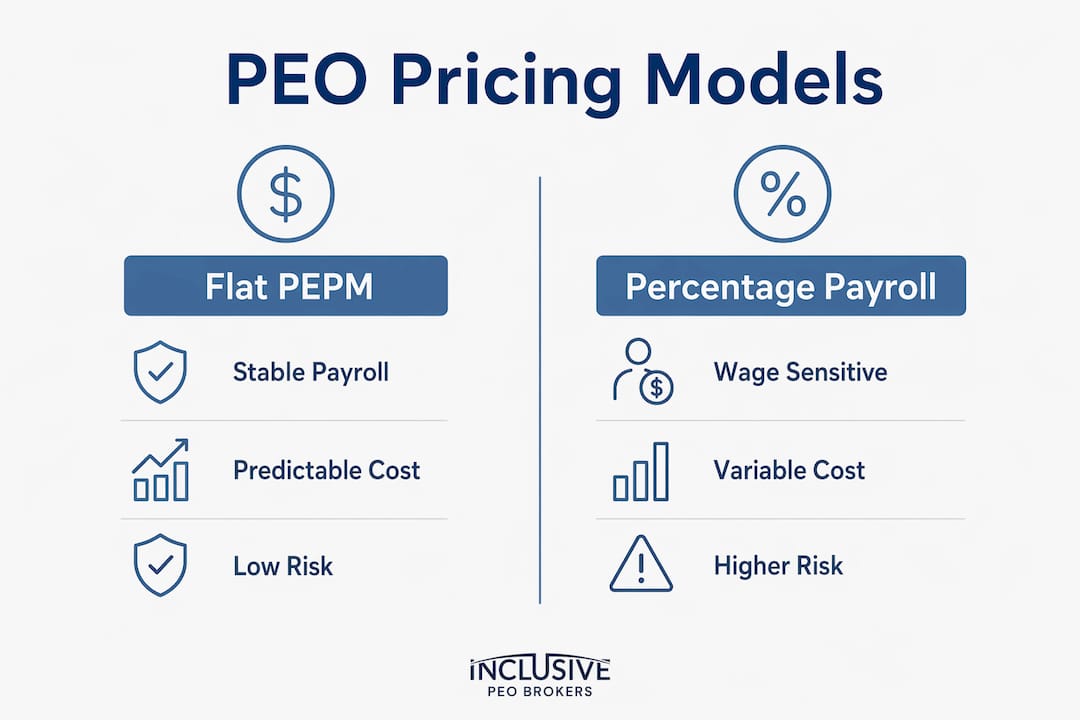
Two primary structures define how PEOs charge for their services: the flat PEPM model and the percentage-of-payroll model. A third option, the hybrid model, combines elements of both.
Flat PEPM pricing charges a fixed dollar amount for each employee on your payroll every month. If you have 20 employees and your PEO charges $100 PEPM, your monthly admin fee is $2,000 regardless of what your employees earn. This model offers predictable budgeting and works best for businesses with a stable workforce and consistent payroll. Justworks, for example, uses a transparent PEPM structure that appeals to small businesses that want to forecast costs without surprises.

Percentage-of-payroll pricing ties your admin fee directly to your total wage bill. At a 4% rate on $200,000 in monthly payroll, you pay $8,000 per month. This model scales with payroll fluctuations, making it a natural fit for businesses with seasonal workers, commission-heavy sales teams, or variable overtime. The downside is that every raise you give your team increases your PEO bill proportionally.
Hybrid pricing combines a base PEPM fee with a payroll percentage applied to specific services like workers’ compensation. Hybrid models are less common but offer flexibility for businesses that want cost predictability on core HR services while allowing variable pricing on risk-based coverage.
| Model | Best for | Cost predictability | Risk |
|---|---|---|---|
| Flat PEPM | Stable headcount, salaried teams | High | Low |
| Percentage of payroll | Variable pay, seasonal staff | Low | Medium |
| Hybrid | Mixed workforce types | Medium | Medium |
Pro Tip: If your average employee salary is above $80,000, the percentage-of-payroll model almost always costs more than a flat PEPM arrangement. Run both calculations before you accept any quote.
What hidden fees drive up the total PEO cost?
The stated admin fee is rarely the full story. Insurance and compliance costs represent 60% to 80% of total PEO spend, meaning the admin fee you negotiate is often the smallest line item on your invoice.
Here are the additional cost components you need to verify before signing a PEO contract:
- Setup and onboarding fees: Many PEOs charge a one-time implementation fee ranging from a few hundred to several thousand dollars depending on company complexity.
- Benefits markups: PEOs negotiate group health insurance rates, but they often add a markup of 5% to 15% on top of the carrier’s premium. This markup is frequently buried in bundled pricing.
- Technology platform fees: Providers like Rippling charge separately for their HR software platform. If your PEO uses a third-party system, expect an additional per-seat fee.
- Termination and administrative surcharges: Hidden fees like termination penalties and volume-based pricing tiers can add 10% to 25% to your effective annual cost.
- Optional add-ons: Recruiting support, learning management systems, and premium compliance services are often sold separately, creating significant variability in final pricing.
Bundled pricing simplifies billing but reduces transparency, which is exactly why requesting a line-item fee breakdown before you commit is non-negotiable. A PEO that refuses to provide an itemized schedule is a PEO worth walking away from.
Pro Tip: Ask every PEO vendor to separate their admin fee from pass-through costs in writing. PEO quotes often shift after due diligence, and requiring this separation upfront prevents markup surprises later.
How does PEO pricing change over time?
A 12-month cost comparison rarely tells the full story. The real test of a pricing model is how it performs over 24 to 36 months as your business grows.
Consider this scenario: a 15-person company with $1.2 million in annual payroll chooses a percentage-of-payroll model at 5%. Year one costs $60,000 in admin fees. By year three, after merit increases push payroll to $1.5 million, that same 5% rate costs $75,000. The PEO did not change its rate. Your own growth drove a 25% cost increase. Long-term cost evaluation over 12 to 36 months shows that percentage models can escalate costs due to wage growth, whereas flat PEPM fees remain steady regardless of salary changes.
The headcount effect runs in the opposite direction. Smaller businesses pay more per employee due to volume discounts. A company with 5 to 10 employees may pay up to $200 PEPM, while a firm with 200 or more employees can negotiate rates as low as $60 PEPM. This means the flat PEPM model becomes increasingly cost-effective as you scale.
Here is how the two primary models compare across growth scenarios:
- Year 1, 15 employees, $80K average salary: Flat PEPM at $100 costs $18,000 annually. Percentage at 5% on $1.2M payroll costs $60,000. Flat PEPM wins decisively.
- Year 2, 25 employees, $80K average salary: Flat PEPM at $100 costs $30,000 annually. Percentage at 5% on $2M payroll costs $100,000. Flat PEPM still wins.
- Year 3, 25 employees with 10% salary growth: Flat PEPM remains $30,000. Percentage at 5% on $2.2M payroll rises to $110,000. The gap widens further.
The percentage model only makes financial sense when your workforce is small, your average wages are low, and your headcount fluctuates significantly month to month. For most growing small businesses with salaried employees, flat PEPM pricing delivers better long-term cost control.
How to choose and negotiate the right PEO pricing model
Selecting the right model starts with understanding your own payroll structure before you speak to a single vendor. Pull your last 12 months of payroll data and calculate your average monthly wage bill, your headcount variance, and your projected growth rate. These three numbers determine which model works in your favor.
When comparing quotes, look beyond the admin fee. Workers’ comp and health insurance dominate PEO costs, so evaluating these alongside admin fees determines total value. A PEO offering a low PEPM rate but a 12% markup on health premiums may cost more than a competitor charging $20 more per employee per month with no benefits markup.
Standardizing service level comparisons is critical since PEO package inclusions vary widely. Build a comparison matrix that lists every service you need, then map each vendor’s quote to that matrix. This approach prevents you from comparing a full-service quote against a stripped-down one.
Negotiation tactics that actually work:
- Request a full fee schedule in writing, including all pass-through costs and optional add-ons.
- Ask for a rate lock guarantee of at least 12 months on the admin fee component.
- Negotiate setup fees down or waived entirely, especially if you are bringing a clean payroll history.
- Ask what happens to your rate if you add 10 or 20 employees. Volume discount thresholds are often negotiable.
- Review the termination clause carefully. Exit penalties of 60 to 90 days of fees are common and rarely disclosed upfront.
The PEO selection guide published by Inclusive PEO Brokers walks through a structured evaluation framework that covers all of these comparison points in detail. Using a structured process saves significant time and reduces the risk of choosing a model that looks affordable today but becomes expensive as your team grows.
Pro Tip: Review your PEO pricing annually, not just at renewal. If your headcount has grown past a volume discount threshold, you may be entitled to a lower rate mid-contract. Most PEOs will not offer this proactively.
Key takeaways
Choosing the wrong PEO pricing model costs more than the difference in rates. It costs you in budget predictability, contract flexibility, and the time spent untangling a poor fit.
| Point | Details |
|---|---|
| Two core models | Flat PEPM and percentage of payroll are the two primary PEO pricing structures, each suited to different workforce types. |
| Hidden fees matter most | Insurance markups and termination fees can add 10% to 25% to your stated admin fee. Always request itemized breakdowns. |
| Flat PEPM scales better | For growing businesses with salaried employees, flat PEPM pricing consistently outperforms percentage models over 24 to 36 months. |
| Company size affects rate | Businesses with fewer than 10 employees pay up to $200 PEPM, while firms with 200 or more employees can access rates as low as $60 PEPM. |
| Negotiate before signing | Rate locks, setup fee waivers, and volume discount thresholds are all negotiable. Most buyers never ask. |
What most buyers get wrong about PEO pricing
I have reviewed hundreds of PEO contracts, and the single most common mistake I see is treating the admin fee as the total cost. Business owners spend hours negotiating a $10 PEPM reduction and then sign a contract with a 10% health insurance markup that costs them $30,000 more per year. The admin fee is the visible tip of the cost structure. The real money is in benefits, workers’ comp, and the fees that never appear in the headline quote.
The second mistake is choosing a pricing model based on what sounds simpler rather than what fits the business. Percentage-of-payroll pricing feels intuitive because it scales with the company. But for a business planning to grow headcount and give annual raises, it is a model that punishes success. Every good hire and every deserved raise increases your PEO bill. That is not a partnership. That is a misaligned incentive.
My honest recommendation is to run a 36-month cost projection for every model you are considering before you accept any quote. Use your actual payroll data, your projected growth rate, and your expected salary increases. The model that looks cheapest in month one is rarely the model that serves you best in year three. If you want a strategic negotiation framework to guide that process, use one built specifically for PEO selection rather than a generic vendor comparison tool.
— John
How Inclusive PEO Brokers simplifies PEO pricing for you
Understanding PEO pricing is one thing. Getting a transparent, apples-to-apples quote from multiple providers is another challenge entirely.

Inclusive PEO Brokers works exclusively with small and medium-sized businesses to cut through the complexity of PEO pricing structures. The team handles vendor outreach, quote standardization, and contract review so you are never comparing a bundled quote against an itemized one without knowing it. Clients save an average of 80 hours in the selection process and $634 in costs, backed by 133 successful implementations. If you are ready to find a PEO that fits your payroll structure and growth plans, explore your options with a broker who has done this before.
FAQ
What is the average cost of a PEO per employee?
PEO administration fees average $1,395 per employee annually, or roughly $40 to $160 per employee per month. Total costs including benefits and workers’ comp are significantly higher.
Which PEO pricing model is better for small businesses?
Flat PEPM pricing is generally better for small businesses with stable, salaried workforces because it provides predictable monthly costs that do not increase as wages grow. Percentage-of-payroll models suit businesses with variable or seasonal payroll.
What fees should I watch for beyond the admin fee?
Setup fees, benefits markups, technology platform charges, and termination penalties are the most common additional costs. These hidden fees can add 10% to 25% to your total annual PEO spend.
Can I negotiate PEO pricing?
Yes. Rate locks, setup fee waivers, and volume discount thresholds are all negotiable before you sign. Requesting a full line-item fee schedule is the first step in any effective negotiation.
How does company size affect PEO pricing?
Larger companies access lower per-employee rates through volume discounts. Businesses with 200 or more employees can pay as little as $60 PEPM, while companies with 5 to 10 employees often pay up to $200 PEPM for the same core services.
Recommended
.svg)
Seeking a different solution? Meet Your Business Needs