.png)


Post-PEO Implementation Support: The Complete Guide to Long-Term PEO Success

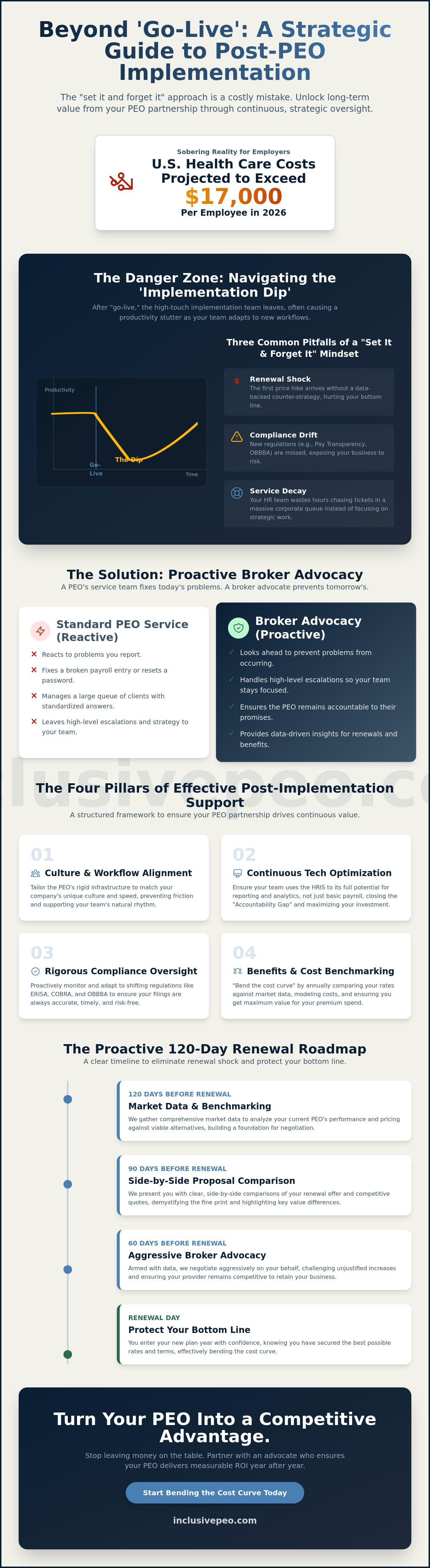
Did you know that U.S. employer health care costs are projected to exceed $17,000 per employee in 2026? That is a 9.5% increase over last year, and it's a sobering reminder that the "set it and forget it" approach to your PEO is no longer a viable strategy. If you've recently finished your launch, it's natural to feel a sense of relief, but the real work of extracting value starts now. Many leaders worry that their provider will become distant once the initial setup is complete. You might already be feeling anxiety over your first renewal price hike or wondering who handles specific HR escalations. Strategic post peo implementation support is the bridge that turns a basic service into a long-term competitive advantage.
We understand that the transition from "go-live" to daily operations can feel overwhelming, especially with new challenges like the One Big Beautiful Bill Act and shifting AI hiring regulations. This guide will show you how to move beyond the initial setup to achieve long-term ROI through aggressive advocacy and continuous oversight. You'll learn a clear framework for managing your PEO relationship, lowering your renewal rates, and ensuring seamless technology adoption across your entire workforce.
Key Takeaways
• Learn why the "go-live" date is only the starting line and how to navigate the common productivity dip that follows a new PEO launch.
• Discover how strategic post peo implementation support aligns your HR infrastructure with your specific company culture and long-term goals.
• Understand the importance of broker advocacy in closing the accountability gap and managing complex service escalations on your behalf.
• Master a proactive 120-day renewal roadmap that uses market data and benchmarking to protect your bottom line from unexpected price hikes.
• Identify how continuous benefits optimization and side-by-side proposal comparisons keep your provider competitive and help you bend the cost curve.
Why 'Go-Live' is Only the Beginning of Your PEO Journey
Many business leaders treat the "go-live" date as a finish line. They assume that once the data is migrated and the first checks are cut, the heavy lifting is over. This "set it and forget it" mentality is a dangerous trap. Real success requires a shift in perspective. You must view post peo implementation support as an ongoing strategic partnership rather than a one-time technical setup. Without a plan for the months following launch, organizations often experience the "Implementation Dip." This is a period where productivity stutters because the internal team is still learning new workflows while the high-touch implementation experts have already moved on to their next project.
Relying solely on a Professional Employer Organization (PEO) to manage itself leads to three common pitfalls. First, you face renewal shock when the first price hike arrives without a counter-strategy. Second, you suffer from compliance drift as new state regulations, like the 2026 pay transparency amendments, are missed. Third, you experience service decay where your HR team spends hours chasing tickets in a massive corporate queue. A dedicated broker serves as the essential filter between your business and the PEO giant. We ensure the PEO remains accountable to the promises made during the sales process.
The Difference Between PEO Service and Broker Advocacy
It's vital to distinguish between reactive service and proactive advocacy. A PEO's internal service team reacts to problems you report. They fix a broken payroll entry or reset a password. Advocacy is different. It's about looking ahead to prevent those problems from occurring. Your broker acts as a People Ops leader, handling the high-level escalations so your internal team doesn't get bogged down in administrative bureaucracy. This level of care starts long before go-live, which is why our peo selection services focus on finding a provider that values long-term alignment over quick signatures.
The First 90 Days: Critical Milestones for Success
The first three months determine the trajectory of your PEO relationship. During this window, you transition from the implementation specialists to the ongoing service team. You must conduct a rigorous audit of the first full payroll cycle to catch data discrepancies early. We recommend setting clear KPIs for your PEO during this quarter. Track their response times, the accuracy of their benefits billing, and the speed of employee onboarding. Establishing these benchmarks early ensures that post peo implementation support remains data-driven and focused on your specific ROI goals.
Core Pillars of Effective Post-PEO Implementation Support
Effective post peo implementation support relies on four foundational pillars that ensure your HR strategy remains agile. First, you must align the PEO’s infrastructure with your company culture. If your organization values autonomy and speed, a PEO with a rigid, slow-moving approval process will create friction. We work to tailor these workflows so the technology supports your team's natural rhythm. Second, continuous technology optimization ensures your team uses the HRIS to its full potential rather than just for basic payroll tasks. This proactive approach to post peo implementation support prevents the "Accountability Gap" that often plagues larger PEO providers.
Third, rigorous compliance oversight protects you from shifting regulations. With the 2026 reporting threshold for 1099 forms increasing to $2,000 under the OBBBA, your systems must be updated to reflect these changes. We monitor these shifts, alongside ERISA and COBRA requirements, to ensure your filings are always accurate and timely. Finally, regular benefits benchmarking is essential. With employer health care costs projected to exceed $17,000 per employee in 2026, you cannot afford to skip annual cost modeling. We help you "bend the cost curve" by comparing your current rates against national averages to ensure you're getting the best possible value for your premium spend.
Fee Auditing and Transparency Checks
Many organizations overlook the "fee creep" that occurs after the first year of a PEO relationship. It's common for small, unannounced administrative charges to appear on invoices, slowly eroding your ROI. We help you identify these hidden costs by benchmarking your administrative fees against current industry standards. Our team verifies that the PEO applies your negotiated contract terms correctly on every single bill. If you aren't sure if you're paying a fair market rate, our side-by-side proposal comparisons can reveal exactly where your current provider stands against the competition. This level of transparency is vital for maintaining the 27.2% average ROI that PEO users typically expect.
Employee Experience and Technology Adoption
A PEO is only as valuable as its adoption rate among your workforce. If employees find the platform confusing, they will revert to asking your internal HR team basic questions, defeating the purpose of outsourcing. We recommend conducting quarterly "tech audits" to ensure the HRIS serves your specific workflows. This process identifies bottlenecks in the user interface and highlights features your team might be underutilizing, such as new Trump Account contribution tracking or updated pay transparency tools. To further reduce the burden on your staff, we provide an Employee Support Advocate. This role serves as a dedicated resource for your people, handling complex benefits questions and ensuring a high-quality experience that boosts retention and morale.
Managing the PEO Relationship: Broker Advocacy vs. Direct Management
Managing a PEO relationship directly often feels like shouting into a void. When you work with a large provider without an advocate, you're just one of thousands of clients in a ticketing queue. This dynamic creates an "Accountability Gap." It's the space between what the PEO promised in the sales pitch and what they actually deliver on a Tuesday afternoon when payroll is due. If a deadline is missed, an internal HR manager might spend hours on hold trying to find a resolution. This is where post peo implementation support through a broker changes the narrative.
We adopt a "Liaison Model" to resolve these friction points. Instead of your team chasing the PEO, we act as your People Ops Leader; we ensure the provider remains accountable to your specific needs. Direct management often leads to a "set it and forget it" trap. Without constant oversight, you lose leverage, especially when it's time for benefits renewals. Businesses that manage the relationship solo often find themselves overpaying because they lack the data to challenge the PEO's initial increase. We ensure you never walk into a negotiation unarmed.
When to Escalate: Handling PEO Service Failures
Identifying red flags early is critical for the long-term health of your organization. Delayed payroll, incorrect tax filings, or repeated errors in benefits enrollment are signs that the standard service model is failing you. When these issues arise, we don't just file another ticket. We use our established relationships to escalate the matter to PEO executive leadership. This level of post peo implementation support allows us to develop a corrective action plan that holds the provider's feet to the fire. It's often possible to fix a broken relationship without the massive disruption of switching providers, provided you have the right leverage to demand better performance.
The Strategic Advantage of Wholesale Market Access
One of the most powerful tools in our arsenal is wholesale market access. We keep your PEO honest by constantly monitoring the broader market. Even after you've signed a contract, we perform side-by-side proposal comparisons to ensure your rates remain competitive. If market data shows that administrative fees or benefit premiums are trending lower elsewhere, we use that information to negotiate better terms mid-contract. This proactive approach ensures you're always paying a fair price, rather than just accepting whatever the PEO offers at renewal time. We help you stay ahead of the curve, ensuring your PEO remains a high-value asset rather than a growing liability.
The Roadmap to Your First PEO Renewal and Beyond
Your first renewal is the moment of truth in a PEO relationship. This is when the "honeymoon phase" ends and the reality of annual cost increases sets in. To protect your bottom line, you must start the renewal process at least 120 days before your contract expires. Waiting for the PEO to send their proposal gives them all the leverage. Effective post peo implementation support involves a proactive stance where you dictate the timeline. We help you analyze the proposed "Renewal Increase" against actual "Market Trends" using sophisticated data modeling. If your PEO suggests a double-digit hike while national averages sit lower, you need the evidence to push back effectively.
One of the most effective negotiation tactics is to unbundle your costs. You should negotiate the administrative fee as a separate line item from your healthcare premiums. PEOs often try to hide margin by blending these figures together. By isolating the admin fee, you can benchmark it against the industry average of $1,395 per employee annually. We also recommend preparing a "Plan B" by securing quotes from niche or regional PEO providers. Even if you don't intend to switch, having a credible alternative creates the competitive pressure necessary to keep your current provider's pricing honest.
Bending the Cost Curve on Healthcare
With employer health care costs projected to exceed $17,000 per employee in 2026, a 9.5% increase over 2025, "business as usual" isn't enough. We use benefits benchmarking to challenge high renewal rates. By presenting the PEO with side-by-side cost comparison modeling, we show them that you're aware of your options in the broader market. This strategy allows us to implement healthcare cost containment measures that keep your benefits package attractive without draining your capital. If you want to see how your current rates stack up against the competition, we can provide benefits benchmarking and optimization to find your true market value.
The Annual HR Infrastructure Audit
A renewal isn't just about the money; it's about the fit. As your company scales from 20 to 100 or more employees, the PEO that worked last year might not be the right partner today. Our post peo implementation support includes an annual audit of your workers’ compensation codes to ensure you aren't being overbilled due to misclassification. We also review your employee handbooks to ensure they meet the 2026 compliance standards, including the latest pay transparency laws now active in over 20 states. This comprehensive review ensures your HR infrastructure remains a foundation for growth rather than a mounting compliance risk.
How Inclusive PEO Brokers Bends the Cost Curve Post-Implementation
Why do most businesses see their PEO costs rise every year while their service quality plateaus? It's often because they lack a dedicated advocate to manage the relationship once the initial setup is complete. At Inclusive PEO Brokers, we provide a "White Glove" advocacy model that ensures your provider remains a high-performing asset. Led by Chris Galy and a team of veteran HR experts, we act as your strategic partner to ensure you never become just another number in a PEO's database. Our post peo implementation support is designed to transition your team from the heavy lift of administration to the high-value work of strategic HR growth.
We keep your current provider competitive by leveraging our wholesale market access. Most employers don't realize that PEO pricing is often flexible if you have the right data to challenge it. We perform side-by-side PEO proposal comparisons throughout your contract, not just at renewal. This constant market pressure forces your PEO to stay honest with their pricing and service levels. By moving from a reactive management style to a proactive advocacy model, you can focus on scaling your business while we handle the complexities of the PEO marketplace.
Our Proprietary Benefits Benchmarking Process
We use a data-driven approach to negotiate your pricing and contract terms. Our team acts as your knowledgeable guide, drawing on years of experience to understand the PEO's internal margins. We know exactly where providers have room to move on administrative fees and where hidden costs often hide. This "insider" confidence allows Inclusive PEO Brokers to bend the cost curve for our clients, often identifying thousands of dollars in annual savings that would otherwise go unnoticed. This isn't just about finding a lower price; it's about ensuring your benefits package remains a powerful tool for attracting and retaining top talent in a competitive 2026 landscape.
Scaling Your HR Infrastructure with Inclusive PEO Brokers
Your business is dynamic, and your HR needs will change as you grow from 20 to 100 or more employees. Our consulting services evolve alongside you. We integrate post peo implementation support with long-term HR strategy to ensure your infrastructure always matches your current scale. Whether you're navigating new AI hiring regulations in Illinois or expanding your footprint into states with complex pay transparency laws, we provide the clarity and mastery you need to stay compliant and efficient. If you're ready to ensure your PEO relationship is delivering maximum ROI, it's time to schedule a PEO performance audit with Inclusive PEO Brokers.
Mastering Your Long-Term PEO Partnership
Transitioning from the initial setup to a high-performing partnership requires more than just luck. It demands a commitment to continuous technology optimization and a proactive approach to the 120-day renewal cycle. By prioritizing post peo implementation support, you protect your organization from fee creep and ensure your benefits package remains competitive as you scale. You've already invested the time to find a provider; now it's time to ensure that provider delivers on every promise.
Founded by veteran HR executive Chris Galy, our team provides the expert oversight needed to navigate a complex marketplace. We leverage wholesale market access to both national and niche providers, giving you the upper hand during contract negotiations. Our side-by-side proposal comparisons reveal the true value of your partnership, allowing you to bend the cost curve on rising healthcare expenses. Breathe a sigh of relief; let Inclusive PEO Brokers manage your PEO relationship for you. You've done the heavy lifting of choosing a partner. Now, let's make sure that partner works tirelessly to support your growth and your people.
Frequently Asked Questions
What exactly is post-PEO implementation support?
Post-PEO implementation support is the ongoing strategic oversight and advocacy that happens after your initial launch. It moves beyond the technical setup to focus on long-term relationship management and ROI. This process includes auditing payroll cycles, monitoring compliance shifts, and ensuring your team actually adopts the new technology. It acts as a bridge between the PEO's standard service and your specific business objectives.
Does my PEO provide its own post-implementation support?
Most PEOs offer a reactive service model through a dedicated or pooled account team. While they will reset passwords or fix payroll errors you bring to them, they rarely look for ways to optimize your costs proactively. Broker advocacy provides an essential layer of protection that the PEO's internal team cannot offer because a broker's primary loyalty is to your business, not the provider's profit margins.
How long does the implementation support period typically last?
The technical implementation window typically closes after the first 30 to 60 days, or once two successful payroll cycles are completed. At this point, you are moved from the implementation team to the general service queue. However, strategic post peo implementation support should never truly end. Continuous advocacy is necessary to manage renewals, audit fees, and ensure the PEO scales alongside your company's growth.
What happens if my PEO rates spike at the first renewal?
You must immediately challenge a renewal spike by presenting market data and alternative quotes. PEOs often increase rates after the first year, betting that you will find the cost of switching too high to bother. By using side-by-side proposal comparisons, you show the provider that you are still monitoring the market. This creates the necessary pressure to negotiate a more reasonable increase that aligns with current national trends.
Can a broker help if my PEO technology is not working as promised?
Yes, a broker serves as your primary point of escalation when PEO technology fails to meet your expectations. If the HRIS is clunky or lacks the features promised during the sales process, we work with PEO executive leadership to find a resolution. We help you conduct tech audits to identify bottlenecks and ensure the platform is configured to support your specific workflows rather than hindering them.
Is post-implementation support included in the PEO administrative fee?
Basic service is included in your administrative fee, but proactive advocacy is a distinct service provided by your broker. The PEO's internal support staff are employees of the provider and are incentivized to protect the PEO’s interests. Professional post peo implementation support from an outside advocate ensures you have a partner who is solely focused on bending your cost curve and maintaining high service standards.
How often should we audit our PEO administrative fees?
You should audit your administrative fees annually, preferably starting four months before your contract renewal. This timing is critical because it gives you enough leverage to negotiate or look at other providers if the fees have become uncompetitive. Regular audits help you catch "hidden" costs or misclassified workers' compensation codes that can silently drain your budget over the course of a year.
What is the most common mistake companies make after a PEO go-live?
The most frequent error is disengaging from the relationship once the systems are live. Companies often stop monitoring their invoices and skip regular benchmarking, which leads to service decay and massive renewal increases. Maintaining a proactive stance ensures you continue to extract the average 27.2% ROI that a well-managed PEO relationship can provide, rather than letting those savings disappear into the provider's margins.
.svg)
Partner with us for expert HR support compliance, and personalized solutions.






.png)