.png)

PEO Service Agreement Explained for Small Businesses
A PEO service agreement is a legal contract that defines the co-employment relationship and divides employer responsibilities between a Professional Employer Organization and your company. In the HR industry, this document is formally called a Client Service Agreement (CSA). Understanding the PEO service agreement explained in full detail is not optional for small business owners. It determines who handles payroll, who owns your HR data, and who absorbs legal risk when something goes wrong.
The CSA works through a co-employment model. Your business remains the worksite employer, controlling day-to-day workforce decisions. The PEO becomes the administrative employer, managing payroll processing, tax filings, benefits enrollment, and compliance paperwork. This split is the foundation of every PEO relationship, and every clause in the contract flows from it.
What a PEO service agreement actually covers
The co-employment model splits responsibilities clearly: the PEO handles payroll tax withholding and remittance, benefits administration, and compliance filings, while you retain hiring, job assignments, performance management, promotions, disciplinary actions, and terminations. That division is not just administrative. It carries real legal weight.
The PEO assumes employer-of-record status for tax and benefits purposes. This means the PEO files W-2s under its own Employer Identification Number, pools your employees into its benefits plans, and takes on workers’ compensation coverage. Your company still directs the work. Think of it as the best of both worlds: you get Fortune 500-level HR infrastructure without giving up control of your team.

The CSA also defines the scope of services in writing. Payroll processing, benefits enrollment, compliance reporting, safety programs, and claims handling are all listed explicitly. If a service is not named in the agreement, the PEO is not obligated to provide it. That is why reading the scope section carefully matters more than most business owners realize.
Pro Tip: Before signing, ask your PEO to walk you through the service scope section line by line. Any service you expect but do not see listed should be added in writing before execution.
Key terms and clauses in a PEO contract
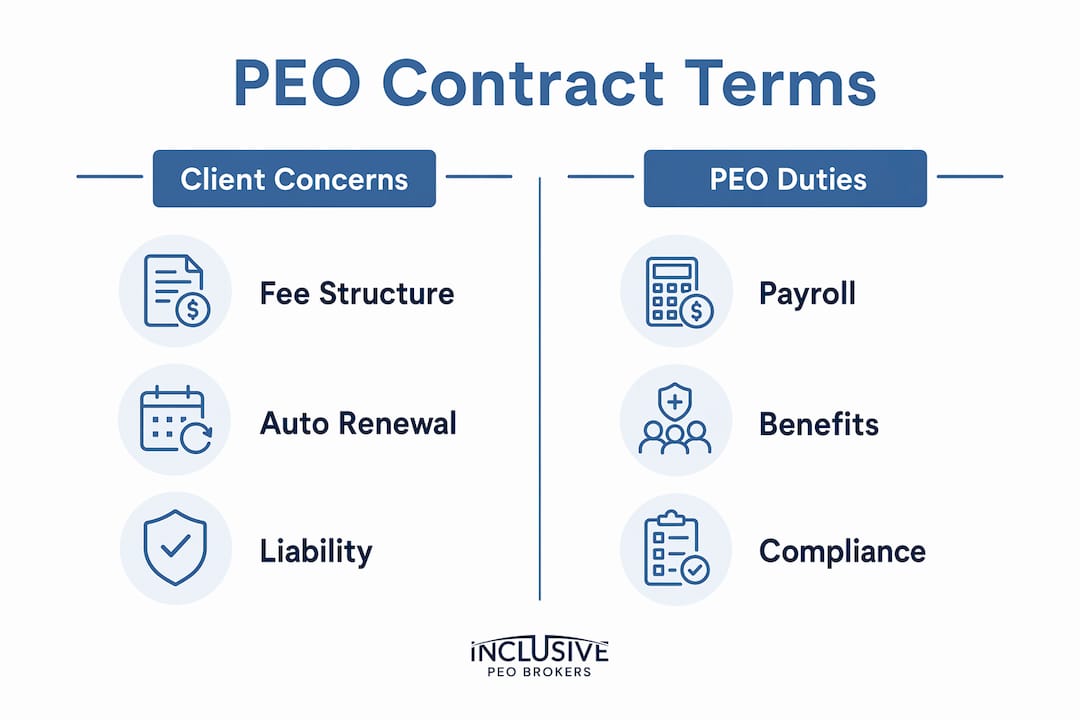
Knowing what to look for separates a well-protected business from one that gets surprised by fees or gaps in coverage. A well-written PEO CSA clearly defines responsibilities, limitations, and costs, including fee charging methods, caps on price increases, and notice requirements. Here are the six clause categories that deserve your closest attention:
-
Fee structures and pricing models. PEOs charge either a flat per-employee-per-month (PEPM) fee or a percentage of total payroll. Both models have trade-offs. PEPM fees are predictable; percentage-based fees grow automatically as you hire or give raises. Ask specifically about PEO administrative fees and whether the contract caps annual increases.
-
Renewal and auto-escalation clauses. PEO contracts commonly renew automatically unless canceled within a defined notice period, and administrative fees may escalate if not capped in the agreement. Missing a 60-day cancellation window can lock you in for another full year at a higher rate.
-
Insurance provisions. The CSA must specify Employment Practices Liability Insurance (EPLI) coverage, workers’ compensation calculations, and how the PEO manages its risk pool. PEO agreements often include clauses detailing EPLI, workers’ compensation calculations, and risk pool management that directly affect your insurance costs.
-
Liability and indemnity provisions. These clauses define who is responsible when an employment claim arises. Some PEOs accept shared liability for HR-related claims; others limit their exposure to actions taken under their direct administrative control. Read this section with a lawyer if your workforce carries elevated legal risk.
-
Data ownership and IT integration. Data ownership provisions in PEO contracts specify who controls HR and payroll data, the process for export, and software integration capabilities. If you ever leave the PEO, you need a clear path to retrieve your employee records without delay or additional cost.
-
Exit, termination, and transition terms. Exit policies usually require 30 to 60 days’ notice to terminate, with penalties or conditions for early exit and obligations for transition support post-termination. Vague offboarding terms are one of the most common sources of disputes between small businesses and their PEOs.
| Clause | What to verify |
|---|---|
| Fee structure | PEPM vs. payroll percentage; annual cap on increases |
| Auto-renewal | Notice period required; opt-out window |
| Insurance | EPLI limits; workers’ comp rate methodology |
| Liability | Scope of PEO indemnification; shared vs. limited liability |
| Data ownership | Export rights; format; timeline after termination |
| Exit terms | Notice period; early termination penalties; transition support |
Pro Tip: Jessica Elliott, a recognized HR advisor, recommends reviewing PEO CSAs carefully with specific attention to fee caps and notice requirements to minimize financial surprises down the line.
How to negotiate PEO contract terms effectively
Most small business owners treat a PEO contract as a take-it-or-leave-it document. It is not. PEOs negotiate regularly, especially with businesses that bring stable headcount and low claims history. Knowing the right PEO contract negotiation steps puts you in a stronger position before you sign.
Start your review with these priorities:
- Fee caps. Push for a written cap on annual fee increases, typically 3 to 5 percent. Without this, a percentage-based fee tied to payroll growth can compound quickly.
- Service level definitions. Vague language like “timely processing” or “reasonable support” creates disputes. Replace it with specific turnaround times: payroll processed within two business days, compliance filings submitted at least five days before deadlines.
- Liability boundaries. Confirm exactly which employment claims the PEO will defend and indemnify. Ask for examples of past claims and how they were handled.
- Exit terms. Negotiate for a 30-day termination notice rather than 60, and confirm that transition support is included at no additional charge.
- Data portability. Require that your employee data be delivered in a standard format (CSV or Excel) within five business days of termination.
When reviewing contract language, watch for terms like “at our discretion,” “subject to change,” and “as determined by the PEO.” These phrases shift decision-making power entirely to the provider. Replace them with specific, measurable commitments wherever possible.
Engaging a PEO broker or an employment attorney for a PEO service level agreement review before signing is money well spent. A broker with experience across multiple PEO contracts will spot non-standard clauses that a first-time buyer would miss entirely.
What changes in your daily HR operations after signing
Signing a CSA changes how HR work flows through your business immediately. The PEO takes over payroll processing, tax filings, benefits enrollment, and compliance reporting. Your HR team, if you have one, shifts from administrative execution to workforce strategy and employee relations.
The client company retains hiring and termination decisions, maintaining full control over the workforce despite co-employment. Your employees will notice some changes. They may receive W-2s from the PEO’s legal entity, enroll in benefits through a new portal, and contact a PEO-managed HR helpline for certain questions. These transitions require clear internal communication to avoid confusion.
On the risk management side, the PEO typically provides workplace safety programs, OSHA compliance support, and workers’ compensation claims handling. For a small business without a dedicated safety officer, this coverage represents a meaningful operational upgrade. A 10-person manufacturing company, for example, gains access to the same safety infrastructure that a 500-person employer maintains in-house.
Pro Tip: Set a quarterly calendar reminder to review your PEO’s service delivery against the terms in your CSA. Tracking response times, payroll accuracy, and compliance filing dates keeps your provider accountable and gives you documented evidence if disputes arise.
The main limitation to anticipate is reduced direct access to raw payroll data. Most PEOs operate through proprietary HR platforms, and pulling custom reports requires working within their system. Confirm during contract negotiation that your team can export the specific data fields your business needs for financial planning and audits.
Key takeaways
A PEO service agreement defines the co-employment split between administrative and worksite employer duties, and every clause from fees to exit terms flows directly from that legal framework.
| Point | Details |
|---|---|
| Co-employment is the foundation | The CSA divides employer duties: PEO handles admin, you control workforce decisions. |
| Six clauses demand close review | Fees, renewals, insurance, liability, data ownership, and exit terms carry the most risk. |
| Negotiation is expected | Push for fee caps, specific service levels, and clear data portability rights before signing. |
| Daily HR operations shift immediately | Payroll, benefits, and compliance move to the PEO; your team focuses on people strategy. |
| Exit terms protect your business | Require 30-day notice, no-cost transition support, and data delivery within five business days. |
What I’ve learned from reviewing hundreds of PEO agreements
After working through PEO contract negotiations with dozens of small businesses, the pattern I see most often is this: owners focus almost entirely on the monthly fee and ignore everything else. That is exactly backwards. The fee is visible and easy to compare. The clauses around liability, auto-renewal, and data ownership are where the real financial exposure lives.
The co-employment legal framework is genuinely unfamiliar to most business owners, and that unfamiliarity creates anxiety. My honest observation is that the anxiety fades quickly once you understand that operational control stays with you. You are not handing your workforce to a third party. You are offloading the administrative burden while keeping every meaningful people decision in your own hands.
The mistake I see most often is neglecting the exit clause until the relationship sours. By then, you are negotiating from a weak position. Read the termination section on day one, before you have any emotional investment in the relationship. If the terms feel punitive, that is a signal worth taking seriously before you sign.
Build a habit of monitoring service levels against what the contract actually promises. A PEO selection services guide can help you establish benchmarks before you even start comparing providers. The businesses that get the most value from PEO relationships treat the CSA as a living management tool, not a document filed away after signing.
— John
How Inclusive PEO Brokers helps you navigate your PEO agreement
Signing a PEO contract without expert guidance is one of the most common and costly mistakes small businesses make in HR outsourcing.

Inclusive PEO Brokers specializes in matching small and medium-sized businesses with PEOs that fit their specific needs, and that includes helping you understand and negotiate the contract before you commit. With 133 successful implementations completed and an average client savings of $634, the process is proven. Clients also save an average of 80 hours in the selection process alone. Whether you need help evaluating PEO broker services or want a second set of eyes on a contract you have already received, Inclusive PEO Brokers provides the expert guidance that turns a complex legal document into a clear, confident decision. Explore your options at Inclusive PEO Brokers.
FAQ
What is a PEO service agreement?
A PEO service agreement, formally called a Client Service Agreement (CSA), is a legal contract that establishes a co-employment relationship between a Professional Employer Organization and your company. It defines which employer responsibilities each party holds, covering payroll, benefits, compliance, and liability.
Who controls hiring and firing under a PEO agreement?
The client company retains full authority over hiring, terminations, and performance management under a PEO agreement. The PEO handles administrative employer functions but does not direct or control your workforce decisions.
What should I look for in a PEO service level agreement review?
Focus on fee structures and annual caps, auto-renewal notice periods, EPLI and workers’ compensation provisions, liability and indemnity language, data ownership rights, and exit terms including transition support obligations.
Can I negotiate a PEO contract?
Yes. PEOs negotiate regularly, particularly on fee caps, service level definitions, termination notice periods, and data portability terms. Engaging a PEO broker or employment attorney before signing strengthens your negotiating position significantly.
How much notice is required to exit a PEO agreement?
Most PEO contracts require 30 to 60 days’ written notice to terminate, and some include early exit penalties. Negotiating for a 30-day notice period and no-cost transition support before signing protects your business if the relationship needs to end.
Recommended
.svg)
Seeking a different solution? Meet Your Business Needs