.png)

What Belongs in a Solid PEO Service Level Agreement

A PEO service level agreement is the contract that spells out exactly what your Professional Employer Organization owes you, in writing, and what happens when it falls short. The single most important move you can make when reviewing one: confirm whether you’re dealing with a Certified Professional Employer Organization (CPEO), because that status determines who the IRS holds liable for employment taxes if something goes wrong. Under standard third-party payer rules, your business generally stays on the hook for payroll taxes even when the PEO is filing them. CPEO status shifts that liability to the PEO for wages it remits.
Before you sign anything, confirm the agreement covers:
- Scope of services — which functions the PEO handles versus what you keep
- Covered employees — a precise, updatable list, not a vague headcount
- Fee model — per-employee-per-month or percentage of payroll, with caps on increases
- Payroll timing SLAs — exact processing windows and error-correction deadlines
- Indemnification and remedies — who pays for whose mistakes, and how you get compensated
- Transition and exit terms — data portability deadlines and exit fees spelled out upfront
Key Takeaways
A PEO service level agreement protects your business only when it names specific fee caps, payroll SLAs, CPEO verification, and exit deadlines in writing.
| Point | Details |
|---|---|
| Verify CPEO status first | Check the PEO’s certificate against the IRS public listing before discussing anything else. |
| Demand specific payroll SLAs | Vague “best efforts” language leaves you with no remedy when payroll runs late. |
| Check workers’ comp sub-limits | Master policies with shared aggregate limits can leave small claims uncovered. |
| Time your start date | Beginning a calendar quarter avoids duplicate FUTA and Social Security wage-base exposure. |
| Get expert contract review | Inclusive PEO Brokers reviews SLA language and negotiates fee caps and exit terms on your behalf. |
Where to Verify These Rules Yourself
Check the IRS third-party payer guidance for the definitive rules on employment tax liability and CPEO certification. For clause-by-clause contract language, LegalClarity’s PEO agreement guide breaks down fee models and co-employment terms in detail. The US Chamber of Commerce overview explains the operational split between client and PEO duties, and PEO Marketplace’s negotiation guide covers what to push back on before signing.
Table of Contents
- What Is a PEO Service Level Agreement?
- What Clauses Should Your PEO SLA Actually Include?
- How Do You Evaluate a PEO SLA Before Signing?
- What Happens After You Sign: Timeline and Exit Planning
- Get Help Negotiating Your PEO Contract
- Frequently Asked Questions
- Sources
What Is a PEO Service Level Agreement?
A PEO SLA is the contract that governs a co-employment arrangement, splitting employer responsibilities between your business and the PEO so both sides know exactly who does what. It exists because co-employment is a legal split, not a marketing term. You keep control over hiring, firing, day-to-day supervision, and workplace safety. The PEO takes on payroll processing, tax withholding, benefits administration, and most compliance filings, according to guidance from the US Chamber of Commerce.
| Function | Client Retains | PEO Handles |
|---|---|---|
| Hiring & firing | Yes | No |
| Workplace safety (OSHA) | Yes | No |
| Payroll processing | No | Yes |
| Tax filings | Shared* | Yes |
| Benefits enrollment | No | Yes |
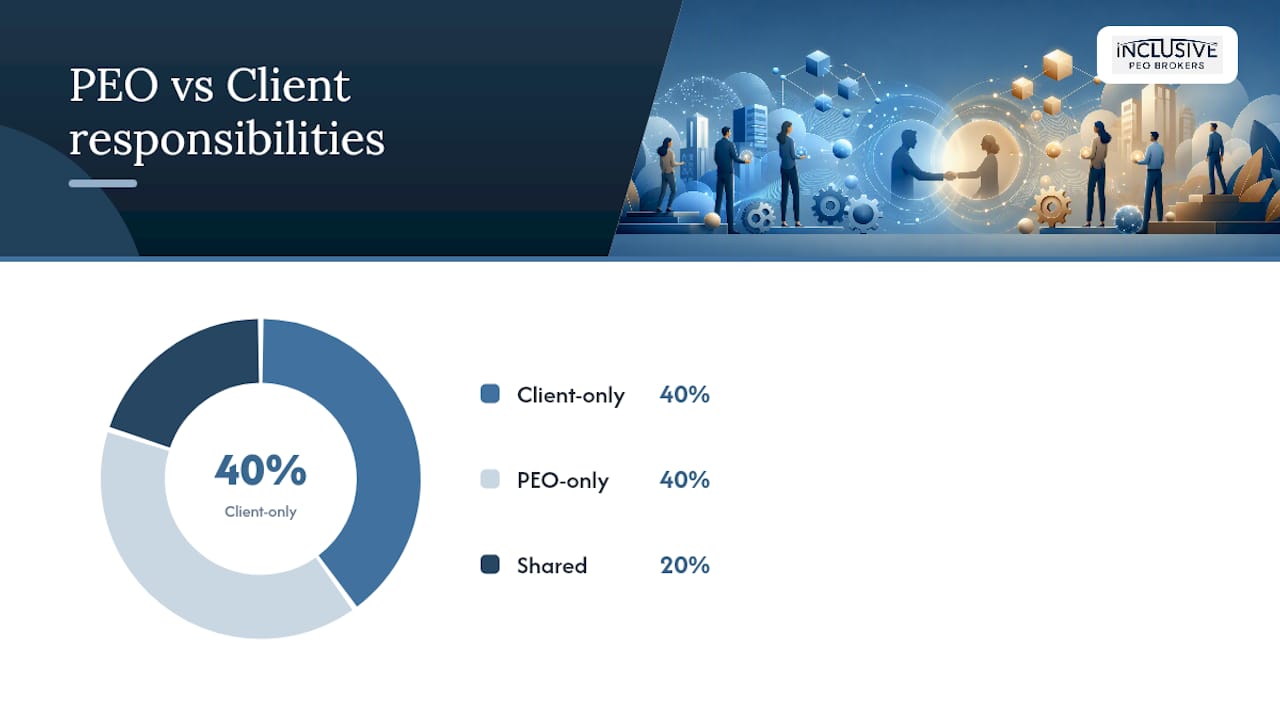
*Here’s the catch worth flagging: tax filing responsibility depends heavily on CPEO status. A certified PEO is treated as the employer for federal tax purposes on wages it remits. A non-certified PEO can file your Form 941 using its own EIN, but your business often remains the party the IRS pursues if deposits go missing. That distinction alone should shape which clauses you fight hardest for.
What Clauses Should Your PEO SLA Actually Include?
This is where most business owners get burned, not because the PEO is dishonest, but because standard templates are written to protect the vendor first. Here’s what to check, clause by clause.
Scope of services and covered employees. The agreement should name every function transferred to the PEO and list covered employees by classification, not just a total count. Red-line vague language like “PEO will provide standard payroll services” and demand a specific service schedule as an exhibit.
Fee structure and increase caps. PEO pricing runs either as a flat per-employee-per-month rate, typically $40 to $200 or more per employee, or as a percentage of payroll, commonly 2% to 12%. Push for a written cap on annual fee increases and a requirement for advance notice before any change takes effect.
Payroll processing SLAs. Contracts should define exact processing windows, error-correction timelines, and HR response times, with real remedies if the PEO misses them repeatedly, according to PEO Marketplace. Without a specific SLA here, you have almost no contractual leverage when payroll runs late.

Tax filing responsibility. Ask for evidence of how Form 941 gets filed and, if the PEO claims CPEO status, request their Schedule R documentation showing client-level wage allocation.
Workers’ comp and insurance limits. Most PEOs run workers’ comp through a master policy, which can mean shared aggregate limits or deductibles of $50,000 to $100,000 that leave small claims effectively uncovered, per RecruitGo’s analysis. Ask specifically for your sub-limit, not the master policy’s headline number.
Indemnification and liability caps. These clauses should be mutual, not one-directional. If the PEO caps its own liability at a token amount while leaving you exposed for their processing errors, that’s a term worth negotiating hard.
| Clause | Good Contract Language | Common Vendor Pushback |
|---|---|---|
| Fee increases | Capped at fixed percentage with advance notice | “Market rates require flexibility” |
| Payroll SLA | Specific processing window with service credits | “Best efforts” language only |
| Exit/data portability | Data delivered within a specified deadline | Delivery “upon reasonable request” |
| Indemnification | Mutual, tied to each party’s own errors | One-sided cap favoring the PEO |
Term, renewal, and exit. Watch for automatic one-year renewals that lock you in unless you cancel within a narrow window. Insist on a defined exit-data-delivery deadline and a cap on any termination or transition fee.
Pro Tip: Require the PEO to attach their CPA financial opinion and surety bond certificate as exhibits to the contract itself, not just a promise to provide them later. This turns a verbal assurance into an enforceable term.
How Do You Evaluate a PEO SLA Before Signing?
Run through this fast before you get deep into negotiation.
Red flags that should stop you cold:
- Scope language that says “standard services” without an attached exhibit
- Indemnification that caps the PEO’s liability but not yours
- Workers’ comp described only at the master-policy level, with no client sub-limit
- No stated data portability deadline for exit
- Exit fees left undefined or “to be determined”
Verification steps to run, in order:
- Ask for the CPEO certificate number and check it against the IRS’s public CPEO listing
- Request the current CPA financial opinion and surety bond details
- Confirm workers’ comp carrier and sub-limits in writing
- Ask for a sample payroll register showing how allocations work
Pro Tip: Require quarter-to-quarter CPA attestation as a standing contract obligation, not a one-time document. If the PEO can’t or won’t provide CPEO documentation, treat every tax-liability clause as if your business carries full exposure, because it does.
If legal review flags unresolved liability gaps or the PEO resists basic verification requests, that’s the moment to loop in tax counsel or bring in a broker who negotiates these contracts daily.
What Happens After You Sign: Timeline and Exit Planning
Most transitions take two to four weeks for full integration, and timing your start date to the beginning of a calendar quarter avoids duplicate wage-base exposure on FUTA and Social Security if you’re working with a non-CPEO mid-year.
| Milestone | Usual Timing | Responsible Party |
|---|---|---|
| Data migration | Weeks 1-2 | PEO, with client validation |
| State unemployment registration | Weeks 1-3 | PEO |
| Initial payroll funding setup | Week 2 | Client |
| Validation payroll run | Week 3-4 | Both parties |
| Benefits enrollment | Week 3-4 | PEO |
Your exit checklist matters just as much as onboarding. Require a data-delivery deadline, written protocol for pending workers’ comp claims, and reconciliation of pre- and post-contract tax bases so you never pay Social Security twice on the same wages.
A Negotiation Posture Worth Adopting
Most business owners treat PEO contracts as take-it-or-leave-it documents. They aren’t. Vendors expect pushback on CPA attestation and CPEO verification language, and they’ll usually accept it faster than a price concession. One high-leverage ask that smaller PEOs often accept: a refundable holdback tied to payroll accuracy for the initial period, which aligns their incentive with getting your first payroll run right.
Get Help Negotiating Your PEO Contract
Reading a 40-page PEO agreement alone, without a benchmark for what “good” fee caps or indemnification language look like, means you’re negotiating blind against a vendor who writes these contracts every day. Inclusive PEO Brokers reviews the specific clauses in this article against your actual quote, side by side with comparable providers, and pushes for the fee caps, service credits, and exit terms that protect your business.

Our matchmaking process includes contract review, side-by-side PEO comparisons, negotiation support on the terms that matter most, and guidance through implementation once you’ve signed. If you want a second set of eyes on a PEO proposal before you commit, book a contract review consultation and bring your draft agreement with you.
Frequently Asked Questions
What is a PEO service level agreement? It’s the contract that defines the specific duties, performance standards, fees, and remedies governing a co-employment relationship between your business and a Professional Employer Organization.
Does a PEO SLA remove my tax liability? Not automatically. Your business generally remains liable for employment taxes unless the PEO holds CPEO certification, which shifts liability to the PEO for wages it remits.
What fee structure should I expect in a PEO SLA?
How long does PEO implementation usually take? Most transitions take two to four weeks, and starting at the beginning of a calendar quarter simplifies tax reporting.
What should an exit clause in a PEO SLA cover? It should specify a data-delivery deadline, define any exit fees upfront, and detail how pending workers’ comp claims and tax-base reconciliation get handled.
Sources
- Third party payer arrangements – Professional Employer Organizations | Internal Revenue Service
- What Is a PEO? A Guide to Professional Employer Organizations | CO- by US Chamber of Commerce
- PEO Contract Terms: What to Negotiate Before Signing
- Guide to PEO Service Agreements for International Organizations | RecruitGo
Recommended
.svg)
Seeking a different solution? Meet Your Business Needs