.png)

PEO Technology Platform Evaluation: 2026 Buyer's Guide
PEO technology platform evaluation is the process of systematically assessing Professional Employer Organization software across payroll processing, compliance management, employee benefits, and data portability to confirm it meets your business needs before you commit. The co-employment model shifts administrative HR duties to the PEO while you retain day-to-day control, which means the platform you choose becomes the operational backbone of your workforce. Platforms like ADP TotalSource, Gusto, and Justworks each offer different feature depths, integration levels, and contract terms. Choosing the wrong one costs more than money. It costs time, compliance exposure, and the headache of a mid-year transition.
What are the key evaluation criteria for PEO technology platforms?
PEO platform assessment starts with five functional pillars: data portability, compliance depth, benefits administration, user permissions, and technical architecture. Each pillar carries real operational risk if you skip it during the vendor selection process.
Data portability is the most overlooked criterion. Key exportable data includes payroll journals, year-to-date tax returns, deductions, benefits enrollment records, and terminated employee history. If a vendor cannot produce these on demand, you are locked in by default.
Compliance management determines whether the platform can handle multi-state tax filing, audit defensibility, and regulatory changes without manual intervention on your end. ADP TotalSource, for example, is IRS-certified and ESAC-accredited, serving over 742,000 employees with dedicated compliance infrastructure. That level of accreditation signals a platform built to withstand regulatory scrutiny.

Benefits administration quality depends on carrier integration depth. A platform that connects with thousands of insurance carriers gives your employees more plan options and reduces manual enrollment errors. Gusto and Justworks both offer flexible report generation in CSV, Excel, and PDF formats, which reduces your dependency on vendor support for routine data pulls.
User roles and permissions matter more than most buyers realize. Admins should have self-service access to run reports across payroll, HR, time, and benefits data without submitting a support ticket every time. If your team cannot access its own data independently, that is a structural weakness in the platform.
- Confirm data export formats and who can trigger them
- Verify multi-state compliance coverage for every state where you employ people
- Test benefits carrier integration before signing any contract
- Map admin role permissions against your internal reporting needs
- Ask for documentation on how the platform handles regulatory updates
Pro Tip: Request a live demo of the export function during your evaluation. Do not accept a screenshot or a PDF walkthrough. Watch an admin export a full payroll journal in real time.
How to assess data export readiness and transition risk
Workflow transition risk is the gap between what a vendor promises about data access and what your team can actually execute on the day you decide to switch. Closing that gap requires a structured assessment before you sign.
Follow this sequence during your vendor evaluation:
- Request a live export demo covering payroll, HR, benefits, and time data. Confirm the file formats match your downstream systems.
- Identify which admin roles can perform exports and whether those permissions require vendor approval or can be self-managed.
- Ask for a sample mid-year exit packet. This should include payroll journals, YTD tax returns, deductions history, and terminated employee records.
- Map benefits carrier dependencies. Understand which carrier feeds the platform manages and what happens to those feeds if you exit mid-renewal cycle.
- Confirm open enrollment timing risks. Timing risks like mid-year exits or open enrollment periods create handoff challenges that vendors rarely disclose upfront.
- Document eligibility rules and deadlines. Providers should clearly document benefits dependencies, carrier feeds, and eligibility cutoffs so your team can recreate workflows independently.
The table below summarizes what to request and why each item matters:
| Data Type | What to Request | Why It Matters |
|---|---|---|
| Payroll journals | Full export by pay period | Required for tax reconciliation and audits |
| YTD tax returns | State and federal filings | Needed for mid-year transitions and IRS compliance |
| Benefits enrollment data | Carrier feeds and eligibility rules | Prevents coverage gaps during transitions |
| Terminated employee history | Records going back at least 3 years | Required for unemployment claims and audits |
| Time and attendance data | Raw exports by employee | Needed to recreate accrual and overtime records |
Pro Tip: Ask your vendor directly: “Can we recreate our full payroll and benefits workflow outside your platform using only the data you export?” If they hesitate, that hesitation is your answer.
Reviewing your PEO exit strategy before you sign a contract is not pessimistic. It is the same logic as reading a lease before you move in.
How does technical architecture quality affect platform scalability?
Technology quality is an intangible asset, and treating it as one means architecture and scalability become key determinants of platform ROI and risk. A platform built on legacy code may function adequately today but create serious constraints as your headcount grows or compliance requirements expand.
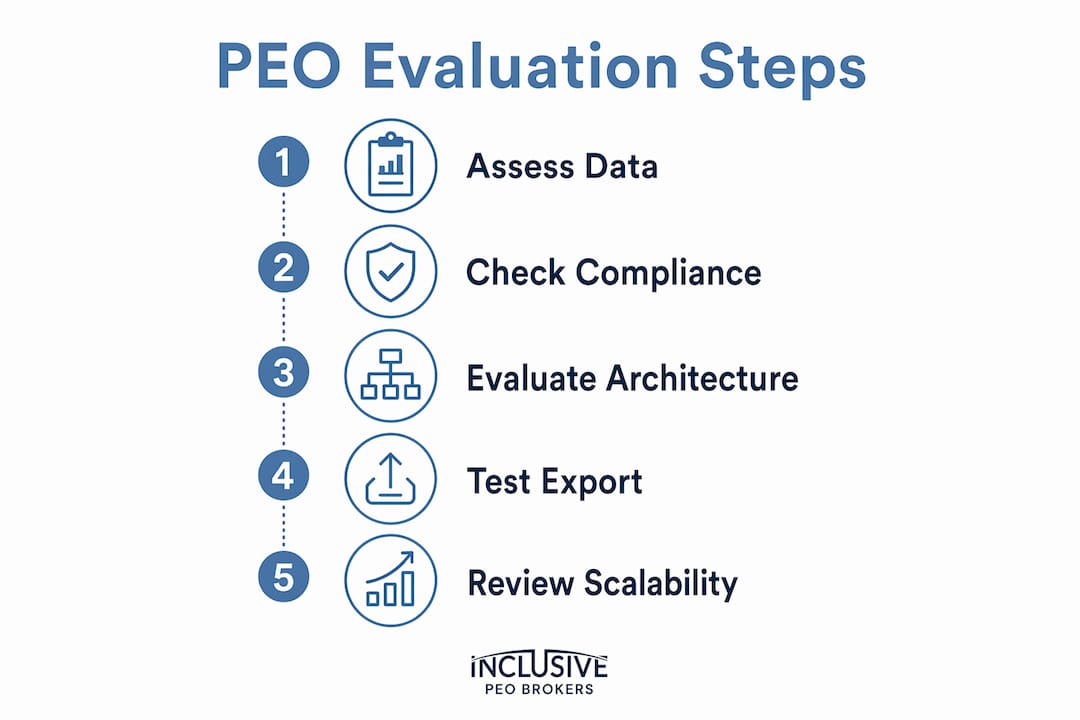
Technical debt is the accumulated cost of shortcuts taken during software development. It shows up as slow feature releases, frequent outages, and security vulnerabilities. When evaluating a PEO platform, assess four debt categories: code debt, architecture debt, infrastructure debt, and security debt. Each carries different remediation costs and operational impacts.
Security vulnerabilities and compliance gaps create liabilities that can severely damage your business if left unaddressed. Ask vendors directly whether they conduct annual penetration testing and whether results are available for review. A vendor that cannot answer this question clearly has not prioritized security maturity.
AI readiness is the newest dimension of platform quality. Platforms lacking AI capabilities or built on legacy architectures face competitive disadvantages as HR automation accelerates. Clean data accessibility and open API architecture are the two markers of a platform positioned to support AI-driven workflows in the next three to five years.
| Architecture Factor | Strong Signal | Weak Signal |
|---|---|---|
| Feature release velocity | Monthly updates with changelog | Quarterly or infrequent releases |
| API architecture | Open REST APIs with documentation | Closed or proprietary integrations only |
| Security practices | Annual penetration testing, SOC 2 certified | No published security audit history |
| AI readiness | Clean data layer, ML features in roadmap | Legacy monolith, no API access |
| Scalability | Handles 10x headcount without re-platforming | Performance issues above 500 employees |
Platforms built on modular architecture allow you to add capabilities without rebuilding from scratch. That modularity directly affects how quickly your HR team can adapt to new compliance requirements or benefits offerings.
PEO technology comparison: ADP, Gusto, and Justworks
Comparing leading PEO technology platforms requires looking beyond feature lists to understand how each platform performs under real operational conditions. ADP TotalSource, Gusto, and Justworks represent three distinct approaches to the same core problem.
ADP TotalSource leads on compliance infrastructure. Its IRS certification and ESAC accreditation make it the default choice for businesses with multi-state workforces or complex regulatory exposure. The platform integrates with thousands of insurance carriers, which gives benefits administrators meaningful flexibility. The trade-off is cost and complexity. ADP’s pricing is less transparent than competitors, and its interface carries the weight of a platform built over decades.
Gusto prioritizes user experience and pricing transparency. It suits small businesses with straightforward payroll needs and a preference for self-service administration. Gusto’s reporting tools are accessible without technical training, and its export formats cover the standard CSV, Excel, and PDF outputs most businesses need. Its compliance depth is narrower than ADP’s, which matters if your workforce spans more than a handful of states.
Justworks sits between the two on most dimensions. Its pricing model is transparent, its interface is clean, and its compliance coverage is solid for businesses operating in major U.S. markets. Justworks also offers strong employee self-service portals, which reduces HR administrative load without requiring a dedicated HR team.
The right choice depends on your headcount, geographic footprint, and how much compliance complexity your business carries. A PEO broker in San Francisco can map those variables against each platform’s actual capabilities, rather than relying on vendor marketing materials alone.
- ADP TotalSource: best for multi-state compliance and large carrier networks
- Gusto: best for small businesses prioritizing ease of use and pricing clarity
- Justworks: best for growing companies that need transparent pricing with solid compliance coverage
- All three platforms support CSV and Excel exports, but depth and admin access vary significantly
Key takeaways
Effective PEO technology platform evaluation requires assessing data portability, technical architecture, compliance depth, and scalability before signing any contract.
| Point | Details |
|---|---|
| Data portability is non-negotiable | Request live export demos covering payroll, benefits, and terminated employee history before committing. |
| Technical debt creates real risk | Assess code, architecture, infrastructure, and security debt to understand long-term platform viability. |
| Compliance depth varies by provider | ADP TotalSource’s IRS certification and ESAC accreditation set the benchmark for multi-state compliance. |
| AI readiness signals future value | Platforms with open APIs and clean data layers are better positioned for HR automation in 2026 and beyond. |
| Exit planning belongs in onboarding | Map your mid-year exit packet requirements before you sign, not after you decide to leave. |
What I’ve learned from watching businesses skip the hard questions
After working through more than 133 PEO implementations at Inclusive PEO Brokers, the pattern I see most often is this: businesses spend 80% of their evaluation time on pricing and 20% on everything else. That ratio needs to flip.
The vendors who are most reluctant to show you a live data export demo are almost always the ones with the most restrictive exit terms. Transparency about data access is a proxy for how a vendor thinks about your long-term interests versus their own retention metrics. When a sales rep says “we can get you that information after you sign,” that is a red flag, not a process step.
Technical debt is the other blind spot. Most business owners are not software engineers, and vendors know it. Asking about penetration testing results or API architecture can feel intimidating. But you do not need to understand the code. You need to understand whether the platform can grow with you and whether your data is secure. Those are business questions, not technical ones.
The businesses that get the most value from their PEO technology are the ones that treat the platform selection process like a vendor audit, not a product demo. They come with a checklist, they ask uncomfortable questions, and they walk away from vendors who cannot answer them. That discipline pays off every time.
— John
How Inclusive PEO Brokers simplifies your platform evaluation
Choosing the right PEO technology platform is a significant decision, and most business owners do not have 80 hours to spend on vendor research, demo calls, and contract reviews. Inclusive PEO Brokers does that work for you.

With 133 successful implementations and an average client savings of $634, Inclusive PEO Brokers matches your business to platforms that fit your payroll complexity, compliance needs, and benefits goals. The process filters out vendors that cannot meet your data portability requirements and flags contract terms that create lock-in risk before you sign. For small and mid-sized businesses in San Francisco and beyond, explore PEO services tailored to your size and industry. You focus on growth. We handle the platform evaluation.
FAQ
What is PEO technology platform evaluation?
PEO technology platform evaluation is the process of assessing PEO software capabilities across payroll, compliance, benefits administration, and data portability to confirm the platform meets your operational and regulatory needs before you commit to a contract.
What data should I be able to export from a PEO platform?
Key exportable data includes payroll journals, year-to-date tax returns, deductions history, benefits enrollment records, and terminated employee history. Platforms like Gusto and Justworks support CSV, Excel, and PDF exports with self-service admin access.
How do I evaluate technical architecture quality in a PEO platform?
Ask vendors about their penetration testing practices, API architecture, and feature release cadence. Platforms with open REST APIs, SOC 2 certification, and monthly update cycles signal lower technical debt and stronger scalability.
What is the difference between ADP TotalSource, Gusto, and Justworks?
ADP TotalSource leads on multi-state compliance and carrier integration depth. Gusto prioritizes user experience and pricing transparency for smaller businesses. Justworks offers a balance of transparent pricing and solid compliance coverage for growing companies.
How do I avoid vendor lock-in when choosing a PEO platform?
Request a live export demo before signing, confirm which admin roles can trigger exports independently, and ask for a sample mid-year exit packet. Understanding your data portability options upfront is the most effective way to protect your business from lock-in risk.
Recommended
.svg)
Seeking a different solution? Meet Your Business Needs