.png)

PEO for Mergers and Acquisitions: The Deal Team Playbook

Yes, you can use a Professional Employer Organization (PEO) during a merger or acquisition — but only if your deal team treats the PEO relationship as a first-class due diligence item, not an afterthought. PEOs help preserve deal value by preventing benefit downgrades and maintaining operational continuity, which directly protects talent retention during the transition. The three actions your team should take right now:
- Discover PEO usage immediately. Ask the seller in your first information request whether the target uses a PEO, an administrative services organization (ASO), or any co-employment arrangement. This single question shapes every HR diligence workstream that follows.
- Gather the core documents. Request the PEO master service agreement, the most recent payroll reports, benefits census, and the last two years of workers’ compensation loss runs before you finalize your diligence scope.
- Assign a people-integration lead. Name one person on your team who owns HR integration from letter of intent through day 90. Without a named owner, PEO transition tasks fall through the cracks at exactly the wrong moment.
Pro Tip: If the seller cannot produce the PEO contract within 48 hours of your request, treat that delay as a yellow flag. A well-run company knows where its HR agreements live.
Key Takeaways
Using a PEO in mergers and acquisitions requires early discovery, a named integration lead, and explicit purchase agreement protections to prevent benefit gaps, payroll disruptions, and ERISA liability from eroding deal value.
| Point | Details |
|---|---|
| Discover PEO usage immediately | Ask about PEO arrangements in your first information request; this shapes every HR diligence workstream. |
| Request seven core documents | PEO contract, census, payroll reports, loss runs, 401(k) plan docs, SUTA history, and benefits SPDs are must-haves before pricing the deal. |
| Watch for six red flags | Missing claims data, long termination notice, non-certified PEO status, fee ambiguity, tax gaps, and active litigation each require escrow or indemnity protection. |
| Build a realistic transition timeline | Retaining the PEO post-close takes 30 days; moving to a new PEO takes 60; moving off entirely takes — with high resource demand. |
| Inclusive PEO Brokers | Clients save an average of 80 hours and $634 per engagement across 133 completed implementations — purpose-built for M&A PEO transitions. |
Table of Contents
- What does a PEO actually do, and why does it matter in a deal?
- PEO-specific due diligence: what documents should you request?
- What contract and ERISA issues come up most often in PEO-related deals?
- How do you manage the payroll transition, and what are realistic timelines?
- What insurance and liability items should you review when a PEO is involved?
- How do you protect employee retention and culture when a PEO is in the picture?
- What are the most important action steps and red flags for buyers and sellers?
- When should you hire a PEO broker or advisor for an M&A deal?
- What most deal teams get wrong about PEOs in acquisitions
- Inclusive PEO Brokers makes M&A HR transitions manageable
- Sources
What does a PEO actually do, and why does it matter in a deal?
A PEO operates under a co-employment model: the PEO becomes the employer of record for tax and benefits purposes, while the client company retains day-to-day control over employees’ work. That split creates specific handoff points that every deal team must understand before closing.
Core services a PEO typically provides include:
- Payroll processing and tax filings — the PEO remits federal and state payroll taxes under its own Employer Identification Number (EIN), which means the target’s payroll history may not appear under the target’s own EIN.
- Benefits administration — health, dental, vision, and ancillary coverage are often bundled under the PEO’s master plan, not the client’s own carrier contracts.
- HR operations and compliance — employee handbooks, leave management, I-9 verification, and state-specific labor law compliance often run through the PEO’s platform.
- Workers’ compensation — coverage is typically placed through the PEO’s policy, and claims history belongs to the PEO’s account, not the client’s.
- 401(k) administration — many PEOs sponsor their own retirement plan, meaning the target’s employees participate in the PEO’s plan rather than a standalone company plan.
- Recruiting and retention support — some PEOs offer access to applicant tracking systems, onboarding tools, and HR advisory services.
The practical consequence for a buyer: a significant portion of the target’s HR infrastructure does not belong to the target. A PEO provides turnkey HR infrastructure that simplifies pre-close assessment and post-close integration, but it also means the buyer is inheriting a three-party arrangement, not a clean employer-employee relationship.
The responsibility map is straightforward once you see it: the seller controls day-to-day operations and employee assignments; the PEO holds the employment contracts, benefits plans, and payroll tax accounts; the buyer inherits whatever the purchase agreement says it inherits. If the agreement is silent on PEO obligations, the buyer inherits the ambiguity.
PEO-specific due diligence: what documents should you request?
Targets using a PEO may not supply full plan documents or insurance policies during diligence. Early engagement of a PEO broker or consultant reduces those gaps and yields a cleaner risk picture. Organize your document requests by priority.
Must-have documents
- PEO master service agreement (MSA) — the full contract, including all amendments, fee schedules, and termination provisions. Look for notice periods (commonly 30–90 days), assignment clauses, and any auto-renewal language.
- Benefits plan documents and summary plan descriptions (SPDs) — confirms coverage levels, carrier names, and whether the plan is fully insured or self-funded.
- Employee census — names, titles, states of employment, benefit elections, and salary data. Verify it matches payroll reports.
- Payroll reports (last 24 months) — confirms wages, tax withholdings, and the EIN under which taxes were filed.
- Workers’ compensation loss runs (last 3–5 years) — claims history, open reserves, and carrier information.
- ERISA/401(k) plan documents — plan adoption agreement, trust agreement, most recent Form 5500, and any IRS determination letters.
- SUTA/FUTA account histories — state unemployment tax account numbers and rate histories, which may be held under the PEO’s account.
Nice-to-have documents
- EPLI (Employment Practices Liability Insurance) policy declarations and claims history.
- Certificates of insurance for all active policies.
- COBRA administration records and recent election rates.
- HR audit reports or compliance reviews conducted by the PEO.
- Onboarding and offboarding process documentation.
Red-flag indicators in the document set
- Missing or redacted loss runs without provided explanation.
- A PEO contract with a long termination notice period and no assignment clause.
- 401(k) plan documents that show the PEO as plan sponsor with no spinoff mechanism described.
- Payroll reports filed under multiple EINs lacking reconciliation.
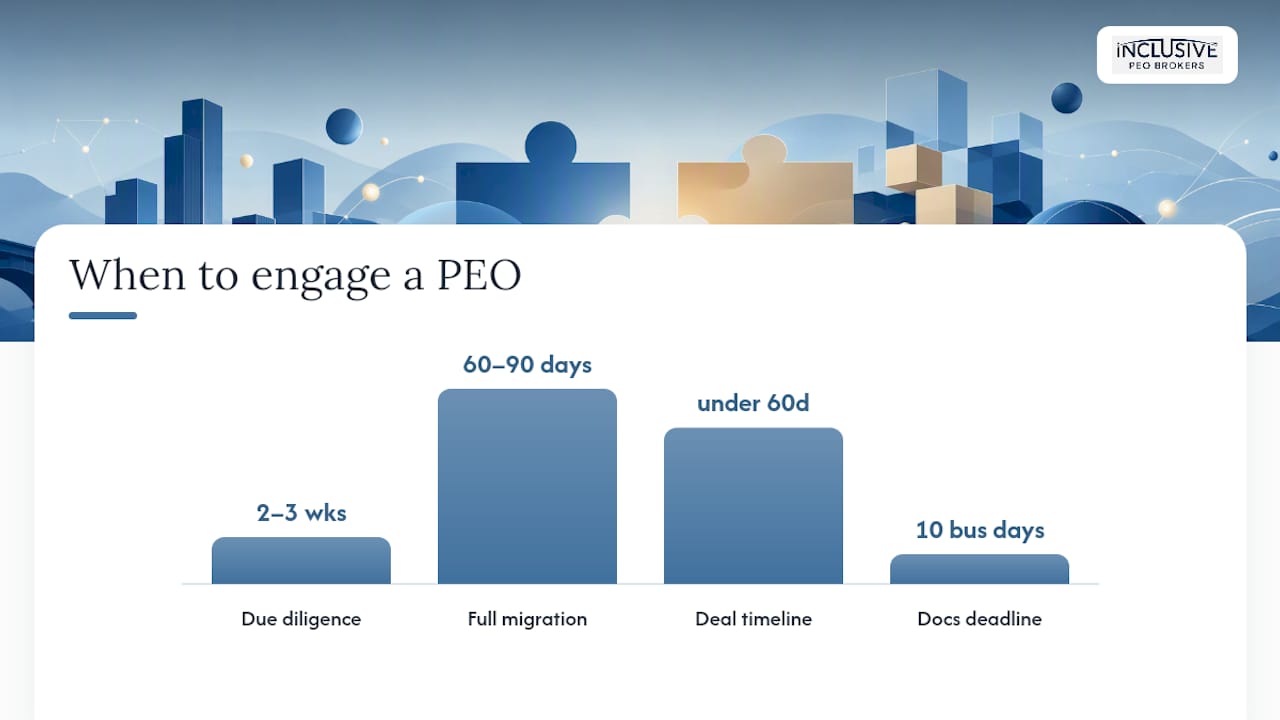
Timing guidance: Request all must-have documents within the first week of signed NDA. Give the seller a reasonable deadline for document submission. If the PEO itself must supply documents directly, expect an additional 5–10 business days and build that into your diligence timeline.
What contract and ERISA issues come up most often in PEO-related deals?
PEO contracts, 401(k) plan spinoffs, health coverage, and payroll transitions require explicit attention in purchase agreements. Legal counsel with M&A and ERISA experience should review these items before you sign.
PEO contract clauses that affect your deal
- Assignment and consent provisions. Most PEO contracts prohibit assignment without the PEO’s written consent. A change of control at the client level may trigger this clause, requiring the buyer to either renegotiate the contract or terminate it.
- Termination notice. Notice periods of 30–90 days are standard. A 90-day notice period with a closing date in 45 days creates a direct conflict — plan for it.
- Data access and portability. Confirm the contract grants the client (and therefore the buyer) access to all payroll data, employee records, and benefits history upon termination.
- Fee structures and true-up provisions. Some PEO contracts include annual fee reconciliations tied to headcount or payroll volume. A mid-year termination may trigger a true-up payment.
- Indemnification and survival clauses. Understand which indemnities survive termination and for how long, particularly around employment claims filed after the PEO relationship ends.
ERISA and 401(k) issues
The 401(k) situation deserves its own workstream. When the target participates in the PEO’s multiple employer plan (MEP), the buyer faces three options: spin off the target’s employees into a new standalone plan, terminate the plan and distribute assets, or negotiate continued participation post-close. Each path has IRS filing requirements, participant notice obligations, and timing constraints.
Plan spinoff requires a plan amendment, IRS notification, and coordination with the PEO’s third-party administrator (TPA). Expect 60–90 days minimum. Plan termination triggers a distributable event for all participants and requires a final Form 5500 filing. Continued participation is rarely available post-acquisition unless the buyer itself qualifies under the MEP’s participation rules.
Pro Tip: Budget $5,000–$15,000 for an ERISA specialist to review the 401(k) situation alone. The cost of a missed plan spinoff deadline or a late Form 5500 filing far exceeds that fee.
Purchase agreement protections to negotiate
- Seller representations confirming PEO contract status, absence of material claims, and current fee payments.
- A covenant requiring the seller to obtain PEO consent to assignment (or terminate the PEO contract) before closing.
- An indemnity covering pre-close employment claims that flow through the PEO.
- Transitional services language obligating the seller to cooperate with PEO data transfer post-close.
- An escrow or holdback sized to cover potential ERISA liability and open workers’ comp claims.
Sign-off internally should involve corporate legal, HR leadership, and a benefits consultant or ERISA attorney. This is not a workstream to delegate to a generalist.
How do you manage the payroll transition, and what are realistic timelines?
Payroll continuity is the most operationally sensitive piece of any PEO transition. Missing a payroll cycle damages employee trust faster than almost any other integration failure. Three realistic scenarios exist, and your choice depends on how much time you have between signing and close.
Operational steps for any payroll handoff:
- Obtain raw payroll files in a portable format (CSV or Excel) covering at least 24 months.
- Confirm all federal and state tax deposits are current and reconcile year-to-date wages against W-2 projections.
- Set a firm payroll cutover date — ideally aligned with a pay period end, not mid-cycle.
- Notify employees of any changes to payroll timing, pay stubs, or benefits portals at least two pay cycles in advance.
- Coordinate with the new payroll processor or payroll management provider to confirm EIN setup, state registrations, and direct deposit routing before the first live payroll run.
For multistate targets, the complexity multiplies. PEOs help navigate federal, state, and local regulations for employers with remote or multistate employees, handling leave mandates, tax reporting, and location-specific rules. If you are moving off the PEO, you are taking on all of that compliance work yourself or through a new vendor.
Short-term continuity options include an ASO (administrative services organization) arrangement, which provides payroll and HR administration without the co-employment structure, or a carve-out where the acquired entity temporarily remains on the seller’s PEO while the buyer stands up its own infrastructure. Both carry trade-offs: an ASO adds cost and a new vendor relationship; a carve-out extends the seller’s liability exposure and requires explicit contractual permission.

What insurance and liability items should you review when a PEO is involved?
Untangling a PEO relationship can introduce surprises on EPLI, workers’ compensation, and payroll tax remittances. Early assessment avoids timeline slips and cost overruns that can erode deal value.
Documents to request:
- Workers’ compensation policy declarations and loss runs for the last 3–5 years.
- EPLI policy declarations, limits, retentions, and any open or pending claims.
- Employer tax remittance histories (federal 941s, state equivalents) confirming timely deposits.
- Certificates of insurance for all active PEO-placed policies.
- Claims audit reports, if the PEO has conducted any.
| Insurance Document | What It Reveals | Next Step If a Problem Appears |
|---|---|---|
| Workers’ comp loss runs | Frequency and severity of claims; open reserves | Require holdback or escrow; obtain independent actuarial review |
| EPLI policy and claims history | Active or threatened employment claims | Require seller indemnity; notify D&O carrier |
| Federal 941 transcripts | Whether payroll taxes were remitted on time | Engage tax counsel; request IRS account transcript |
| SUTA account history | State unemployment rate and any disputed charges | Confirm rate transfer rules in target states |
Red-flag indicators that should trigger deeper review:
- Large open workers’ comp reserves with no resolution timeline.
- Inconsistent payroll reporting across quarters (suggests EIN switching or unreported wages).
- Frequent carrier disputes or policy cancellations in the loss run history.
- Missing EPLI coverage for a company with more than 15 employees.
- Tax remittance gaps of more than one quarter.
The SUTA issue deserves specific attention. Because many PEOs file unemployment taxes under their own account, the target’s state unemployment experience rating may be pooled with other PEO clients. When the target separates from the PEO, it may receive a new employer rate in some states rather than inheriting its historical rate. That can meaningfully increase payroll costs in the first year post-close.
How do you protect employee retention and culture when a PEO is in the picture?
Human capital issues — cultural misalignment and poor communication — are frequent causes of M&A underperformance. PEOs can surface these risks early through specialized HR due diligence, but the buyer’s communication strategy ultimately determines whether key employees stay.
When the target uses a PEO, employees often experience the acquisition as a benefits disruption first and a cultural change second. Their health plan, 401(k) login, and HR portal may all change simultaneously. That concentration of change in the first 90 days is a primary driver of voluntary attrition.
Retention levers specific to PEO transitions:
- Communicate benefit continuity plans before close, not after. Employees who know their coverage is protected are significantly less likely to begin a job search.
- Use stay interviews (not just surveys) with key employees in the first 30 days. Ask directly what would cause them to leave and what would cause them to stay.
- Offer targeted retention bonuses tied to 6- and 12-month milestones for employees in roles that are hard to replace.
- Maintain the target’s existing HR portal and benefits access for at least 60 days post-close, even if you are transitioning to a new PEO. Abrupt system changes signal instability.
Sample employee communication timeline:
- Pre-close (2–4 weeks before signing): Leadership message confirming the deal and stating that benefits and payroll will continue without interruption through at least day 60.
- Day one post-close: Written FAQ covering benefits, payroll dates, HR contacts, and the integration timeline. Delivered by the acquired company’s own leadership, not a corporate email blast.
- Days 30–60: One-on-one or small-group sessions with managers to address questions and surface concerns before they become departures.
- Days 60–90: Formal benefits enrollment communication if a transition to a new PEO or carrier is planned.
Pro Tip: Review the target’s employee handbook during diligence, not just for legal compliance, but for cultural signals. A handbook that reflects the PEO’s generic template with no customization often indicates the target has not invested in its own HR identity — which means cultural integration will require more active work from your team.
Pro Tip: If the target’s PEO offers an HR advisory hotline, keep it active for 90 days post-close even if you are transitioning away. Employees who can call a familiar number for HR questions are less likely to escalate concerns or disengage.
What are the most important action steps and red flags for buyers and sellers?
7-day checklist (immediate post-signing)
- Assign a named people-integration lead with authority to request documents and make vendor decisions.
- Request the PEO master service agreement, employee census, and workers’ comp loss runs.
- Confirm the PEO contract’s termination notice period and set a decision deadline for retain vs. transition.
- Identify all states where the target has employees and flag any with complex leave or tax rules.
- Notify your benefits broker and legal counsel that a PEO relationship is in scope.
- Set a preliminary payroll cutover date and confirm it with the PEO and any new vendor.
- Check whether the target’s 401(k) is a standalone plan or a PEO-sponsored MEP.
30–90-day checklist (integration and migration)
- Complete benefits enrollment for all employees under the new carrier or PEO within the first months post-close.
- Reconcile year-to-date payroll data and confirm all tax deposits are up to date before the first post-close payroll run.
- Harmonize employee handbooks and HR policies by day 60, using the PEO’s compliance resources where available.
- File any required ERISA notices for 401(k) plan changes within the IRS-mandated windows.
- Conduct a post-close HR audit covering I-9s, offer letters, and state-specific compliance items.
- Confirm SUTA account transfer or new-employer rate assignment in each state.
Top 6 red flags that should pause or change deal terms
- Missing claims data. No workers’ comp or EPLI loss runs after two requests. Require an escrow or holdback sized to cover unknown claims.
- Long PEO termination notice. A 90-day notice period when closing is in 45 days. Negotiate a seller covenant to issue notice immediately upon signing, or adjust the closing date.
- Unclear fee allocation. PEO invoices that bundle fees without itemization make it impossible to assess true HR costs. Require a fee schedule breakdown before pricing the deal.
- Non-certified PEO status. The IRS Certified PEO (CPEO) program provides specific tax liability protections. A non-certified PEO shifts more tax risk to the client. Verify certification status at NAPEO or the IRS CPEO registry.
- Unresolved tax remittance gaps. Any quarter where payroll taxes were not remitted on time creates direct IRS exposure. Require a tax indemnity and consider a tax escrow.
- Active employment litigation. Open EEOC charges, wage claims, or EPLI claims that flow through the PEO require specific indemnity language and may affect the PEO’s willingness to cooperate post-close.
When should you hire a PEO broker or advisor for an M&A deal?
The honest answer: earlier than most deal teams think. The trigger is not complexity alone — it is the combination of complexity and limited internal HR capacity. If your team has never unwound a PEO relationship, the learning curve is steep and the timeline is short.
Specific triggers for engaging a PEO broker:
- The target operates in three or more states, each with different leave, tax, or workers’ comp rules.
- The target’s PEO contract is missing, incomplete, or contains unusual provisions your legal team has not seen before.
- Benefits are mid-year and a carrier transition would create a coverage gap.
- The seller cannot produce complete plan documents or loss runs within the first 10 business days.
- The buyer’s internal HR team has fewer than two people with PEO transition experience.
- The deal timeline is under 60 days from signing to close.
What a PEO broker delivers in an M&A context:
- Rapid document collection and gap analysis against the standard diligence checklist.
- Vendor matching to identify PEOs that can onboard the target’s employee population on the buyer’s timeline.
- Migration project management covering payroll cutover, benefits enrollment, and carrier coordination.
- Negotiation support to secure favorable PEO contract terms, pricing, and transition assistance.
- Post-close implementation oversight to confirm the new arrangement is running correctly before the broker disengages.
Working with a dedicated PEO broker early in the M&A process allows better navigation of information gaps and more accurate risk assessment than relying on the seller’s initial disclosure alone.
Engagement scopes and expected outcomes:
- Due diligence only (2–3 weeks): Document collection, contract review summary, risk flag report, and a go/no-go recommendation on PEO transition timing. Suitable when the buyer has internal HR capacity for execution.
- Full migration (60–90 days): End-to-end project management from PEO selection through first live payroll on the new platform. Suitable when internal HR capacity is limited or the timeline is compressed.
- Hybrid: Broker leads diligence and vendor selection; internal HR team manages execution with broker advisory support. Most common for mid-market deals.
Inclusive PEO Brokers has completed 133 successful PEO implementations, with clients saving an average of 80 hours in the selection process and an average cost saving of $634 per engagement. In an M&A context, those time savings translate directly to deal team bandwidth and reduced transition risk.
What most deal teams get wrong about PEOs in acquisitions
The most common mistake is not discovering the PEO relationship late — it is discovering it on time but treating it as an HR administrative task rather than a deal-structure issue. A PEO contract with a 90-day termination notice is not an HR problem. It is a closing mechanics problem that affects your purchase agreement, your escrow structure, and your day-one operating plan.
Consider a scenario that plays out regularly in middle-market deals: a buyer signs a letter of intent, assigns diligence to a generalist HR consultant, and receives a clean summary that notes “target uses a PEO for payroll.” No one requests the PEO contract. At closing, the buyer discovers the PEO contract auto-renewed three weeks before signing, locking in a 90-day notice period. The buyer closes anyway, then spends the first three months post-close paying two sets of HR fees — the PEO’s and the new vendor’s — while managing a benefits transition that employees experience as chaotic. The cost is real and entirely avoidable.
The second most common mistake is underestimating benefit continuity risk. Employees who lose access to their health plan, even temporarily, do not frame it as a transition issue. They frame it as a broken promise. In a tight labor market, that perception accelerates departures in exactly the roles the buyer valued most.
The practical fix is straightforward: treat the PEO relationship as a named workstream in your diligence plan, assign it to someone with PEO-specific experience, and build the termination or transition timeline into your closing conditions. The PEO exit strategy and transition support process is well-defined when you have the right advisor — the variable is whether you engage that advisor before or after the problems surface.
Inclusive PEO Brokers makes M&A HR transitions manageable
When you are managing a deal, the last thing you need is a PEO transition that consumes your HR team’s bandwidth for three months. Inclusive PEO Brokers specializes in exactly this situation: rapid PEO matching, document collection, migration project management, and negotiation support, all coordinated by a team that has guided 133 successful implementations.

For M&A specifically, the value is concrete. Clients save an average of 80 hours in the PEO selection process and an average of $634 per engagement — time and cost that matter most when your deal team is already stretched. Whether you need a focused due diligence review to assess PEO risk before close, or full migration support from vendor selection through first payroll, Inclusive PEO Brokers can scope the right engagement for your timeline.
Request an M&A readiness review at Inclusivepeo and get a clear picture of your PEO risk before it becomes a closing problem.
Sources
The sources below provide deeper technical and legal context for the topics covered in this article.
- HOW PEOS HELP PRESERVE VALUE DURING M&A TRANSACTIONS - NAPEO PEO Insider
- How PEO Can Transform a Merger
Recommended
.svg)
Seeking a different solution? Meet Your Business Needs