.png)

The Role of Employee Wellness Programs for HR Teams
Most HR professionals and small business owners assume that launching a wellness program will quickly reduce sick days, cut healthcare costs, and boost morale. The reality is more nuanced. The role of employee wellness programs, formally called occupational health and well-being initiatives, is far broader than handing out gym memberships or posting mental health hotlines on the break room wall. Done right, these programs address physical, emotional, and professional well-being simultaneously. Done poorly, they create the illusion of care while leaving root causes untouched. This guide cuts through the noise and tells you what actually works.
Table of Contents
- Key Takeaways
- The role of employee wellness programs in the workplace
- What the evidence actually says about wellness ROI
- Design principles and pitfalls to avoid
- How to implement wellness programs that actually work
- My honest take on where wellness programs go wrong
- How Inclusive PEO Brokers can help you build a better wellness foundation
- FAQ
Key Takeaways
| Point | Details |
|---|---|
| Wellness goes beyond perks | Effective programs address physical, mental, and professional well-being as interconnected systems, not isolated benefits. |
| Evidence is mixed but promising | Well-designed, multicomponent programs produce real economic returns when duration, design quality, and targeting are prioritized. |
| Measure presenteeism, not just absence | ROI benefits reflect improved on-the-job productivity, so tracking presenteeism alongside absenteeism gives a truer picture. |
| Incentives can backfire | Programs that reward health scores rather than behavior change risk unfair outcomes and can mask burnout. |
| Culture and leadership are non-negotiable | Wellness initiatives only sustain impact when embedded in daily work and backed by visible leadership commitment. |
The role of employee wellness programs in the workplace
Occupational health and well-being initiatives serve a dual purpose. They protect employees from health risks tied to work, and they help employers maintain a productive, engaged workforce. That dual mandate is why the scope of a well-designed program extends well beyond a step-challenge app.
Wellness programs support multiple dimensions of employee health, including physical health through ergonomic support and fitness resources, emotional health through mental health counseling and stress management tools, and professional well-being through skills development and workload management. When all three are addressed together, the program reinforces itself. An employee who manages stress better tends to be more focused. A worker with ergonomic support tends to stay healthier and more present.
The specific objectives most programs target include:
- Reducing absenteeism by preventing health-related absences before they occur
- Addressing presenteeism, which is the productivity loss that happens when employees show up but cannot perform at full capacity due to health or stress
- Improving retention by signaling that the organization genuinely invests in its people
- Lowering long-term healthcare costs through preventive care and early intervention
- Strengthening workplace culture by making well-being part of how the team operates day to day
The last point deserves more attention than it usually gets. Wellness initiatives at work that sit outside the normal flow of business, offered as optional add-ons with no connection to how work is actually structured, tend to see low adoption and minimal impact. When well-being is woven into team norms, manager behavior, and daily routines, it becomes self-sustaining.
Pro Tip: Before you design a single program element, survey your employees to identify their top health and stress concerns. Programs built around actual employee needs consistently outperform those built around what leadership assumes employees need.
What the evidence actually says about wellness ROI
Here is where many employers get tripped up. The research on wellness program effectiveness is real, but it is also more complicated than vendor brochures suggest.
A meta-analysis of occupational health interventions found a positive ROI tendency of 1.92, but the result was not statistically significant (95% CI of -0.34 to 4.17, P=0.096). Absenteeism reduction effects were similarly non-significant. That does not mean wellness programs do not work. It means that measuring absenteeism alone misses where the benefits actually show up.
“ROI benefits likely reflect improved presenteeism, highlighting the need for broader productivity metrics.” — Research insight from occupational health meta-analysis
The economic case becomes clearer when you model presenteeism alongside absence. One economic model estimated a net cost saving of approximately £4,207 per employee from workplace mental well-being interventions in a hypothetical 50-employee scenario, with each employee costing just £100 to support. The savings were driven primarily by reduced presenteeism, not just sick days avoided.
Here is a summary of what the research tells us about program design and expected outcomes:
| Design Factor | Lower Impact | Higher Impact |
|---|---|---|
| Duration | Under 12 weeks | 12 weeks or longer |
| Scope | Single-component (e.g., fitness only) | Multicomponent (physical + mental + professional) |
| Measurement | Absenteeism only | Absenteeism plus presenteeism proxies |
| Targeting | General population | Higher-risk employee segments |
| Integration | Standalone offering | Embedded in daily work and culture |
Programs shorter than 12 weeks consistently fail to produce sustained behavior change or meaningful health outcomes. This is a critical planning detail that many small businesses overlook when they launch a short wellness “challenge” and then wonder why nothing changed.
The practical takeaway: use economic modeling to translate your planned investment into a cost-benefit scenario before you commit. Employers who do this work upfront make smarter decisions about program scope and duration.
Design principles and pitfalls to avoid
Knowing what the evidence says is only half the battle. How you design your program determines whether it delivers on that evidence or falls short.
One of the most significant risks in wellness program design is the incentive trap. Incentive-driven programs can create unfair outcomes when they reward gameable health scores rather than genuine behavior change. A Gartner survey found that while 87% of employees have access to mental and emotional health resources, only 23% actually use them. Incentives that focus on outcomes, like hitting a specific BMI or cholesterol number, can penalize employees with chronic conditions or genetic predispositions through no fault of their own. This is sometimes called the wellness paradox: programs designed to help can inadvertently harm the employees who need support most.
The fix is not to abandon incentives entirely. It is to redesign them around participation and behavior rather than biometric scores. Reward employees for attending a stress management workshop, completing a financial wellness module, or participating in a walking group, not for achieving a specific number on a health screening.
A second major pitfall is treating wellness as a purely individual intervention. Individual wellness programs underperform when organizational issues causing ill health go unaddressed. If your employees are burning out because of unmanageable workloads, poor management, or inadequate compensation, a meditation app will not fix that. The program has to work alongside structural changes, not instead of them.
Pro Tip: Review your retail chain benefits case study to see how pairing wellness initiatives with broader HR restructuring produces more durable outcomes than wellness alone.
Accessibility and inclusion matter too. Programs that require employees to opt in during work hours, use personal devices, or navigate complex enrollment processes will systematically exclude the workers who need them most. Design for your highest-risk, lowest-access employees first, and the rest of your workforce will benefit as well.
How to implement wellness programs that actually work
Planning a wellness program that sticks requires more than good intentions. Here is a practical framework built for HR professionals and small business owners working with limited resources.

Step 1: Define your outcome metrics before you launch. Decide whether you are targeting absenteeism, presenteeism, retention, or a combination. Align those metrics with your business goals so you can make a credible case for continued investment.
Step 2: Segment your employee population. Identify higher-risk groups, such as employees in high-stress roles, those with known health challenges, or teams with historically high turnover. Direct your most intensive resources toward these segments.
Step 3: Pilot before you scale. Run a 12-to-16-week pilot with a defined group, clear success criteria, and a feedback loop built in. Collect data on participation rates, employee satisfaction, and any measurable health or productivity indicators.
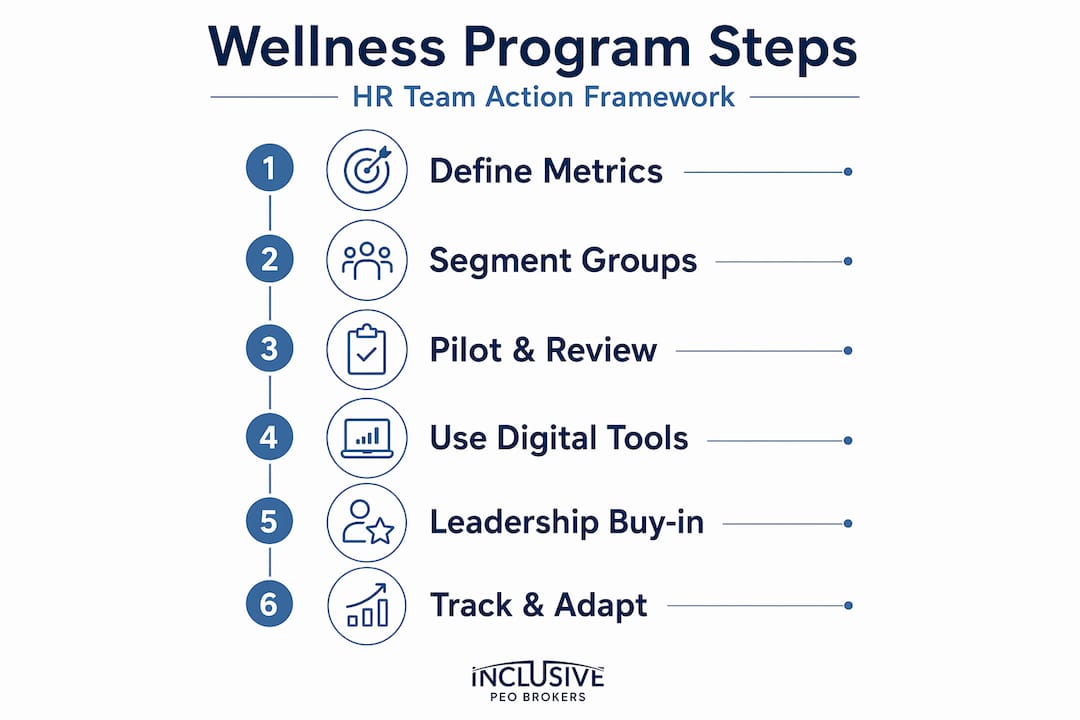
Step 4: Use digital, low-friction tools. Digital wellness interventions integrated into existing workflows increase adoption significantly. Think tools that live inside platforms your team already uses rather than separate apps requiring new logins.
Step 5: Get leadership visibly involved. When managers participate in wellness activities and talk openly about well-being, it sets a norm. Leadership commitment is one of the strongest predictors of whether wellness becomes “how we work” rather than a program employees ignore.
Step 6: Track both health and productivity data. Use manager ratings, project completion rates, or self-reported productivity scores as presenteeism proxies. Absenteeism data alone will understate your program’s value.
Step 7: Adapt continuously. Schedule a quarterly review of participation data and employee feedback. Programs that do not evolve lose relevance quickly.
For small businesses specifically, partnering with a Professional Employer Organization (PEO) can dramatically simplify this process. A PEO gives you access to benefit platforms, wellness tools, and HR expertise that would otherwise require a much larger internal team. If you are evaluating that option, understanding PEO selection for small businesses is a logical starting point.
My honest take on where wellness programs go wrong
I have worked with enough small and mid-sized businesses to say this plainly: most wellness programs fail not because the idea is wrong, but because the execution treats symptoms instead of causes.
I have seen companies invest in premium wellness platforms while simultaneously running their teams into the ground with unrealistic deadlines. The platform gets ignored. The burnout continues. Leadership then concludes that “wellness programs don’t work,” when the real problem was never addressed.
What I have learned is that the importance of health programs at work is inseparable from the quality of the organizational environment around them. You cannot separate a wellness initiative from how managers treat their teams, how workloads are distributed, or whether employees feel psychologically safe enough to actually use mental health resources. The wellness paradox is real, and it catches well-meaning employers off guard.
My honest advice: start smaller than you think you need to. A focused, well-designed 16-week program targeting your highest-risk employees will outperform a sprawling initiative with dozens of components and no clear owner. Build the culture first. The programs will land better once the soil is ready.
— John
How Inclusive PEO Brokers can help you build a better wellness foundation

Designing and managing employee well-being strategies is one of the most time-intensive HR challenges a small business faces. At Inclusive PEO Brokers, we help small and medium-sized businesses find the right PEO partner to handle exactly this kind of complexity. That includes access to employee benefits platforms, wellness program infrastructure, and HR compliance support that most small businesses cannot build on their own.
Our process has guided 133 successful PEO implementations, saving clients an average of 80 hours in the selection process and $634 in costs. If you are ready to move from planning to action, explore our PEO services to see how the right HR partner can take the administrative burden off your plate and give your wellness initiatives the support structure they need to succeed.
FAQ
What is the main role of employee wellness programs?
Employee wellness programs are designed to support physical, mental, and professional well-being at work, with the goal of reducing absenteeism, improving on-the-job productivity, and strengthening workplace culture. Their impact is greatest when they are embedded in daily operations rather than offered as standalone perks.
Do wellness programs actually deliver a positive ROI?
Research shows a positive ROI tendency, but results are not statistically significant when measuring absenteeism alone. The strongest returns appear in presenteeism reduction, which is why tracking productivity alongside absence data gives a more accurate picture of program value.
How long should a wellness program run to be effective?
Programs need to run for at least 12 weeks to produce meaningful behavior change and measurable health outcomes. Shorter initiatives, particularly those under 12 weeks, consistently fall short of sustained results according to randomized controlled trial literature.
What are the biggest mistakes in wellness program design?
The two most common pitfalls are incentivizing health scores instead of behavior change, which can create unfair outcomes for employees with chronic conditions, and ignoring organizational stressors like poor management or excessive workload that undermine individual-level interventions.
How can small businesses implement wellness programs affordably?
Small businesses can start with a focused pilot targeting high-risk employee segments, use digital tools that integrate into existing workflows, and consider partnering with a PEO to access employee benefits infrastructure at a scale that would otherwise be cost-prohibitive.
Recommended
.svg)
Seeking a different solution? Meet Your Business Needs