.png)

What Is Bundled HR Services? A Small Business Guide
If you run a small business or manage HR for a growing team, you have probably heard the term “bundled HR services” and wondered what exactly falls under that label. The concept is straightforward once unpacked, but many owners confuse it with basic payroll software or assume it only applies to large corporations. Understanding what bundled HR services actually include, how they are delivered, and whether they fit your situation is the kind of clarity that can save you real time and money. This guide covers all of it, from core components to delivery models to the pitfalls most people miss.
Table of Contents
- Key takeaways
- What bundled HR services are
- Delivery models: PEO vs. ASO
- Key benefits of bundling HR services
- Potential pitfalls when choosing bundled HR
- How to choose and implement bundled HR effectively
- My honest take on bundled HR for small businesses
- How Inclusive PEO Brokers helps you find the right bundle
- FAQ
Key takeaways
| Point | Details |
|---|---|
| One provider, multiple functions | Bundled HR services combine payroll, benefits, compliance, and more under a single outsourcing partner. |
| PEO vs. ASO models differ significantly | A PEO uses co-employment; an ASO provides admin support only. The distinction affects liability and control. |
| Cost savings are documented | Businesses using bundled HR solutions report an average 27% ROI from cost efficiencies and benefit access. |
| Pitfalls exist in the details | Contract clarity, data ownership, and benefit suitability require scrutiny before you sign. |
| Selection process matters | Matching your business needs to the right bundle type determines whether the arrangement delivers or disappoints. |
What bundled HR services are
At its core, bundled HR services means working with a single third-party provider who handles multiple HR functions together, rather than using separate vendors for payroll, benefits, compliance, and recruiting. Think of it as having an off-site HR department that covers most of the operational and administrative work your internal team would otherwise handle alone. HR outsourcing providers commonly deliver day-to-day support that spans payroll and tax administration, benefits administration, compliance and risk management, recruitment coordination, onboarding, and employee training.
The functions typically included in a bundled human resources package are:
- Payroll and tax administration: Processing employee wages, withholding taxes, and filing payroll tax returns on time.
- Benefits administration: Managing health insurance, retirement plans, and ancillary benefits enrollment and renewals.
- Compliance and risk management: Tracking regulatory changes, maintaining policy templates, and reducing exposure to labor law violations.
- Recruiting and onboarding: Coordinating job postings, applicant tracking, offer letters, and new-hire paperwork.
- Employee relations and training: Supporting managers with HR guidance, dispute resolution resources, and learning management tools.
- HR technology platform (HRIS/HCM): Many bundled HR solutions include integrated software for time tracking, self-service portals, ACA compliance dashboards, and COBRA administration.
The key distinction from standalone HR services is scope. When you buy standalone services, you shop separately for a payroll processor, a benefits broker, a compliance consultant, and an HR software tool. With a bundled package, those pieces arrive together under one contract and one account manager. That integration is where the real value lives, but it is also where the complexity begins.
Pro Tip: Before evaluating any bundle, write down every HR task your business handles each month. That list becomes your benchmark for comparing what each provider’s package actually covers.
Delivery models: PEO vs. ASO
Once you understand what is included, the next question is how bundled HR services are actually delivered. Two models dominate the market, and choosing between them is one of the most consequential decisions you will make.
The PEO model
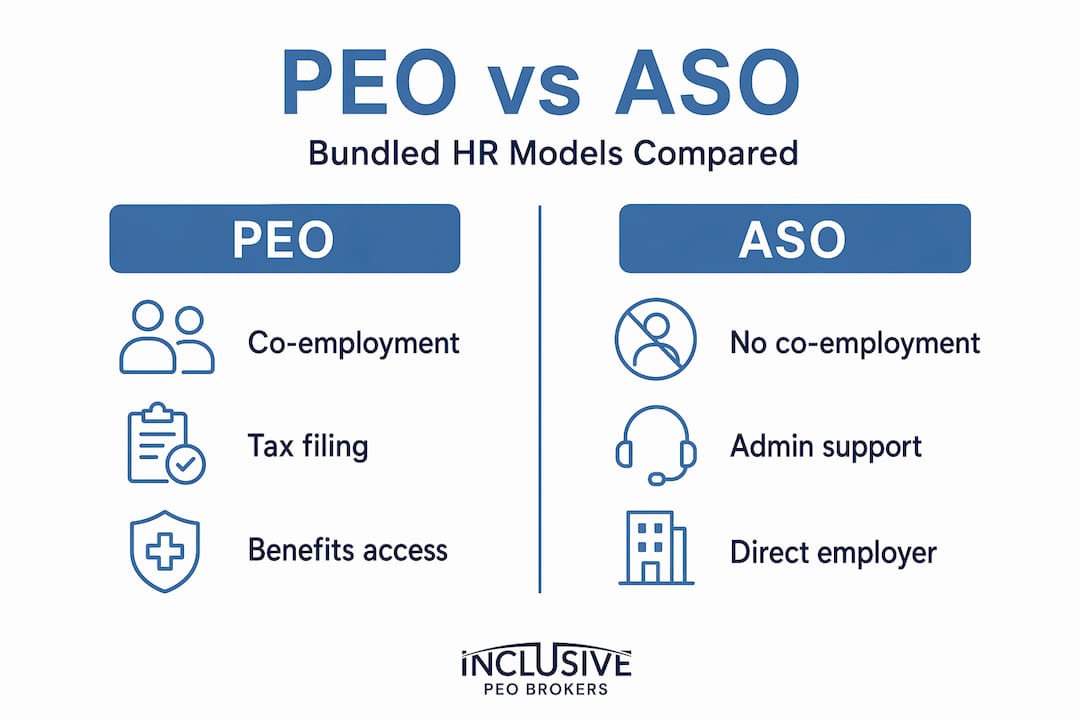
A Professional Employer Organization (PEO) operates through what is called a co-employment model. In practical terms, the PEO becomes the employer of record for payroll tax and benefits purposes, while you retain full control over who you hire, how you manage your team, and what your business does. This shared employment structure lets the PEO pool your employees with thousands of others, which is how smaller businesses gain access to Fortune 500-quality benefits at competitive rates.

The ASO model
An Administrative Services Organization (ASO) provides HR administrative support without entering into co-employment. Your business stays the sole employer of record. The ASO manages the paperwork and processes, but payroll taxes are filed under your employer identification number and benefits are sponsored by your company. The liability and administrative responsibilities remain with you rather than being shared with the provider.
Here is a direct comparison to help you evaluate which model fits your situation:
| Feature | PEO | ASO |
|---|---|---|
| Co-employment relationship | Yes | No |
| Employer of record for payroll tax | PEO | Client business |
| Benefits sponsorship | PEO pools coverage | Client sponsors own plan |
| Compliance liability sharing | Shared with PEO | Client retains all liability |
| Access to large-group benefits | High | Limited |
| Employer control over workforce | Full | Full |
| Best for | Growing businesses needing benefit access | Businesses wanting admin support without co-employment |
The structural distinction between PEO and ASO is foundational because it determines employer liability and administrative responsibilities at every level. Neither model is universally better. A 20-person retail company that needs competitive health insurance will likely favor a PEO. A 50-person professional services firm with an existing benefits plan may prefer an ASO’s lighter-touch support.
Pro Tip: If liability sharing is a concern, ask any PEO candidate to walk you through exactly which tax filings and compliance obligations shift to them under the co-employment agreement. Get it in writing.
Key benefits of bundling HR services
The advantages of HR bundling are well-documented and go beyond simple convenience. Here is where the real business case builds.
Administrative simplicity
Managing four separate vendor relationships takes time, creates inconsistencies, and multiplies the risk of data falling through the gaps. A single bundled provider means one contract, one platform, and one point of contact. Bundling HR with payroll outsourcing lets business leaders focus more on growth by shifting operational HR tasks to external specialists.
Documented cost savings
This is where skeptics often become converts. Businesses using bundled HR solutions report an average 27% return on investment through cost savings and access to large-company benefits at lower cost. That ROI comes from multiple directions: reduced administrative overhead, fewer compliance penalties, and the economies of scale that come when your employees are pooled with thousands of others for benefits pricing.
Access to better employee benefits
This is the advantage that is hardest to replicate on your own. A 15-person company cannot negotiate the same health insurance rates as a provider managing 50,000 employees. Through a PEO-style bundle, your team can access medical, dental, vision, life, and disability coverage at rates that would otherwise be unavailable to a small employer. That benefit access directly affects your ability to attract and retain talent.
Additional benefits worth noting:
- Reduced compliance risk as regulatory changes are tracked and managed by specialists.
- Scalability: as your headcount grows, bundled services scale with you without requiring you to hire additional internal HR staff.
- Consistent HR processes across your team, reducing the variation that creates liability.
Potential pitfalls when choosing bundled HR
Bundled HR service packages are not without their complications. Knowing what to watch for before you commit protects both your business and your employees.
- Confusing administrative support with strategic HR: Administrative help desk services differ vastly from strategic HR roles like performance management and internal policy decisions. Your provider handles the operational layer. Your team is still responsible for building culture, managing performance, and making people decisions.
- Benefit quality and cost-shifting: Watch out for introductory discounts that fade. Promotional discount packages on bundled benefits can lead to higher employee out-of-pocket costs over time, which undermines the value employees perceive from the arrangement.
- Data ownership and workflow integration: Bundled HR only reduces fragmentation if your data actually flows cleanly across payroll, benefits, and compliance systems. Integrated HR lifecycle platforms are designed to unify these functions, but not every provider delivers that integration equally. Verify how your data is stored, who owns it, and what happens to it if you exit the contract.
- Scope clarity in the contract: Understand precisely which HR functions the provider handles day-to-day versus which ones remain your internal responsibility.
Pro Tip: Ask every provider for a written service scope document before signing. If they cannot produce one, that gap will show up in your first 90 days.
How to choose and implement bundled HR effectively
Selecting the right bundled HR solution is a process, not a single decision. Follow these steps to give yourself the best chance of a successful outcome.
- Audit your current HR workload. Document every recurring HR task, the time it takes, and who handles it. This baseline tells you what you need covered and what you can handle internally.
- Define your priorities. Decide whether your primary need is cost reduction, compliance support, better benefits, or simply freeing up time. Your top priority shapes which delivery model fits best.
- Compare PEO and ASO options side by side. Use the comparison table above as a starting framework. Evaluate at least three providers and ask each one the same set of questions about scope, pricing, and contract terms.
- Scrutinize contract terms. Look closely at service scope, pricing escalation clauses, data privacy provisions, and exit terms. Many businesses have been caught by long lock-in periods or fees for data retrieval after leaving.
- Plan your employee communication strategy. When you move to a bundled provider, especially a PEO, employees will receive new onboarding materials and may have questions about their employment status. Prepare clear, simple explanations in advance.
- Leverage technology from day one. The HRIS platform included in your bundle is only as useful as your team’s adoption of it. Schedule training during implementation and designate an internal point of contact for ongoing support questions.
For businesses evaluating first-time PEO selection, working with a broker who has already vetted providers saves significant time and reduces the risk of picking the wrong fit.
Pro Tip: Run a pilot evaluation by asking your top two finalists to walk through a mock payroll cycle and benefits enrollment scenario with your actual data setup. Real demos reveal gaps that sales presentations hide.
My honest take on bundled HR for small businesses
I have worked with enough small businesses navigating HR decisions to say this plainly: bundled HR is more than a convenience play. It is an operational shift that, done well, changes how a business functions at a fundamental level.
What I have seen go wrong most often is not the technology or the pricing. It is the expectation gap. Business owners sign up thinking the provider will handle everything HR-related, then feel let down when they realize performance reviews and culture decisions still belong entirely to them. That is not a provider failure. It is a communication failure that happens before the contract is signed.
What I have also seen work beautifully is a business that was clear about what it needed, selected a provider whose model matched that need, and committed to a clean implementation with proper employee communication. In those cases, the time savings are real, the benefit quality improves noticeably, and the internal HR person or office manager stops spending half their week on compliance paperwork.
My advice: do not shy away from bundled HR because the selection process feels overwhelming. The right partner simplifies far more than it complicates. But do your homework on contract terms, scope definitions, and data ownership before you commit. The details matter as much as the concept.
— John
How Inclusive PEO Brokers helps you find the right bundle

Selecting the right bundled HR solution takes time that most small business owners simply do not have. Inclusive PEO Brokers specializes in exactly this challenge. With 133 successful implementations completed and an average client savings of $634 through the PEO selection process, the team filters the market to identify providers that match your specific business needs, whether that means a full PEO co-employment model or an ASO arrangement. Clients save an average of 80 hours in the evaluation process alone. If you are ready to stop sorting through confusing provider options and start working with a partner who has already done the vetting, explore what Inclusive PEO Brokers offers for small businesses like yours.
FAQ
What is bundled HR services in simple terms?
Bundled HR services means one external provider handles multiple HR functions together, including payroll, benefits administration, compliance, and recruiting, under a single contract rather than separate vendors for each.
How do bundled HR services work day to day?
Your provider manages recurring HR tasks like payroll processing, benefits enrollment, and compliance tracking on an ongoing basis, while you retain control over hiring decisions, performance management, and workplace culture.
What is the difference between a PEO and an ASO?
A PEO uses a co-employment model where it becomes the employer of record for payroll and benefits purposes, sharing liability. An ASO provides administrative support only, with no co-employment and full liability remaining with your business.
Are bundled HR services worth it for small businesses?
For most small businesses, yes. Research shows bundled HR solutions deliver an average 27% ROI through cost savings and access to better employee benefits that would otherwise be unaffordable at small-company scale.
What should I watch out for in a bundled HR contract?
Review pricing escalation terms, exit clauses, data ownership provisions, and the precise scope of services covered. Introductory discounts on benefits can shift costs to employees over time, so validate benefit quality alongside price before signing.
.svg)
Seeking a different solution? Meet Your Business Needs