.png)

What Is HR Outsourcing? A Guide for Small Businesses
If you’re running a small business and HR tasks are eating up time you don’t have, you’re not alone. What is HR outsourcing, exactly, and could it solve your problem? Simply put, HR outsourcing means hiring an external provider to handle some or all of your HR functions, from payroll and benefits administration to compliance and recruitment. It’s a model that 63% of organizations already use in some form. This guide breaks down how it works, what it costs, and how to decide whether it’s the right move for your business.
Table of Contents
- Key Takeaways
- What HR outsourcing actually includes
- Benefits of outsourcing HR functions
- Challenges and things to evaluate carefully
- How to decide whether to outsource HR
- Comparing HR outsourcing models
- My honest take on where HR outsourcing goes wrong
- How Inclusive PEO Brokers helps you find the right fit
- FAQ
Key Takeaways
| Point | Details |
|---|---|
| HR outsourcing is common | Nearly two-thirds of organizations outsource at least one HR function, with payroll being the most frequent. |
| Cost savings are real | Companies that outsource HR report cost reductions of 27% to 40% compared to keeping everything in-house. |
| Multiple models exist | PEOs, ASOs, and hybrid providers each offer different levels of control, coverage, and pricing structures. |
| Culture stays internal | Administrative tasks can be outsourced, but employee relations and company culture must stay managed in-house. |
| Start small if needed | You can begin with a single function like payroll and expand your outsourcing scope as your business grows. |
What HR outsourcing actually includes
HR outsourcing means transferring the management of specific HR tasks to a third-party provider rather than handling them with internal staff. Think of it as hiring a specialist firm to run your HR operations off-site, while your leadership team stays focused on growing the business.
The range of what you can outsource is broad. Some businesses hand off a single function. Others outsource nearly everything. Here are the HR functions most commonly handled by outside providers:
- Payroll processing: Calculating wages, managing deductions, filing payroll taxes, and distributing pay
- Benefits administration: Enrolling employees in health, dental, vision, and retirement plans
- Compliance management: Keeping up with federal, state, and local labor laws, including ADA, FMLA, and FLSA requirements
- Recruitment and onboarding: Posting jobs, screening candidates, running background checks, and managing new hire paperwork
- Employee training and development: Delivering required compliance training or professional development programs
- Risk management: Handling workers’ compensation, safety programs, and unemployment claims
The 79% of outsourcing companies that outsource payroll do so because it’s time-consuming, error-prone, and carries real legal liability. But the model scales well beyond payroll alone.
Your engagement with a provider can range from a narrow service agreement covering just one function to a full co-employment arrangement where the provider becomes the employer of record for your staff. The right scope depends on your business size, internal HR capacity, and budget.
Benefits of outsourcing HR functions
The case for outsourcing your HR functions goes well beyond saving a few hours each month. Here are the advantages that matter most for small businesses.
-
Significant cost reduction. Maintaining a full in-house HR team is expensive. Salary, benefits, software, training, and compliance infrastructure add up fast. Companies report cost reductions of 27% to 40% when they outsource HR compared to running everything internally. For a business with 20 to 50 employees, that’s a meaningful number.
-
Access to expert knowledge. HR law changes constantly. A dedicated outsourcing provider employs specialists who track legislative changes, court rulings, and regulatory updates as their full-time job. 68% of companies face compliance penalties at least once a year. Outsourcing to a specialist is one of the most direct ways to reduce that risk.
-
Scalability that matches your growth. When your headcount doubles, your HR workload more than doubles. An outsourced provider scales with you without requiring you to hire, train, and manage additional HR staff. Proactive outsourcing allows you to integrate technology, workflows, and expertise before complexity becomes unmanageable.
-
Better employee experience. Outsourcing providers often bring HR technology platforms that your employees can access for benefits enrollment, time tracking, and policy questions. Self-service portals reduce friction and give employees faster answers than a single in-house HR coordinator can provide.
-
Strategic focus for your internal team. 61% of HR leaders say that demands on their teams exceed their capacity. When you offload administrative tasks to an outside provider, your internal people, including yourself, can spend time on hiring strategy, culture building, and performance management instead of chasing down paperwork.
Pro Tip: Outsourcing HR administration also signals operational maturity to investors and lenders. If you ever seek outside funding, having structured HR operations in place through a professional provider can strengthen your due diligence profile.
Challenges and things to evaluate carefully
HR outsourcing delivers real advantages, but it isn’t the right fit for every situation without careful thought. Before signing a contract, consider these trade-offs.
-
Reduced direct control. When a third party runs your payroll, benefits, or recruiting process, you give up some day-to-day control over how those tasks are executed. Poorly defined service agreements can lead to delays, errors, or a provider acting in ways that don’t reflect your company’s standards.
-
Data privacy and security. Your HR provider will handle sensitive employee data, including Social Security numbers, salary information, and health records. You need to confirm that any provider you consider uses enterprise-grade security, maintains proper access controls, and complies with relevant data protection requirements.
-
Hidden costs beyond the base fee. Providers typically price services using a Per Employee Per Month (PEPM) model, but high-touch services generate extra fees for things like termination support, complex leave management, or additional reporting. Read your contract carefully and ask for a full breakdown of when additional charges apply.
-
Cultural disconnect. An outside provider doesn’t know your team. Internal management of culture and employee relations remains something you cannot fully hand off. Sensitive conversations around performance, conflict resolution, and trust belong inside your organization.
-
Provider fit matters. A provider built for enterprise clients will not serve a 15-person business well. Matching provider capabilities to your company’s size, industry, and growth stage is one of the most important decisions you’ll make in this process.
Pro Tip: Before signing with any provider, request a sample service agreement and have your legal counsel review it. Pay particular attention to termination clauses, data ownership language, and what’s included vs. what generates an additional invoice.
How to decide whether to outsource HR
Knowing the theory is one thing. Deciding whether HR outsourcing makes sense for your specific business is another. Here’s a practical approach.
-
Identify your pain points. Start by listing the HR tasks that take the most time, generate the most errors, or create the most stress. Payroll errors, missed compliance deadlines, and slow hiring processes are classic indicators that your current approach isn’t working.
-
Assess your internal HR capacity honestly. If you have no dedicated HR staff and you’re handling everything yourself, you’re already operating beyond sustainable limits. Waiting too long to outsource often forces businesses into crisis mode rather than allowing smooth transitions.
-
Start with one function and expand. You don’t have to outsource everything at once. Many small businesses begin by outsourcing payroll only, then add benefits administration and compliance support as they grow more comfortable with the model. This phased approach reduces risk and helps you evaluate provider performance before committing more.
-
Define the scope clearly before you sign. Ambiguity in a service agreement is where problems start. Know exactly what the provider is responsible for, what response times they commit to, and what falls outside the agreement. Both parties should sign off on a written scope of work before any services begin.
-
Treat outsourcing as a strategic tool, not just a cost-cutting move. The businesses that get the most from HR outsourcing use it to free up leadership attention for growth, not just to reduce a budget line. Think about what your team could accomplish with 10 or 15 hours per week back from administrative HR tasks.
Comparing HR outsourcing models
Not all HR outsourcing works the same way. Three primary models serve small businesses, and the differences between them matter significantly when you’re choosing.
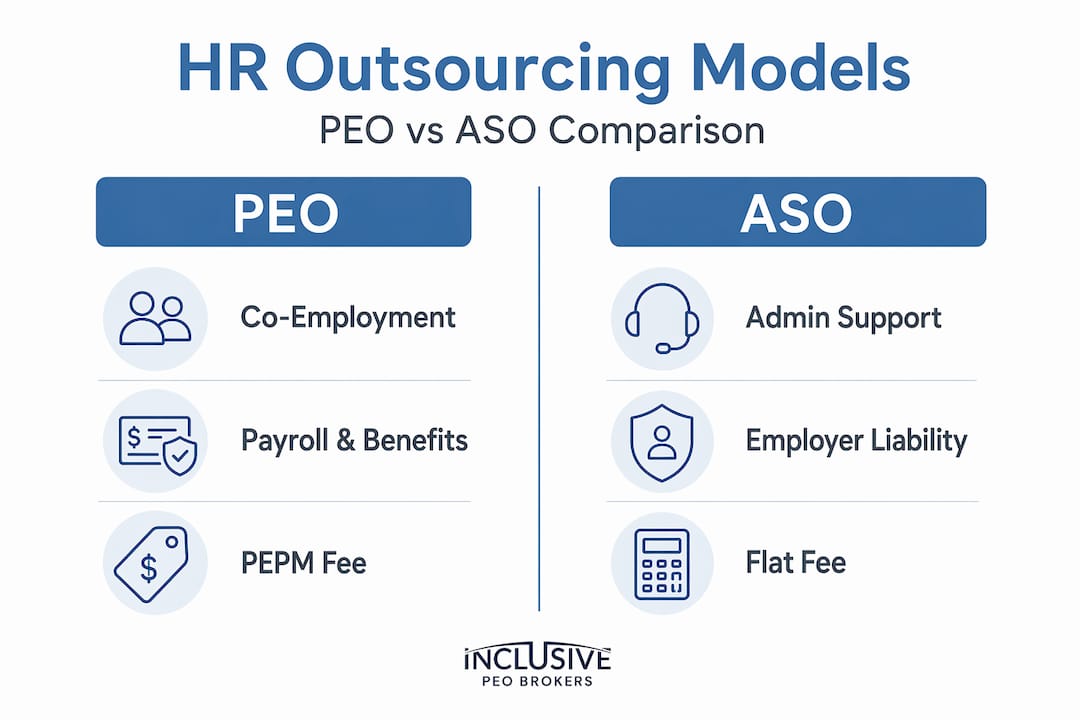
| Model | What they handle | Employment relationship | Best for | Typical cost structure |
|---|---|---|---|---|
| PEO (Professional Employer Organization) | Full HR suite: payroll, benefits, compliance, risk | Co-employment (shared employer) | Businesses wanting full-service HR partnership | 2%–12% of payroll or PEPM |
| ASO (Administrative Services Organization) | Payroll, benefits admin, HR support | You remain sole employer | Businesses wanting administrative support without co-employment | PEPM flat fee |
| Third-party provider | Single-function (e.g., payroll only) | You remain sole employer | Businesses outsourcing one specific function | Per-service or PEPM |
A PEO operates through a co-employment model, meaning the PEO becomes the employer of record for tax and benefits purposes while you retain full control over day-to-day management and job responsibilities. This arrangement gives your employees access to Fortune 500-level benefits at group rates, which is one of the most compelling advantages for small businesses competing for talent.

An ASO performs similar administrative functions but without the co-employment relationship. You own the employer liability. The ASO simply manages the processes on your behalf. This appeals to businesses that want administrative help but aren’t comfortable with shared employer status.
For scalability and offshore staffing considerations, hybrid models combining domestic PEO services with global workforce management are also growing in relevance as small businesses expand internationally.
Pricing across all three models deserves scrutiny. PEPM fees look straightforward, but scope limitations and add-on charges can significantly change the real cost. When evaluating any provider, ask specifically about fees for payroll and compliance processing beyond standard runs, and request examples of what triggers additional billing.
My honest take on where HR outsourcing goes wrong
I’ve worked with enough small businesses to know that the biggest HR outsourcing mistakes aren’t about picking the wrong software or underestimating costs. They’re about handing off the wrong things.
The most common error I see is what I’d call “outsourcing the relationship.” Business owners get excited about offloading administrative work, then they inadvertently let the provider become the face of HR for their team. Employees start calling the vendor hotline instead of talking to leadership. Performance conversations get routed through ticketing systems. That’s where culture quietly starts to erode, and it’s very hard to reverse.
The research supports this. Outsourcing doesn’t replace the human side of HR. Employee relations and culture remain core internal responsibilities, and the businesses that thrive with outsourced HR understand that distinction clearly.
My other strong opinion: don’t wait until you’re drowning. I’ve seen founders try to hire their way out of an HR crisis at 80 employees when outsourcing at 20 would have cost a fraction and prevented the mess entirely. Early adoption means you integrate technology and workflows before everything becomes complicated.
Choose providers who act as strategic partners, not just vendors processing transactions. The right partner will push back when your policies create risk and proactively flag regulatory changes before they become your problem. If a provider just executes tasks without offering guidance, find a better one.
— John
How Inclusive PEO Brokers helps you find the right fit
Knowing what HR outsourcing is and actually choosing the right provider are two very different challenges. That’s where Inclusive PEO Brokers comes in.

Inclusive PEO Brokers specializes in matching small and midsize businesses with the PEO or HR outsourcing provider that fits their specific needs, industry, and growth stage. Their process has saved clients an average of 80 hours in the selection process and generated an average cost saving of $634. With 133 successful implementations completed, they bring a proven track record to what would otherwise be an overwhelming search. Whether you’re exploring first-time PEO selection or need help evaluating your current provider, Inclusive PEO Brokers guides you through every step with no pressure and no guesswork.
Book a Free Consultation → inclusivepeo.com/services/peo-broker-in-san-francisco-ca
FAQ
What is HR outsourcing in simple terms?
HR outsourcing means hiring an external company to manage some or all of your HR functions, such as payroll, benefits, or compliance, instead of handling them with in-house staff.
What HR functions are most commonly outsourced?
Payroll is the most frequently outsourced HR function, with 79% of companies that outsource any HR task starting there, followed by benefits administration and compliance management.
How much does HR outsourcing cost?
Most providers charge a Per Employee Per Month (PEPM) fee, and businesses typically see cost reductions of 27% to 40% compared to maintaining full in-house HR departments.
What is the difference between a PEO and an ASO?
A PEO enters a co-employment relationship with your business, sharing employer responsibilities, while an ASO provides administrative HR support without becoming a co-employer, leaving full employer liability with you.
Can a small business benefit from HR outsourcing?
Yes. Small businesses often benefit the most because outsourcing gives them access to specialist expertise, enterprise-level benefits, and compliance support they couldn’t afford to build internally.
.svg)
Seeking a different solution? Meet Your Business Needs