.png)

PEO Unemployment Claims: Your State-by-State Guide

Under a PEO co-employment arrangement, who handles unemployment insurance claims depends entirely on which reporting model your state uses. In PEO-reporting states, the PEO is the employer of record for state unemployment insurance (SUI) purposes and files taxes, receives claim notices, and manages responses on your behalf. In client-reporting states, your company holds its own SUI account, receives notices directly, and bears full responsibility for responding. Hybrid states split those duties in ways that vary by state statute. When a UI claim notice arrives, your first moves matter more than anything else.
Immediate actions when a UI claim notice arrives:
- Forward the notice to your PEO contact within 24 hours, regardless of reporting model.
- Confirm in writing which reporting model applies to your state (check your PEO contract or your state workforce agency page).
- Pull separation documentation: termination letters, performance records, final pay stubs, and any written warnings.
- Note the response deadline on the notice, which typically runs 10–14 days from the mail date.
- If the deadline is within 48 hours or the claim is disputed, contact your PEO representative immediately, or reach out to a PEO broker for escalation support.
In a PEO-reporting state, your PEO handles the response. In a client-reporting state, your HR team files directly with the state. In a hybrid state, confirm the split before assuming either party has it covered.
Key Takeaways
The reporting model your state uses determines who files SUI taxes, who receives claim notices, and whose experience rating absorbs the financial impact of every approved unemployment claim.
| Point | Details |
|---|---|
| Reporting model is the foundation | Confirm whether your state is PEO-reporting, client-reporting, or hybrid before your first claim arrives. |
| Deadlines are unforgiving | Most states allow only 10–14 days to respond to a UI claim notice; missing the window typically results in a default finding against you. |
| Pooled models carry hidden cost risk | Under a pooled PEO account, your SUI rate can rise due to other clients’ claims, not your own history. |
| Contract clauses protect you | Require a notification SLA, audit rights, chargeback methodology disclosure, and an indemnity clause before signing any PEO agreement. |
| Inclusive PEO Brokers screens for SUI fit | With 133 implementations completed, Inclusive PEO Brokers matches employers to PEOs based on reporting model, contract terms, and SUI handling in their specific state. |
Table of Contents
- Why the SUI reporting model changes your tax bill and claim outcomes
- How PEO-reporting, client-reporting, and hybrid models actually work
- Which states use PEO-reporting, client-reporting, or hybrid rules
- How unemployment claims are processed from notice to charge
- How to give your PEO or TPA authority to act on claims
- What HR must do when a UI claim notice arrives: a step-by-step checklist
- How claims affect your SUI tax rate and what chargebacks actually cost
- Contract clauses that protect you from surprise UI costs
- How Inclusive PEO Brokers reduces your SUI risk before you sign
- What actually matters most when managing UI claims with a PEO
- Inclusive PEO Brokers helps you find the right PEO for your SUI needs
- Sources
Why the SUI reporting model changes your tax bill and claim outcomes
State unemployment insurance is an employer-funded, state-administered program. You pay SUI taxes on each employee’s wages up to a state-defined taxable wage base, and the state uses those funds to pay benefits to workers who qualify after separation. Employees contribute nothing to SUI in most states. What most employers don’t fully appreciate is that the PEO reporting model determines whose experience rating drives the tax rate your business actually pays.
Experience rating is the mechanism states use to tie an employer’s SUI tax rate to its own claims history. The more former employees who collect benefits charged to your account, the higher your rate climbs over time. Under a pooled (aggregate) model, your claims are blended into the PEO’s master account alongside every other client company. A single large employer with heavy layoffs can push the pooled rate up for everyone. Under a client-level model, your claims stay on your own SUI account, so your rate reflects your own history, not your PEO’s portfolio. Many states have shifted toward client-level reporting specifically to reduce SUTA-dumping risk and preserve accurate experience ratings.
The practical stakes are real:
- Who pays SUI taxes: In PEO-reporting states, the PEO remits taxes under its own account. In client-reporting states, you remit directly.
- Whose rate changes: In a pooled model, the PEO’s blended rate applies. In a client-level model, your individual experience rating drives your rate.
- Who receives and responds to claim notices: PEO-reporting states route notices to the PEO. Client-reporting states send them to you.
- Risk at PEO exit: Leaving a pooled model can reset your experience rating to the new-employer rate, which is often higher than what you earned through years of low claims activity. Moving away from a pooled model can cause a company to lose its accumulated experience rating entirely.
- FUTA credit exposure: If SUI taxes are not filed correctly, your FUTA credit (the federal offset that reduces your 6% FUTA rate to 0.6%) can be jeopardized.
Pro Tip: Ask your PEO for a breakout of SUI charges by employee and by quarter before your annual renewal. Most PEOs can produce this report, but few clients ever request it. Seeing your individual charge history lets you spot anomalies, verify that disputed claims were resolved in your favor, and build a data-backed case for a lower rate at renewal.
How PEO-reporting, client-reporting, and hybrid models actually work
The three-category framework used by major PEOs like Justworks and Deel maps directly to how states have written their PEO statutes. Understanding the model in your state is the single most important factor in knowing what your HR team is responsible for.
PEO-reporting states: The PEO registers as the employer of record with the state workforce agency and maintains the SUI account. It files quarterly wage reports, remits SUI taxes, and receives all claim and charge notices. When a former employee files for unemployment, the state sends the notice to the PEO. Your company’s claims history is pooled into the PEO’s master account. You pay SUI as a pass-through cost embedded in your PEO service fee, often at the PEO’s blended rate.

Client-reporting states: Your company maintains its own SUI account with the state. The PEO may handle payroll and HR administration, but SUI tax filings and claim responses are your responsibility. Notices go directly to your registered address. Your experience rating is entirely your own, which is an advantage if your claims history is clean and a liability if it isn’t.
Hybrid states: Some states split the duties. A common hybrid arrangement requires the PEO to file wage reports and remit taxes under its own account while routing claim notices to the client employer for response. The exact split varies by state statute and sometimes by the specific PEO’s registration status.
Here is how the filing and claims flow looks in practice:
- PEO-reporting: Employee files claim → state sends notice to PEO → PEO gathers separation docs from client → PEO files response → adjudication → charge assigned to PEO’s pooled account → PEO passes charge back to client via invoice or rate adjustment.
- Client-reporting: Employee files claim → state sends notice directly to client employer → client files response (often with PEO assistance) → adjudication → charge assigned to client’s own SUI account → client’s experience rating adjusts.
- Hybrid: Employee files claim → state sends notice to client (or PEO, depending on state) → response filed by designated party → charge assigned per state rules, sometimes split.
State examples illustrate the range. Indiana’s Department of Workforce Development publishes explicit guidance on how PEOs affect SUTA accounts, treating the client employer as the responsible party for SUI in most circumstances. Washington State requires PEOs to register with the Employment Security Department and handles reporting through the PEO’s account. New York falls into a hybrid category where registration and reporting obligations depend on the PEO’s specific licensure status.
Which states use PEO-reporting, client-reporting, or hybrid rules
The state breakdown below reflects the framework documented by major PEOs and state workforce agencies. Because state statutes and administrative rules change through rulemaking and legislation, treat this as a starting point, not a final answer. Always verify your state’s current designation directly with your state workforce agency or your PEO’s compliance team before making any billing or tax decisions.
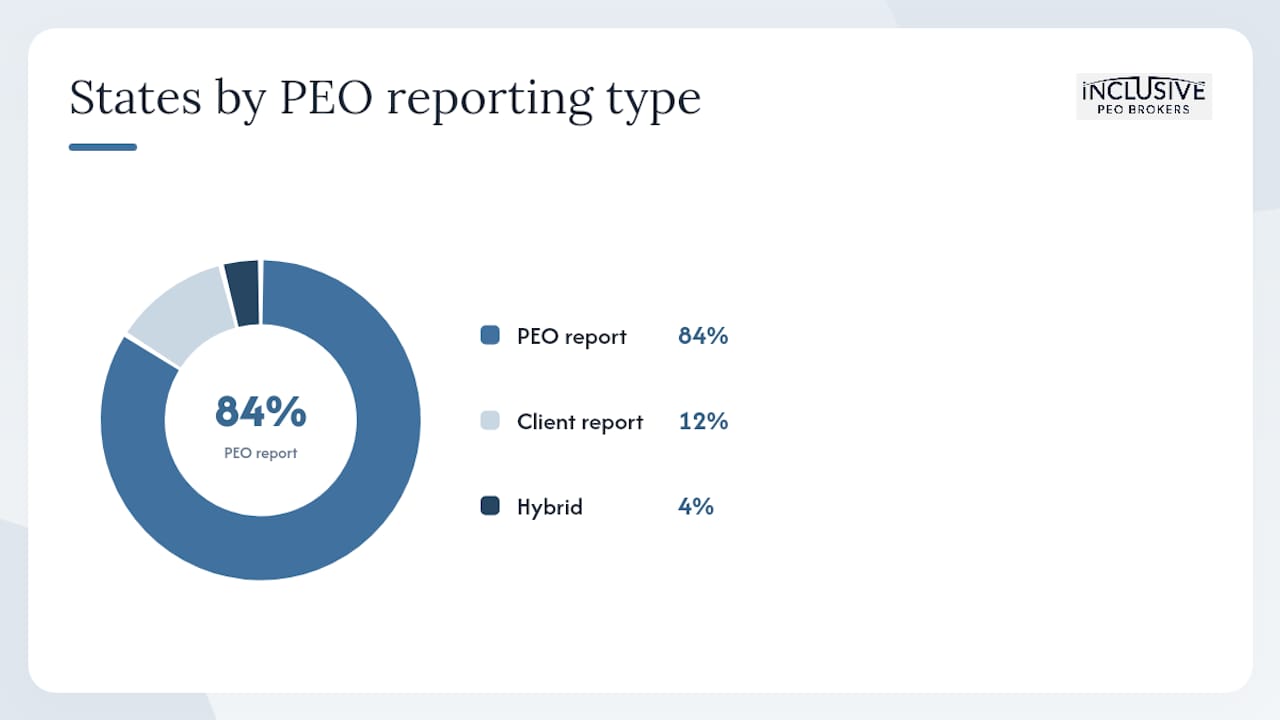
PEO-reporting states (PEO holds the SUI account, files taxes, receives notices):
States in this group include Alabama, Alaska, Arizona, Arkansas, Colorado, Connecticut, Delaware, Georgia, Hawaii, Idaho, Illinois, Iowa, Kansas, Kentucky, Louisiana, Maine, Maryland, Massachusetts, Michigan, Minnesota, Mississippi, Missouri, Montana, Nebraska, Nevada, New Hampshire, New Mexico, North Carolina, North Dakota, Ohio, Oklahoma, Oregon, Rhode Island, South Carolina, South Dakota, Tennessee, Utah, Vermont, Virginia, West Virginia, Wisconsin, and Wyoming. In these states, your SUI obligations flow through the PEO’s master account.
Client-reporting states (employer holds the SUI account, files taxes, receives notices):
California, Florida, New Jersey, New York, Pennsylvania, and Texas are among the states that require client-level reporting, meaning your company maintains its own SUI account even while working with a PEO. Deel’s help center and Justworks both publish state lists that cross-reference these designations, though each PEO’s list may reflect its own registration status rather than a universal rule.
Hybrid states (split duties between PEO and client):
Indiana and Washington are two well-documented hybrid examples. Indiana DWD’s guidance explains that the client employer typically retains the SUI account while the PEO may handle administrative filings. Washington’s Employment Security Department requires PEO registration and outlines specific quarterly reporting obligations that differ from standard employer filings.
How to verify your state’s current rule:
- Go to your state’s workforce agency website (search “[state name] unemployment employer” or “[state] workforce agency”).
- Search for “PEO” or “professional employer organization” in the employer section.
- Check your PEO contract’s SUI exhibit, which should name the reporting model and the account holder.
- Cross-reference with your PEO’s state list (Justworks and Deel both publish these), but confirm against the state .gov page.
State rules do change. Nebraska’s statutes, for example, define PEO obligations under Nebraska statute 48-2702, and any amendment to that statute can shift reporting responsibilities. Build a calendar reminder to re-verify your state’s designation annually or whenever your PEO notifies you of a regulatory update.
How unemployment claims are processed from notice to charge
The claim life cycle follows a predictable sequence, but the party receiving each notice depends on your reporting model. Here is the end-to-end flow.
In a PEO-reporting state, the state workforce agency sends the initial claim notice to the PEO. In a client-reporting state, it comes directly to your registered employer address. In a hybrid state, confirm with your PEO which party is designated to receive notices before a claim ever arrives.
Step-by-step claim timeline:
- Day 0 — Claimant files: A former employee submits a claim to the state workforce agency, typically online or by phone.
- Days 1–5 — Notice issued: The state sends a claim notice (sometimes called a “Notice of Unemployment Insurance Claim Filed”) to the employer of record on file.
- Days 1–10 — Response window opens: Most states give the employer 10–14 days from the mail date to respond. Washington Administrative Code 192-300-200 illustrates how state-specific procedural rules define these windows. Missing this window almost always results in a default finding against the employer.
- Days 5–14 — Employer response filed: The employer (or PEO on the employer’s behalf) submits a response with the reason for separation and supporting documentation.
- Days 14–30 — Adjudication: The state reviews both sides, may conduct a phone interview, and issues an initial determination.
- Days 30–45 — Charge assignment: If benefits are approved, the state assigns the charge to the employer’s SUI account (or the PEO’s pooled account in PEO-reporting states).
- Days 30–45 — Appeal window: Either party can appeal the initial determination, typically within 10–30 days of the determination date. Deadlines vary by state.
Evidence to assemble before the response deadline:
- Written termination letter or resignation notice
- Performance improvement plans, written warnings, or disciplinary records
- Final payroll records confirming last day worked and final pay
- Any signed agreements (severance, separation, non-compete)
- Attendance records if the separation involved attendance issues
- Email or written communications relevant to the reason for separation
Common pitfalls that cost employers:
- Forwarding the notice to the PEO a day before the deadline, leaving no time for the PEO to prepare a complete response.
- Submitting a response that states only “terminated for cause” without attaching the documentation that proves it.
- Assuming the PEO received the notice when it was actually mailed to the client’s address (common in hybrid states or when addresses on file are outdated).
- Missing the appeal window because the initial determination was filed in a portal the HR team doesn’t monitor regularly.
How to give your PEO or TPA authority to act on claims
Even in PEO-reporting states, there are situations where your company needs to formally authorize a third party to act on your behalf: during a PEO transition, when a third-party administrator (TPA) handles claims management, or when your PEO requires explicit client authorization to access state portals on your account.
Common authorization documents you may need:
- Power of attorney (POA): A general or limited POA authorizing the PEO or TPA to represent your company in unemployment proceedings.
- State-specific representative authorization forms: Many states have their own forms. California’s Employment Development Department, for example, uses a specific representative designation form separate from a general POA.
- Agent authorization letters: Some states accept a signed letter on company letterhead designating the PEO or TPA as your authorized representative.
- Employer portal access credentials: For states with online claims management portals, your HR team may need to add the PEO as an authorized user within the portal itself.
Washington State is a useful example of how specific these requirements can get. The Washington Employment Security Department requires PEOs to register separately and outlines the documentation needed for PEOs to act on behalf of client employers in quarterly reporting and claims. New York’s Department of Labor publishes dedicated PEO guidance covering registration and employer responsibilities that includes representative authorization steps.
Action items for HR after granting access:
- Log into the state’s employer portal and confirm the PEO or TPA appears as an authorized representative.
- Send a test inquiry to the PEO to verify they can see your account and receive forwarded notices.
- Update your company’s registered mailing address with the state to match where notices should actually go.
- Set up email routing rules so that any UI-related correspondence forwarded from the state goes to both your HR team and your PEO contact simultaneously.
- Document the authorization date and the scope of authority in your HR records.
What HR must do when a UI claim notice arrives: a step-by-step checklist
Speed and documentation quality determine most outcomes. A well-prepared response filed on day 8 beats a rushed, incomplete one filed on day 13.
- Day 0 — Log the notice: Record the date received, the claimant’s name, the state, and the response deadline. Set a calendar alert for 48 hours before the deadline.
- Day 0 — Identify the reporting model: Confirm whether your state is PEO-reporting, client-reporting, or hybrid. This determines who files the response.
- Day 0 — Notify your PEO: Forward the notice to your PEO contact immediately, even if you believe it’s their responsibility to handle. Confirm receipt in writing.
- Day 1 — Pull the employee file: Gather the separation letter, performance records, attendance logs, final pay stub, and any signed agreements. Organize them in a single folder (physical or digital).
- Day 1–2 — Verify the separation reason: Confirm internally with the manager who made the separation decision. Get a written statement if the reason was performance-based or for cause.
- Day 2–3 — Draft the response: In client-reporting states, your HR team drafts the response. In PEO-reporting states, your PEO drafts it, but you supply the facts and documentation. Review the draft before it is submitted.
- Day 3–7 — Submit with documentation: File the response through the state’s designated channel (online portal, fax, or mail) and keep a timestamped confirmation.
- Day 7–14 — Monitor for adjudication: Watch for the state’s initial determination. In PEO-reporting states, confirm your PEO will forward the determination to you promptly.
- Post-determination — Evaluate the appeal: If the determination goes against you and you have strong documentation, file an appeal within the state’s window. Most states allow 10–30 days.
- Post-resolution — Update your records: Note the outcome, the charge amount (if any), and any process gaps that caused delays. Use this to improve your response process for future claims.
Keep all claim documentation for an extended period, as many states audit SUI accounts and may reassess charges retroactively. Many states audit SUI accounts and can reassess charges retroactively.
How claims affect your SUI tax rate and what chargebacks actually cost
Every approved unemployment claim that is charged to your account raises your experience rating over time, which translates directly into a higher SUI tax rate. The financial mechanics differ depending on whether you are in a pooled or client-level model.
Under a pooled (PEO master account) model, your claims are aggregated with every other employer in the PEO’s portfolio. The PEO charges you SUI as a pass-through cost, often at its blended portfolio rate. If the PEO’s overall claims experience worsens, your rate can rise even if your own employees rarely file claims. This cross-subsidization effect is one of the primary reasons states have moved toward client-level reporting. The transparency problem is real: under a bundled pricing model, you may not see a line-item breakdown of what you are actually paying for SUI versus other pass-through costs.
Under a client-level account model, your SUI rate is a direct function of your own claims history. A clean record over three to five years can push your rate well below the new-employer rate. A single large layoff can spike it for the next three years. Peometrics documents real employer scenarios where the SUI account changed materially during PEO onboarding, catching employers off guard.
Practical budgeting and audit steps:
- Request a line-item SUI invoice from your PEO each quarter showing charges by employee and by state.
- Compare the rate on your invoice to your state’s published new-employer rate and your prior-year rate to spot unexpected increases.
- Ask your PEO to confirm whether your charges are pooled or client-level, in writing, before signing any renewal.
- Build a SUI reserve fund equal to roughly one quarter of your estimated annual SUI liability to absorb unexpected chargebacks.
- If you are in a pooled model and considering leaving the PEO, request your claims history before exit so you can apply for experience-rating transfer where the state allows it.
FUTA credit preservation is a separate but related concern. If SUI taxes are filed late or under the wrong account, that credit can be reduced or lost entirely. In a PEO-reporting state, the PEO’s filing accuracy directly affects your FUTA credit, which is one more reason to audit SUI filings annually.
Contract clauses that protect you from surprise UI costs
The PEO contract is where your protections either exist or don’t. Negotiating the right clauses before signing is far easier than disputing charges after the fact.
Clauses to require in your PEO agreement:
- Reporting model confirmation: A written statement naming your state’s reporting model (PEO-reporting, client-reporting, or hybrid) and which party holds the SUI account.
- Notification SLA: A clause requiring the PEO to forward any UI claim notice to your designated HR contact within 24–48 hours of receipt, with a written confirmation.
- Chargeback methodology: A clear description of how SUI charges are calculated and passed through to you, whether pooled or client-level, and how the rate is determined.
- Indemnity clause: Protection against charges that result from the PEO’s administrative errors, late filings, or failure to respond to a claim on time.
- Audit rights: Your right to request and receive a full accounting of SUI charges, filings, and experience-rating history at any time during the contract term.
- Termination transition handling: A clause specifying how SUI accounts, experience ratings, and pending claims are handled when you exit the PEO, including who retains the claims history and how in-flight claims are resolved.
- Data access on exit: A guarantee that you receive your full SUI account history, claims records, and tax filings within a defined period (typically 30 days) after contract termination.
Negotiation realities: Notification SLAs and audit rights are typically negotiable. Chargeback methodology is often a standard policy the PEO applies uniformly across its client base, but you can negotiate for client-level reporting in states where the PEO offers it as an option. Indemnity clauses vary widely; some PEOs offer them only for errors directly attributable to their own administrative team, not for outcomes driven by adjudication decisions.
Suggested SLA values to push for: 24-hour notice forwarding, 48-hour acknowledgment of receipt, and a 5-business-day turnaround for providing claims documentation to your HR team. For termination transitions, a 60-day advance notice requirement and a 30-day data delivery window are reasonable starting points.
How Inclusive PEO Brokers reduces your SUI risk before you sign
Most employers discover their PEO’s SUI reporting model after the first claim arrives. A broker-assisted selection process surfaces that information before you commit.
Inclusive PEO Brokers screens PEO vendors specifically for how they handle SUI in your state, what their chargeback methodology looks like, and whether client-level reporting is available as an option. That screening happens during vendor evaluation, not after onboarding. The firm has completed many successful PEO implementations, with clients reporting substantial time saved in the selection process and meaningful cost savings. Those numbers reflect a process built around matching employers to PEOs whose contract terms, reporting models, and SUI handling align with the client’s actual risk profile.
During contract negotiation, a broker can push for the specific clauses outlined above, including notification SLAs, audit rights, and indemnity language, because they know which PEOs will move on those terms and which won’t. After implementation, Inclusive PEO Brokers provides ongoing support, including guidance on PEO exit strategy and transition planning when a client needs to change vendors without losing their accumulated experience rating.
What to ask when engaging a broker for SUI-related concerns:
- Which PEOs in my state offer client-level reporting, and which use a pooled model?
- What is the PEO’s standard notification SLA for UI claim notices?
- Does the PEO’s contract include an indemnity clause for administrative errors?
- How does the PEO handle in-flight claims during a contract termination?
- Can you provide a side-by-side comparison of SUI pass-through costs across the PEOs you are recommending?
Bring a broker into the process before you sign, not after a claim dispute surfaces. The earlier the engagement, the more leverage you have on contract terms.
What actually matters most when managing UI claims with a PEO
The single most important thing your HR team can do is verify your state’s reporting model on day one of your PEO relationship, then build a response protocol around it before any claim arrives. Everything else, the documentation, the deadlines, the contract clauses, flows from knowing who is responsible for what.
My practical priorities, in order:
- Confirm the reporting model in writing. Don’t rely on a verbal assurance from a sales rep. Get the state-by-state breakdown in your contract exhibit.
- Keep separation documentation centralized. Every termination should generate a file that is complete enough to support a UI response without any additional research. Build that habit before you need it.
- Set up dual notification. In PEO-reporting states, UI notices go to the PEO, but you should receive a copy within 24 hours. Build that into your contract and verify it works with a test scenario.
- Insist on audit rights. You cannot manage SUI costs you cannot see. Quarterly charge breakouts are the minimum; annual experience-rating reviews are better.
- Plan your exit before you need it. If you ever leave a PEO, your experience rating and in-flight claims are at risk. Know the transition terms before you sign, not when you are trying to leave.
Inclusive PEO Brokers helps you find the right PEO for your SUI needs
Sorting through PEO contracts, reporting models, and SUI pass-through costs on your own takes time most HR teams don’t have. Inclusive PEO Brokers cuts that process down to what matters: matching your business to a PEO whose SUI handling, contract terms, and state coverage actually fit your situation.

Clients save an average of 80 hours in the selection process and $634 in costs, backed by 133 completed implementations. The firm handles vendor screening, side-by-side comparisons, contract negotiation, and post-implementation support, including exit planning when you need to change PEOs without losing your experience-rating history.
If you have an urgent UI claim notice or you are evaluating PEOs and want to understand how SUI reporting will work in your state, book a free discovery call with Inclusive PEO Brokers. You can also explore the full broker service to see how the matching process works before you commit to anything.
Sources
State rules change through legislation and rulemaking. Verify your state’s current designation directly with the relevant agency before acting on any list, including this one.
- PEO vs Client Reporting States: How It Affects Your SUI Rate - LegalClarity
- State Unemployment Insurance (handling under PEO) - PeoMetrics
- Professional employer organizations
- Indiana Unemployment for Employers
State workforce agency websites follow a consistent pattern: search “[your state] unemployment employer” or “[your state] workforce agency” to reach the primary source for your jurisdiction. Confirm the current reporting model designation annually, particularly if your state has active PEO legislation pending.
Recommended
.svg)
Seeking a different solution? Meet Your Business Needs