.png)

PEO for Trucking: What Fleet Owners Need to Know

A PEO is a strong fit for most trucking companies, and the clearest case is when you’re managing multi-state payroll, mileage and per-diem pay structures, and workers’ compensation exposure across a mixed driver workforce. A Professional Employer Organization enters a co-employment arrangement with your business, handling payroll processing, tax filings, benefits administration, and HR compliance while you retain full operational control over dispatch, routing, and safety. Inclusive PEO Brokers helps trucking companies find and implement the right PEO partner, matching your specific fleet profile to providers with real trucking experience.
Three situations where a PEO for trucking clearly pays off:
- Multi-state payroll and tax nexus. Drivers crossing state lines trigger withholding and unemployment obligations in multiple states. A trucking-capable PEO manages those registrations and filings automatically.
- Mileage, per-diem, and complex pay runs. Calculating pay from cents-per-mile rates, percentage-of-load, detention pay, and IRS-compliant per-diem substantiation is error-prone without purpose-built payroll tools.
- Workers’ comp pooling and benefits purchasing. Trucking carries some of the highest comp premiums in any industry. A PEO’s pooled purchasing power can reduce those rates and give your drivers access to health benefits that compete with larger carriers.
One scope note worth stating plainly: a PEO handles employment records, payroll, and HR compliance. Safety management, dispatch decisions, and daily driver oversight remain with you as the carrier.
Key Takeaways
A PEO for trucking delivers the most value when your fleet faces multi-state payroll complexity, high workers’ compensation exposure, and driver classification risk that a general payroll provider isn’t equipped to handle.
| Point | Details |
|---|---|
| Classification comes first | Audit employee vs. contractor status before engaging a PEO — existing misclassification follows you into the arrangement. |
| Payroll capability is non-negotiable | Confirm native support for mileage pay, per-diem substantiation, and multi-state withholding before any proposal stage. |
| Workers’ comp pricing matters | Pay-as-you-go comp and pooled rates can reduce premiums; verify NCCI code accuracy and claims response SLA in writing. |
| Hidden fees are common | Require an itemized fee schedule and review exit terms, state registration costs, and audit adjustment policies before signing. |
| Inclusive PEO Brokers shortens selection | The broker’s matchmaking process saves clients significant time and expense, with numerous completed implementations. |
Table of Contents
- How does a PEO support your trucking operations?
- Trucking payroll, classification, and regulatory challenges your PEO must handle
- How PEOs manage workers’ compensation and safety programs for fleets
- What does a trucking PEO actually cost, and what are the trade-offs?
- How do you choose the right PEO for your trucking company?
- How Inclusive PEO Brokers helps trucking companies find the right PEO
- What most trucking owners get wrong when evaluating PEOs
- Inclusive PEO Brokers can match your fleet with the right PEO partner
- Primary sources and further reading
- Sources
How does a PEO support your trucking operations?
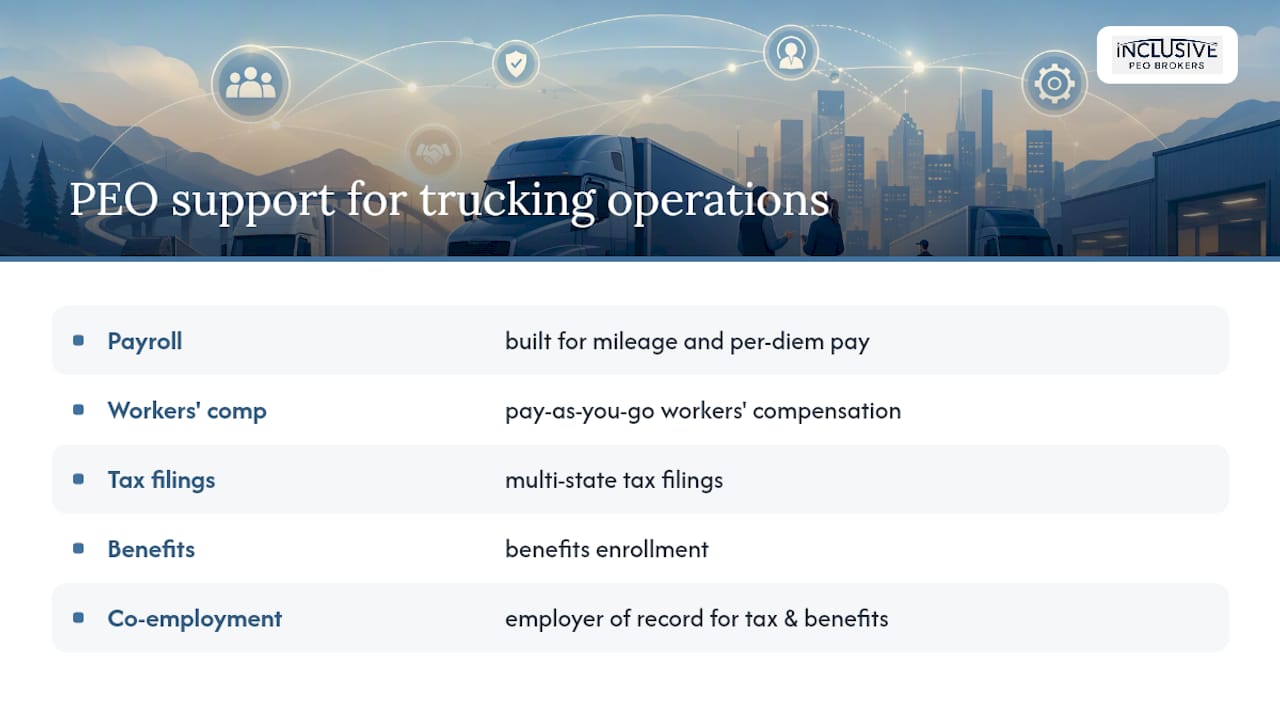
A PEO functions as an off-site HR department that takes on the administrative weight of employment. For a trucking company, that means payroll processing built for mileage and per-diem pay, pay-as-you-go workers’ compensation, multi-state tax filings, benefits enrollment, and onboarding paperwork for new drivers. The co-employment model lets the PEO act as the employer of record for tax and benefits purposes, while you direct the work.
The table below maps core PEO capabilities to the trucking-specific needs they address.
Pro Tip: When evaluating a PEO, ask specifically whether their payroll engine handles mileage-based pay natively or whether it requires a manual workaround. A PEO that processes mileage pay through a flat-salary field and then adjusts manually is a red flag for errors and audit exposure. Also confirm how they handle fuel tax interactions if you reimburse drivers for fuel separately from per-diem.
The delineation of control matters here. Your PEO partner owns the employment records and tax filings. You own the truck, the route, the safety policy, and the driver relationship on the road. That split is not a limitation; it is the design. A well-structured PEO arrangement frees your operations team from payroll administration without touching your authority over how drivers do their jobs.
Trucking payroll, classification, and regulatory challenges your PEO must handle
This is where most trucking PEO arrangements succeed or fail. The complexity is real, and a PEO without genuine trucking experience will struggle with all of it.
Driver classification: employee vs. independent contractor
Misclassifying a driver as an independent contractor when the working relationship meets the IRS or DOL employee tests creates back-tax liability, penalties, and potential FMCSA audit complications. The facts that matter for a defensible classification:
- Does your company control how the driver performs the work, not just the result?
- Does the driver use your equipment, or their own?
- Is the driver economically dependent on your company as their primary source of income?
- Does the driver operate under your DOT authority, or their own?
- Is the driver a true owner-operator with their own authority and insurance, or a lease-purchase driver under your authority?
Lease-purchase drivers are a particularly common classification trap. They may feel like contractors because they’re paying toward truck ownership, but if they operate under your authority and you control their dispatch, most regulators treat them as employees. Your PEO must understand this distinction and help you document it correctly.
Payroll complexity: a real example
Consider a driver who runs 2,800 miles in a week at $0.58 per mile, earns $75 in detention pay, receives a $66-per-day per-diem allowance for four nights away from home, and crosses into three states. Their gross pay calculation involves mileage wages, a non-taxable per-diem component (substantiated under IRS accountable plan rules), state withholding allocations for each state worked, and overtime analysis under the Motor Carrier Act exemption. A PEO without a payroll engine built for this scenario will either miscalculate the taxable/non-taxable split or misfile state withholding, or both.
Multi-state unemployment insurance adds another layer. Driver domicile state, the state where work is primarily performed, and reciprocity agreements between states all affect where UI premiums are owed. A trucking-capable PEO tracks this automatically rather than requiring your office to manage it manually.
DOT/FMCSA touchpoints: what a PEO can and cannot do
A PEO can support FMCSA-aligned medical qualification processes, maintain employment and pay records in audit-ready format, and administer your DOT drug and alcohol testing program. What a PEO cannot do is make safety decisions on your behalf. The carrier retains responsibility for Hours of Service compliance, driver qualification file maintenance, and the operational decisions that affect road safety.
Driver qualification file management is an area where PEO support is genuinely useful. Keeping current CDL copies, medical certificates, MVR pull records, and annual review documentation in order is time-consuming. A PEO with trucking experience builds this into their HR administration workflow.
Checklist: what to verify during PEO demos
- Does their payroll system handle mileage pay, per-diem substantiation, and detention pay natively?
- Can they register and remit state withholding and UI in all states your drivers operate?
- How do they handle owner-operator payments (1099 vs. W-2)?
- What is their process for lease-purchase driver classification?
- Do they integrate with your ELD provider for hours-of-service data, or does that remain a separate system?
- Can they administer a DOT-compliant drug and alcohol testing program, including random testing pools?
- What is their experience with FMCSA audit support for employment records?
How PEOs manage workers’ compensation and safety programs for fleets
Trucking workers’ compensation is expensive. NIOSH identifies truck driving as a high-risk occupation with elevated rates of musculoskeletal injuries, fatigue-related incidents, and loading/unloading accidents. That risk profile translates directly into comp premiums, and for a small fleet, a single serious claim can spike your experience modification rate (EMR) for three years.

A PEO addresses this in two ways. First, pay-as-you-go workers’ comp ties your premium payments to actual payroll each period rather than requiring a large upfront deposit and a year-end audit reconciliation. That smooths cash flow and eliminates the surprise of a large audit bill. Second, a PEO with a large employer pool can access comp rates that a small carrier cannot negotiate independently.
Beyond pricing, the claims management process matters. A PEO should provide:
- First-report-of-injury filing and claims administration
- Return-to-work program coordination to reduce lost-time claims
- Loss-run analysis to identify injury patterns and target safety training
- Audit-ready OSHA recordkeeping and incident documentation
Safety program support from a trucking-capable PEO typically includes role-based training modules, DOT drug and alcohol program administration, and documentation systems that hold up under FMCSA audit. Sleep apnea screening and return-to-work policies are two areas where HR and safety intersect directly: a driver removed from service for a medical condition needs a clear return-to-work pathway that satisfies both FMCSA medical qualification rules and your HR recordkeeping requirements.
Pro Tip: Before signing with any PEO, ask for their claims response SLA in writing. Specifically: how quickly does a claims adjuster make first contact after a reported injury? A 24-hour SLA is the standard to hold them to. Slow claims response is one of the most common causes of inflated trucking comp costs, because delayed treatment leads to longer recovery times and higher total claim costs.
What does a trucking PEO actually cost, and what are the trade-offs?
PEO pricing in trucking typically follows two common models. One is a percentage of gross payroll, varying based on service scope and workforce size, and the other is a per-employee per-month (PEPM) fee, which can be easier to budget but may not reflect true costs if driver headcount changes seasonally.
Trucking tends to push fees toward the higher end of those ranges because of comp classification complexity, multi-state tax handling, and the specialized payroll features required. That is not a reason to avoid a PEO; it is a reason to model the total cost carefully against what you’re currently spending on payroll processing, comp premiums, HR administration, and compliance errors.
Watch for these red flags and hidden costs:
- Vague fee schedules. If a PEO cannot give you a clear breakdown of what is included in their base fee versus billed separately, that is a problem. Setup fees, state registration fees, and benefits administration charges are common add-ons.
- Poor workers’ comp classification audits. If a PEO misclassifies your drivers into the wrong NCCI comp code, you will either overpay premiums or face a large audit adjustment at year-end.
- Missing mileage and per-diem capabilities. A PEO that cannot handle per-diem substantiation under IRS accountable plan rules will either tax the entire per-diem amount (costing your drivers money) or leave you exposed to IRS audit risk.
- Weak exit terms. Some PEOs lock clients into multi-year agreements with steep termination fees. Review exit strategy implications before signing.
Quick cost checklist for comparable estimates:
- What is the all-in cost per employee per month, including comp, benefits admin, and payroll processing?
- Are state registration and multi-state filing fees included or billed separately?
- What are the implementation fees, and are they one-time or recurring?
- What is the termination notice period and any associated fee?
- How are year-end workers’ comp audit adjustments handled?
How do you choose the right PEO for your trucking company?
Selection comes down to seven criteria. A PEO that scores well on all seven is worth a serious conversation; one that stumbles on payroll features or multi-state tax handling is not worth your time regardless of price.
- Trucking industry experience. Ask how many trucking or transportation clients they currently serve and request references from carriers of similar size and fleet type.
- Payroll capabilities. Confirm native support for mileage pay, per-diem substantiation, detention pay, and the Motor Carrier Act overtime exemption.
- Multi-state tax handling. Verify that they register and remit in all states your drivers operate, not just your domicile state.
- Workers’ comp and safety program support. Confirm pay-as-you-go comp availability, their NCCI code expertise for trucking classifications, and their claims response SLA.
- DOT/FMCSA support. Ask specifically about driver qualification file management, drug and alcohol program administration, and employment record audit readiness.
- Pricing transparency. Require a written, itemized fee schedule before any demo progresses to a proposal stage.
- Implementation speed and onboarding support. A realistic onboarding timeline for a trucking company runs 30–60 days. Anything faster usually means corners are being cut on state registrations or comp classification.
For a deeper selection and negotiation framework, the PEO selection guide from Inclusive PEO Brokers walks through how to structure vendor comparisons and negotiate contract terms.
Questions to ask in every PEO demo
- Show me a sample pay stub for a mileage-paid driver with per-diem.
- How do you handle state withholding for a driver who works in four states in one week?
- What is your process when a driver files a workers’ comp claim on a Friday afternoon?
- Can you integrate with our ELD system, and what does that integration actually do?
- What happens to our employment records if we leave the PEO?
Decision timeline
| Phase | Typical Duration | Who Owns It |
|---|---|---|
| Requirements capture and vendor shortlist | 2–3 weeks | Owner / operations manager |
| Demo and proposal review | 2–3 weeks | Owner, HR lead, CFO or bookkeeper |
| Contract negotiation and signing | 1–2 weeks | Owner with broker or legal counsel |
| State registrations and system setup | 2–4 weeks | PEO implementation team |
| First live payroll run | Week 6 from start | PEO payroll team with your input |
How Inclusive PEO Brokers helps trucking companies find the right PEO
Choosing a PEO without industry-specific guidance is where most trucking companies lose time and money. They sit through demos from providers who don’t understand mileage pay, accept pricing they can’t compare apples-to-apples, and sometimes sign with a PEO that turns out to be the wrong fit entirely.
Inclusive PEO Brokers runs a structured matchmaking process designed to prevent exactly that. The steps:
- Requirements capture. A broker works with you to document your fleet size, driver mix (employees, owner-operators, lease-purchase), state footprint, current comp experience, and payroll complexity.
- Shortlisting. The broker filters the PEO market to providers with verified trucking experience and the specific payroll and comp capabilities your operation needs.
- Side-by-side cost modeling. Rather than comparing proposals that use different fee structures, the broker normalizes costs so you can see the true all-in price for each option.
- Negotiation support. The broker negotiates contract terms on your behalf, including implementation fees, comp classification codes, and exit provisions.
- Implementation support. After you sign, the broker stays involved through your first live payroll run to catch setup errors before they become compliance problems.
Clients working with Inclusive PEO Brokers report significant time and cost savings in the selection process, with numerous successful implementations completed. Those numbers reflect a repeatable process, not a one-time result. You can review the broker matchmaking process in detail, or see specific client outcomes from completed engagements.
One thing the broker does not do: Inclusive PEO Brokers does not manage your fleet, make safety decisions, or act as your PEO. The broker’s role is selection, negotiation, and transition support. Operational control stays with you.
What most trucking owners get wrong when evaluating PEOs
The most common mistake is treating PEO selection like a commodity purchase. Owners collect three proposals, sort by price, and pick the cheapest one. That approach consistently produces bad outcomes in trucking because the differences that matter most — payroll engine capability, comp classification accuracy, multi-state tax handling — are invisible in a price comparison and only surface after you’ve signed.
The second mistake is misclassifying drivers before the PEO engagement even starts. A PEO can help you maintain correct classification going forward, but if you bring in a workforce that’s been misclassified for years, the liability follows you into the co-employment arrangement. Audit your classifications before you start the PEO selection process, not after.
The third mistake is ignoring ELD integration. Your ELD data contains hours-of-service records that affect payroll (split-shift calculations, overtime analysis under the Motor Carrier Act exemption) and safety compliance. A PEO that cannot connect to your ELD system creates a manual reconciliation burden that defeats part of the purpose of outsourcing HR.
Three things you can do this week:
- Pull your current driver roster and verify the classification basis for every driver, especially lease-purchase and owner-operators under your authority.
- Ask your current payroll provider to show you exactly how they substantiate per-diem under IRS accountable plan rules. If they can’t explain it clearly, you have audit exposure right now.
- Request your workers’ comp loss runs for the past three years and review your EMR. That number will determine your comp pricing in any PEO arrangement.
Inclusive PEO Brokers can match your fleet with the right PEO partner
Trucking companies that try to navigate PEO selection alone often spend weeks on demos that go nowhere, receive proposals they can’t compare, and end up either overpaying or signing with a provider that doesn’t actually support mileage pay or multi-state filings.

Inclusive PEO Brokers cuts that process down to what matters. The PEO broker service covers requirements capture, shortlisting of trucking-experienced providers, side-by-side cost modeling, contract negotiation, and post-signing implementation support. For fleet owners evaluating a PEO for the first time, the first-time PEO selection service walks you through benefits modeling and transition planning so you know exactly what you’re getting before you commit. With 133 successful implementations and an average client savings of $634, the process is proven. Book a free consultation to get matched with a PEO that actually understands trucking.
Primary sources and further reading
These sources support the regulatory and industry claims made throughout this article. Each is worth bookmarking if you manage compliance for a fleet.
- FMCSA Sleep Apnea Guidance — FMCSA’s official guidance on driver medical fitness and sleep apnea. Carriers designing medical qualification processes should align HR and onboarding workflows with these expectations.
- Inclusive PEO Brokers — Our Process — Documents the structured matchmaking and implementation workflow used to evaluate and place clients with PEO partners.
- Inclusive PEO Brokers — First-Time PEO Selection — A service page for employers new to PEOs, covering benefits modeling, cost comparison, and transition planning.
This article is general information, not a substitute for advice from a qualified lawyer. Consult a qualified legal professional about your own circumstances before acting on anything here.
Sources
.svg)
Seeking a different solution? Meet Your Business Needs