.png)

PEO Hidden Fees: What SMBs Miss in Pricing Quotes

PEO fees are rarely dishonest, but they’re often built to look simpler than they are. Many providers structure pricing so the important charges, like workers’ comp true-ups or benefits markups, appear as optional add-ons rather than baked-in costs. Treat every quote as incomplete until you’ve seen the underwriting behind it.
Your first move: request a fully itemized, underwritten all-in quote, plus a sample invoice and recent reconciliation statements. Anything a provider can’t show you in writing is a number you’re guessing at.
- Ask for the all-in quote in writing, itemized by service line
- Request a sample invoice and at least one reconciliation statement
- Confirm the quote is underwritten, not a rough estimate
NAPEO publishes the benchmarks most brokers use to sanity-check PEO pricing, and any provider handling payroll data should meet PCI Security Standards for that information. Inclusive PEO Brokers has guided 133 successful PEO implementations, and clients who go through that matchmaking process save an average of 80 hours and $634 compared to shopping quotes alone.
Key Takeaways
PEO hidden fees typically emerge from ambiguous contract language and billing structures that separate “base” services from carrier pass-throughs and administrative surcharges.
| Point | Details |
|---|---|
| Demand an itemized quote | Request a fully underwritten, unbundled quote before comparing any PEO’s pricing. |
| Know your billing basis | Confirm whether percentage fees apply to gross payroll or taxable wages. |
| Watch the top offenders | Workers’ comp true-ups, benefits markups, and termination fees cause the most surprise charges. |
| Get contract language in writing | Insist on capped markups and 30-day notice for price changes. |
| Use a broker to audit the quote | Inclusive PEO Brokers reconciles carrier invoices against client billing and has completed 133 implementations, saving clients an average of $634. |
Table of Contents
- Understanding PEO Pricing Breakdown: PEPM vs. Percentage of Payroll
- What’s Included in a Base PEO Rate, and What Gets Billed Separately
- Common Hidden Fees That Inflate Your PEO Bill
- How to Calculate Your True All-In PEO Cost
- Contract Red Flags That Signal Future Hidden Charges
- How to Avoid or Negotiate Hidden PEO Fees
- How Brokers Uncover Hidden Fees: A Look at the Audit Process
- Get a Fee-Transparency Review Before You Sign
- Frequently Asked Questions
- Sources
Understanding PEO Pricing Breakdown: PEPM vs. Percentage of Payroll
PEOs price their services one of two ways, and the model you choose shapes which fees are easy to hide. The first is per-employee-per-month, or PEPM: a flat dollar amount per worker, regardless of salary. The second is a percentage of payroll, where the fee scales with what you actually pay your team. Some providers blend the two, charging a base PEPM rate plus a percentage for specific services like benefits administration.
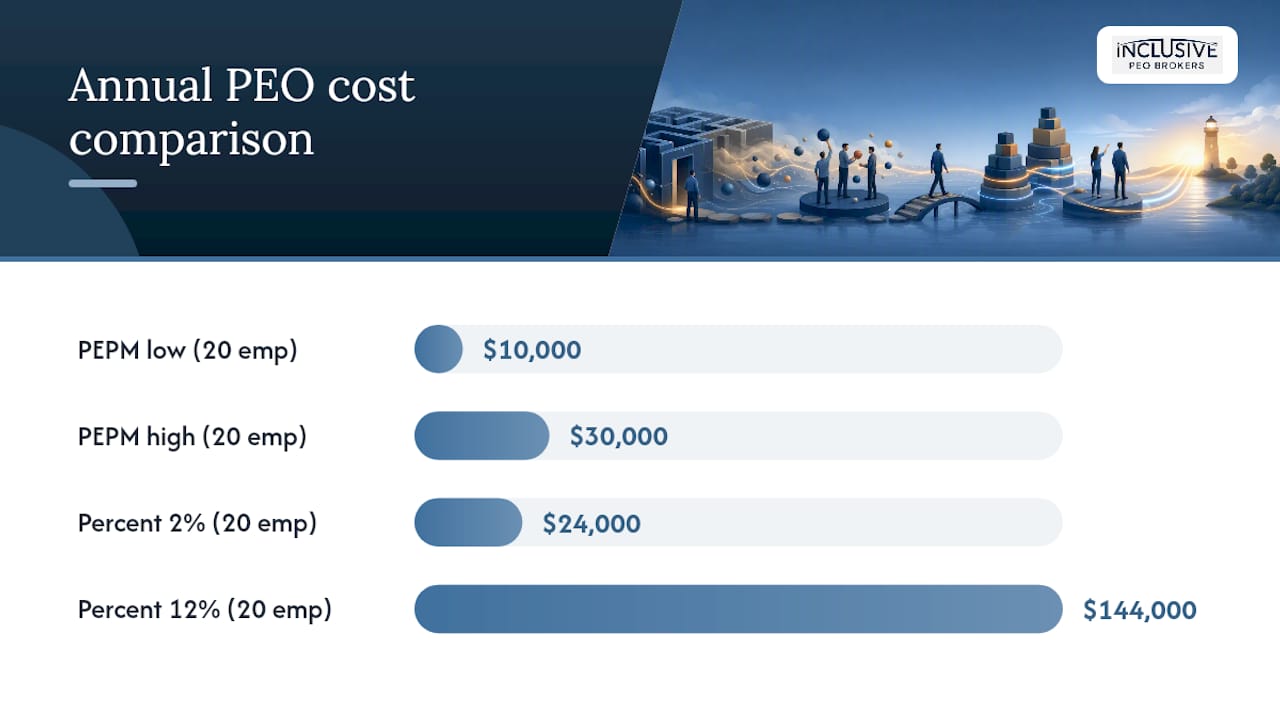
Industry guides commonly cite $500 to $1,500 per employee per year for PEPM models or 2% to 12% of total payroll for percentage-based pricing. Those ranges swing widely based on your industry, headcount, and the benefits package attached.
Statistic Callout: A company with 20 employees averaging $60,000 in annual salary could pay anywhere from $10,000 to $30,000 a year under PEPM, or $24,000 to $144,000 under a percentage model, depending on where the provider sets its rate.
The math gets trickier once bonuses, commissions, and pre-tax deductions enter the picture. Here’s why:
- Percentage-of-payroll fees are usually calculated on gross wages, so a commission-heavy sales team inflates the fee base every quarter.
- Pre-tax deductions like 401(k) contributions sometimes reduce the taxable wage base used for billing, but not always, depending on how the contract defines “payroll.”
- Year-end bonuses can spike your percentage-based bill in December even though your headcount hasn’t changed.
Two things to watch when comparing models:
- Ask whether the percentage rate applies to gross payroll or taxable wages
- Request a projection showing how bonuses and overtime would affect your annual total
A PEPM quote might look cheaper on paper, but if it excludes services a percentage model bundles in, you’re not comparing apples to apples. That’s the core problem with PEO pricing transparency: the structure itself can obscure the comparison.
What’s Included in a Base PEO Rate, and What Gets Billed Separately
Most base administrative fees cover payroll processing, basic HR support, and routine tax filings. That’s the floor, not the ceiling. Workers’ comp premiums, benefits markups, and specialized compliance services frequently sit outside that base rate, billed as separate line items you won’t see until the invoice arrives.
Contract language is where this gets murky. Phrases like “pass-through,” “administrative surcharge,” and “subject to change” sound neutral, but they give a provider room to adjust charges without renegotiating the whole contract.
Ask your provider to replace vague pass-through language with something specific: “Workers’ compensation premiums billed at carrier-invoiced rates with no markup.” That single sentence closes one of the most common gaps in PEO contract terms.
The billing basis matters too. Some providers calculate fees on gross payroll, others on taxable wages after pre-tax deductions. A shift from one basis to another can change your effective rate by a percentage point or more without any headline number changing.
What to request in writing before signing:
- A line-item list of every service included in the base admin rate
- Explicit confirmation of whether workers’ comp, COBRA administration, and benefits markups are extra
- The exact billing basis (gross payroll vs. taxable wages) used for percentage fees
Common Hidden Fees That Inflate Your PEO Bill
Here’s where most surprise charges live. None of these are illegal or even unusual. They’re just easy to overlook when you’re comparing headline PEPM or percentage rates.
- COBRA administration fees. A modest monthly charge per qualified beneficiary, justified by the administrative burden of tracking eligibility and notices.
- Workers’ comp administration and audit true-ups. Annual audits can trigger retroactive charges if your actual payroll or job classifications differed from the initial estimate. This is one of the most commonly cited surprise costs in buyer complaints.
- Year-end W-2 and tax form fees. Some providers bill separately for year-end processing even though it feels like a core payroll function.
- Termination or exit fees. Charged when you leave the PEO relationship, sometimes structured as a flat fee, sometimes as a percentage of remaining contract value.
- Minimum monthly fees. If your headcount drops below a threshold, you may still owe a fixed minimum, quietly changing your effective per-employee cost.
- ACH, check, or per-payrun fees. Small charges per payroll cycle that add up across a year of biweekly or weekly runs.
- Garnishment processing fees. A per-order charge for handling wage garnishments, often overlooked until you have an employee with a court order.
- ACA reporting fees. Charged for preparing and filing Affordable Care Act compliance forms, sometimes bundled, sometimes not.
- Technology or HRIS platform surcharges. Access to the employee self-service portal, advanced reporting, or single sign-on can carry its own fee, separate from admin services.
Most of these exist because the PEO is passing through a real cost, whether that’s a carrier premium, a state filing requirement, or the labor of reconciling an audit. The problem isn’t that the fee exists. It’s that it’s rarely disclosed until after you’ve signed.
How to Calculate Your True All-In PEO Cost
Understanding PEO costs means building your own projection instead of trusting the headline number. Here’s the process:
- Collect the all-in quote, then ask for the unbundled invoice breaking out every fee separately.
- Request recent reconciliation statements from an existing client relationship, if the provider will share a redacted sample.
- Get a workers’ comp estimate and ask about the provider’s audit history and typical true-up size.
- Ask for the benefits pass-through detail, including whether markups are capped or open-ended.
- Run a sample payroll, including a bonus month, through the pricing model to see how the bill moves.
Sample calculation: A 15-employee company quoted at $95 PEPM pays $17,100 a year in base fees. The “true” first-year cost lands closer to $26,800, not the $17,100 implied by the base rate alone.
Before you sign anything, request:
- Every fee itemized by name, not bundled into “administrative services”
- The billing basis for any percentage-based charge
- A written termination fee schedule
- At least one full reconciliation statement showing actual vs. estimated charges
Statistic Callout: NAPEO’s research and multiple buyer guides consistently point to the itemized, unbundled quote as the only reliable way to compare PEO proposals side by side.
Contract Red Flags That Signal Future Hidden Charges
Certain contract clauses are practically guarantees of future billing surprises. Watch for:
- Automatic renewal clauses with short notice windows (30 days or less to cancel before renewal)
- Vague pass-through language without a defined rate or cap
- Unilateral price-change clauses that let the provider adjust fees without your written agreement
- Uncapped markups on benefits or workers’ comp with no stated ceiling
- An audit dispute process that isn’t clearly defined in writing
Push for specific language: “30-day written notice required for any price increase” and “fees billed at carrier-invoiced rates with no markup.” If a provider won’t commit to that in the contract, treat it as a warning sign, not a formality.
Termination fees and minimum monthly charges deserve extra scrutiny. A $5,000 exit fee on a 10-person company changes your effective per-employee cost far more than it would on a 200-person company, so read that clause relative to your actual headcount.
How to Avoid or Negotiate Hidden PEO Fees
The best defense against unexpected PEO fees is asking sharper questions before you sign, not after. Bring this script to your next vendor call:
- “Can you send an itemized quote broken out by service line, not bundled?”
- “Is the percentage fee based on gross payroll or taxable wages?”
- “What’s your policy on benefits markups, capped or uncapped?”
- “What’s the exact termination fee schedule if we leave in year one versus year three?”
- “Can you share a sample reconciliation statement from an existing client?”
Some vendors will trade concessions for commitment. Multi-year agreements, committed headcount bands, or carrier-direct billing arrangements can unlock lower markups or waived setup fees. If a provider won’t move on markup transparency, that’s often more telling than the number itself.
Pro Tip: Bring in a broker or third-party auditor before you sign, not after a surprise invoice arrives. A reconciliation audit that compares carrier invoices to client billing is the fastest way to confirm whether a quote matches reality.

How Brokers Uncover Hidden Fees: A Look at the Audit Process
A proper PEO audit starts with documents, not opinions. Inclusive PEO Brokers requests the underwritten quote, the unbundled invoice, and, when available, prior reconciliation statements. Then we run your actual payroll mix, bonuses included, through both PEPM and percentage models to see which structure holds up.
- Reconcile carrier-invoiced amounts against what the provider actually billed
- Compare workers’ comp estimates to the provider’s own audit history
- Flag any contract clause without a defined rate or cap
Statistic Callout: Clients working with Inclusive PEO Brokers save an average of 80 hours and $634 during selection, based on 133 completed implementations. One recent engagement uncovered an uncapped benefits markup and a $3,000 undisclosed termination fee before the client signed, both renegotiated before the contract closed.
Why transparency in PEO pricing matters
Transparent pricing isn’t a nicety. It’s the difference between a PEO relationship that supports your budget and one that quietly erodes it. When I look at a quote, I’m not just checking the headline rate. I’m checking whether the provider is willing to show its math. That willingness tells you more about long-term fit than any single number, and it protects the budgeting certainty and compliance confidence your business actually needs.
Get a Fee-Transparency Review Before You Sign
You shouldn’t have to become a payroll auditor just to trust a PEO quote. Inclusive PEO Brokers reviews contracts, reconciles line items against carrier rates, and negotiates on your behalf so the number you sign matches the number you actually pay.

Our matchmaking and PEO selection process has guided 133 successful implementations, saving clients an average of 80 hours and $634 in the process. We compare providers side by side, flag ambiguous pass-through language, and push for the exact contract terms that keep your costs predictable. If you’re evaluating your first PEO or reconsidering an existing one, our first-time PEO selection service walks through every fee before you commit to anything. Book a free quote review and find out what your current or prospective provider isn’t showing you.
Frequently Asked Questions
Are PEO hidden fees actually illegal?
No. Most PEO hidden fees are legal pass-through costs or administrative charges disclosed somewhere in the contract, just not in the headline quote. The issue is transparency, not legality.
What’s a normal PEPM rate for a small business?
Most providers quote $500 to $1,500 per employee per year, though your final rate depends on benefits selection, state footprint, and headcount.
How do I know if a benefits markup is reasonable?
Ask for the carrier-invoiced premium separately from the PEO’s markup. A 5% to 20% markup is common; anything uncapped or undisclosed is worth negotiating.
Should I check a PEO’s reputation before signing?
Yes. Reviewing complaints on sites like the Better Business Bureau can surface transparency issues other clients have already flagged.
Can a broker really help me avoid hidden fees?
A broker who reconciles carrier invoices against client billing catches markups and pass-through errors most business owners never see until the invoice arrives.
This article is general information, not a substitute for advice from a qualified financial advisor. Consult a qualified financial professional about your own circumstances before acting on anything here.
Sources
.svg)
Seeking a different solution? Meet Your Business Needs