.png)

Justworks vs Gusto: Which Model Fits Your Business?

If your business needs shared compliance liability and access to large-group health plans, a PEO co-employment model is the stronger fit. If you want lower base costs and full control over your HR stack, a payroll-first SaaS platform is the better starting point.
Quick “best for” guide:
- Early-stage bootstrapped startup (1–10 employees): Payroll SaaS gives you affordable, flexible tools without the overhead of a co-employment agreement.
- Growing multi-state employer (11–50+ employees): A PEO co-employment model shares compliance liability and simplifies state registrations as you add remote workers.
- Small firm with no in-house HR: A PEO acts as an off-site HR department, handling benefits administration, workers’ comp, and payroll taxes under a certified PEO structure.
- Benefits-driven hiring environment: PEO pooling gives small employers access to large-group insurance rates that they cannot reach on their own.
Inclusive PEO Brokers helps businesses at any of these stages identify the right model and the right provider without spending weeks on vendor demos.
Table of Contents
- How do Justworks and Gusto actually compare?
- How do you decide between a PEO and payroll SaaS?
- What do these models actually deliver day to day?
- What does the real cost look like beyond the monthly fee?
- What does onboarding and switching actually involve?
- Which model fits your specific situation?
- Key Takeaways
- What brokers actually see in the field
- Ready to find the right HR model for your business?
- Useful sources and further reading
How do Justworks and Gusto actually compare?
Third-party reviewers consistently identify the PEO vs. payroll-SaaS distinction as the single most important factor shaping pricing, benefits access, and liability. The table below maps the key dimensions.
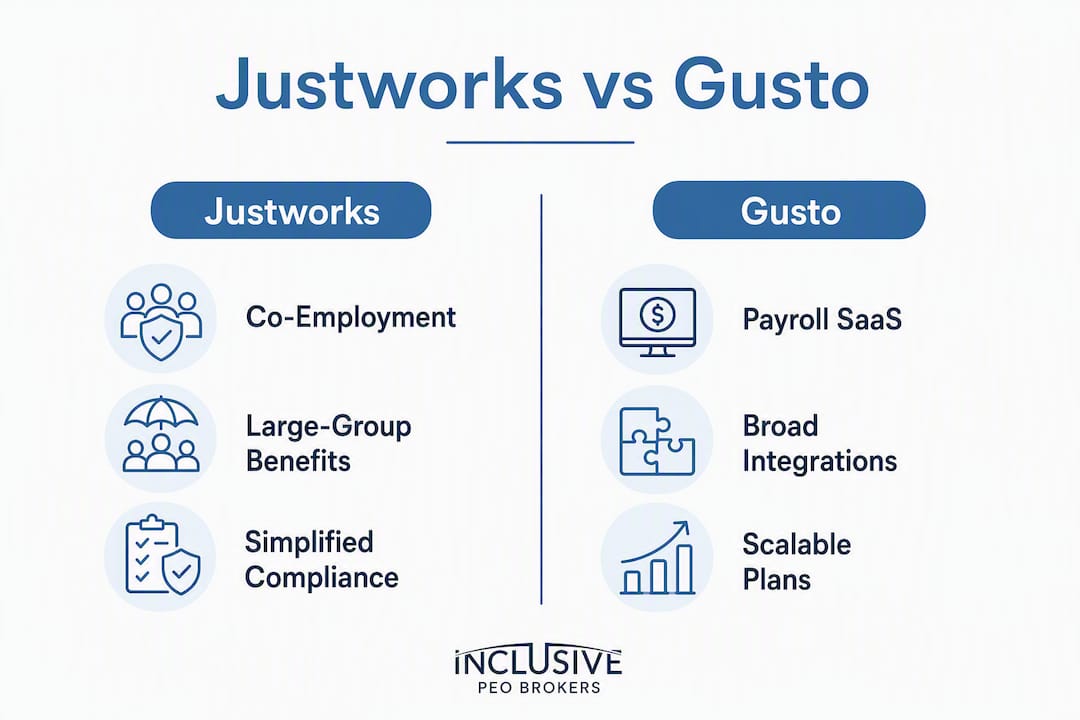
| Dimension | PEO / Co-employment model | Payroll-first SaaS |
|---|---|---|
| Service model | Co-employer shares liability | Client remains sole employer |
| Best-for profile | 11–50+ employees, multi-state, limited HR staff | 1–50 employees, lean compliance needs |
| Compliance & liability | Shared under co-employment agreement | Client holds full responsibility |
| Payroll features | Bundled, automated, multi-state included | Tiered; multi-state often requires upgrade |
| Benefits access | Large-group pooled plans | Marketplace or broker-sourced plans |
| Pricing shape | Flat per-employee-per-month bundle | Base fee plus per-employee, tiered features |
| Multi-state support | Included in core offering | Add-on or higher-tier requirement |
| Onboarding/support | Dedicated HR advisers, guided setup | Self-serve with tiered support levels |
PEO model: pros and cons
- ✅ Shared employer liability reduces your compliance exposure
- ✅ Access to large-group health, dental, and vision plans
- ✅ Multi-state payroll and state registrations handled for you
- ❌ Higher per-employee monthly cost than entry-level SaaS
- ❌ Co-employment agreement requires careful contract review
Payroll SaaS: pros and cons
- ✅ Lower base cost for small headcounts
- ✅ Full control over your HR data and vendor relationships
- ✅ Wide integration ecosystem with accounting and HRIS tools
- ❌ Compliance responsibility stays entirely with you
- ❌ Multi-state payroll and advanced features sit behind higher tiers, adding cost as you grow
How do you decide between a PEO and payroll SaaS?
Work through this checklist in order. The earlier items carry more decision weight.
- Assess your compliance exposure. Do you operate in a regulated industry (healthcare, finance, staffing)? High regulatory risk favors the shared-liability PEO model.
- Count your active states. Hiring in three or more states makes per-state registration fees and filings a real cost driver under SaaS pricing.
- Measure your HR bandwidth. No dedicated HR manager means someone is absorbing compliance work. A PEO offloads that burden.
- Define your benefits goals. If competitive health insurance is a hiring lever, PEO pooling typically delivers better rates than a small employer can negotiate independently.
- Model total cost of employment (TCE), not just the software fee. Include administrative time, compliance risk, and insurance premium differentials. More on this in the TCE section below.
- Decide how much control you want. SaaS keeps you in the driver’s seat on every HR decision. A PEO is a partnership, and that means shared governance.
Questions to ask vendors in demos:
- Who is the employer of record, and what liability do you assume under the co-employment agreement?
- Which states are you registered in, and how do you handle new state registrations?
- Are large-group health plans available at my headcount, and what are the enrollment windows?
- What is your support SLA, and do I get a dedicated HR adviser?
- What are the termination terms, and how long does offboarding take?
Red flags to watch for:
- Vague language around who holds payroll tax liability
- Per-state fees buried in the contract addendum rather than the main pricing page
- Support that downgrades to email-only below a certain employee count
- Automatic renewal clauses with 60-day or shorter cancellation windows
What do these models actually deliver day to day?
Payroll automation and tax filing
Both models automate payroll runs and file federal and state payroll taxes. The difference is accountability. Under a co-employment structure, the PEO is jointly responsible for those filings. Under payroll SaaS, the software processes the run but you remain the liable party if something goes wrong. Off-cycle payroll, contractor payments, and multi-entity support are available in both models, though SaaS platforms often require a higher-tier plan to unlock them.
Benefits and insurance access
PEOs provide access to large-group health plans that small employers cannot access on their own. A 20-person company under a PEO can access the same insurance pool as a 500-person company. Payroll SaaS platforms connect you to marketplace or broker-sourced plans, which carry higher per-employee premiums at small headcounts. For benefits-driven hiring, this gap is often the deciding factor.
Integrations and ecosystem
| Category | PEO model | Payroll SaaS |
|---|---|---|
| Accounting (QuickBooks, Xero) | Available, often pre-built | Native integrations, broad ecosystem |
| Time tracking | Typically bundled | Often a paid add-on or third-party |
| HRIS / ATS | Limited native options | Wider marketplace of connectors |
| Benefits admin | Fully managed within platform | Varies by plan tier |

Payroll SaaS generally wins on integration breadth. PEO platforms tend to be more self-contained, which reduces integration complexity but limits flexibility.
What does the real cost look like beyond the monthly fee?
Total cost of employment (TCE) captures what you actually spend: software fees, benefits premiums, administrative time, compliance risk, and any add-on charges. Comparing sticker prices alone misses the full picture.
Sample TCE calculation for a 50-employee company:
- Base software or PEO fee: Payroll SaaS entry-level plans use a base fee plus a per-employee charge. PEOs bundle payroll, benefits admin, and workers’ comp into a flat per-employee-per-month rate.
- Multi-state add-ons: Per-state registration fees and required tier upgrades accumulate quickly for distributed teams. At 50 employees across five states, these charges can narrow the price gap with a bundled PEO significantly.
- Benefits premium differential: If PEO pooling saves $80 per employee per month on health premiums versus marketplace rates, that is $4,000 per month in savings at 50 employees.
- Administrative time: The HR manager salary benchmark helps quantify the cost of hours spent on compliance tasks that a PEO would absorb.
- Compliance risk cost: One payroll tax penalty or missed state registration can cost more than a year of PEO fees.
Pro Tip: When modeling benefits costs, ask each vendor for a benefits census quote using your actual employee demographics. The premium difference between a PEO’s large-group rate and a marketplace plan is often larger than the PEO’s per-employee fee.
Analysts consistently recommend focusing on TCE rather than base fees because administrative time saved and insurance premium differentials routinely change the apparent price calculus at scale.
What does onboarding and switching actually involve?
Realistic timelines vary by model, but neither is a same-week switch.
Typical onboarding timelines:
- Payroll SaaS: 1–2 weeks for data setup; payroll cutover usually happens at the next pay period.
- PEO co-employment: 3–6 weeks to complete the co-employment agreement, benefits enrollment, workers’ comp setup, and state registrations.
Migration checklist:
- Payroll history export (year-to-date figures for every employee)
- Active benefits carrier and plan details, including enrollment windows
- Workers’ comp policy transfer or new policy setup
- State tax account numbers and registration status for every active state
- Employee I-9 and onboarding documents
- Time tracking and PTO balances
Missing any of these items can delay the switch by weeks, particularly benefits enrollment windows, which are often fixed to calendar quarters.
Contract clauses to review before signing:
- Termination notice period (30, 60, or 90 days)
- Who holds payroll tax liability during transition
- Service SLA commitments and escalation paths
- Data portability terms when you exit
Which model fits your specific situation?
- 1–10 employees, founder-run: Payroll SaaS keeps costs low and gives you full control while your headcount is small.
- 11–50 employees, hiring remotely across states: A PEO co-employment model handles state registrations and shared compliance liability as your footprint grows.
- Professional services firm with high compliance needs: PEO co-employment reduces your exposure on payroll tax filings and workers’ comp.
- Rapid multi-state expansion: A PEO’s bundled state registration support prevents the per-state fee accumulation that tier-gated SaaS pricing creates.
- Benefits-driven hiring (competing with larger employers): PEO pooling gives your team access to large-group health plans that a standalone small employer cannot match.
Key Takeaways
The right choice between a PEO co-employment model and payroll-first SaaS comes down to your compliance exposure, multi-state footprint, and whether benefits access is a hiring lever.
| Point | Details |
|---|---|
| Model difference is the core decision | A PEO co-employs your staff and shares liability; payroll SaaS leaves you as the sole employer. |
| TCE beats sticker price | Benefits premium savings and admin time absorbed by a PEO often offset the higher per-employee fee. |
| Multi-state growth changes the math | Per-state SaaS fees and required tier upgrades can close the price gap with a bundled PEO quickly. |
| Contract terms matter as much as features | Review termination clauses, liability language, and support SLAs before signing either model. |
| Inclusive PEO Brokers | Matches your business to the right PEO, models TCE, and guides implementation across 133 completed engagements. |
What brokers actually see in the field
Most businesses that come to us have already spent weeks comparing feature lists and pricing pages. The real decision, though, almost always comes down to two questions: how much compliance risk are you comfortable holding, and do you need benefits that can compete with larger employers?
When assessing fit, the clearest signal is multi-state hiring. A company adding its third or fourth state is usually at the inflection point where a PEO’s bundled registrations and shared liability start to outweigh the higher per-employee cost. The most common misstep we see is underestimating that overhead. A founder who has only ever hired in one state often does not realize that each new state brings its own registration, tax account setup, and ongoing filing obligations. Under payroll SaaS, every one of those is your responsibility.
Inclusive PEO Brokers has completed 133 successful PEO implementations, and clients typically save 80 hours in the selection process. That time savings is not just convenience. It is the difference between a rushed vendor decision and one grounded in a real cost reduction model built around your headcount, states, and benefits goals.
Ready to find the right HR model for your business?
Sorting through PEO contracts and SaaS pricing tiers takes time most small business owners do not have. Inclusive PEO Brokers cuts through that by matching your business to the right provider based on your actual compliance exposure, benefits goals, and growth plans — not a generic feature checklist.

Clients save significant time in the selection process and cost reductions, backed by numerous completed implementations. Whether you are evaluating a PEO for the first time or re-assessing a payroll SaaS setup that has grown more expensive than expected, the process starts with a no-obligation assessment. Book your free consultation and get a side-by-side cost model built around your business.
Useful sources and further reading
- Gusto vs. Justworks: What We Recommend & Why — Fit Small Business: in-depth third-party comparison covering model differences, pricing, and reviewer verdicts.
- Gusto vs. Justworks: At a Glance — Forbes Advisor: expert framing of the risk-tolerance and scale decision, with guidance on when each model fits.
- Justworks vs. Gusto (2026): Which HR Platform Wins? — DeployHyre: feature-level breakdown including pricing structures and benefits access analysis.
- Compare Gusto and Justworks — G2: aggregated user reviews and ratings for both platforms from verified business users.
.svg)
Seeking a different solution? Meet Your Business Needs