.png)

PEO for Real Estate: Simplify Payroll and Scale Fast

A Professional Employer Organization (PEO) is the most direct way for real estate firms to convert HR from a fixed overhead into a compliant, scalable service. If your brokerage or property management company runs a mixed W-2 and 1099 workforce, operates across multiple states, or needs group benefits competitive enough to recruit top talent, a PEO is worth serious evaluation right now.
Before your first vendor call, flag these must-have features:
- Commission and off-cycle payroll support: Can the PEO run split commissions, draws, and advances on a non-standard schedule?
- Multi-state tax filing: Does the vendor file payroll taxes in every state where your agents hold licenses or your properties sit?
- EPLI and workers’ comp access: Are employment practices liability insurance and workers’ compensation bundled or readily accessible through the PEO?
- Dedicated HR consultant: Will your team have a named contact, not a rotating call center?
The fastest path to answers is a matchmaking consult with Inclusive PEO Brokers, which runs a qualification checklist against your specific setup and returns a shortlist of vetted vendors rather than leaving you to cold-call dozens of providers.
Table of Contents
- What real estate PEO features should you require?
- When should a real estate business move to a PEO?
- How do you choose a PEO for your real estate company?
- What risks and compliance pitfalls should you watch for?
- How Inclusive PEO Brokers helps real estate clients
- Key Takeaways
- What most real estate owners get wrong about PEOs
- Get matched with the right PEO for your real estate business
- Useful sources and references
What real estate PEO features should you require?
Not every PEO is built for real estate. Many are designed for uniform W-2 workforces in single-state environments. Before advancing any vendor past the first call, verify these capabilities directly.
Commission payroll and draw handling
Ask the vendor to walk you through a split-commission scenario: two agents share a $30,000 commission, one receives a $5,000 draw against future earnings, and the deal closes mid-month. If the answer involves manual workarounds or “we’d need to check with our payroll team,” move on.
Mixed W-2 and 1099 workforce support
Most brokerages misunderstand where a PEO adds value. The PEO covers your W-2 employees, not your 1099 independent contractors. That said, a good PEO will provide contractor oversight tools and guidance on classification to reduce misclassification risk, which is one of the most common and costly compliance errors in real estate.
Multi-state payroll and compliance
If your agents hold licenses in multiple states or your properties span several markets, the PEO must file payroll taxes in each relevant jurisdiction. Ask for a list of states the vendor currently files in and how they handle new-state setup when you expand.
Insurance and benefits access
| Feature | Must-Have | Nice-to-Have | Disqualifier |
|---|---|---|---|
| Workers’ comp administration | Yes | No workers’ comp access | |
| EPLI access | Yes | No EPLI or referral | |
| Group health, dental, vision | Yes | Benefits-only through third party | |
| E&O / professional liability | No | Referral to carrier | Claiming E&O is included |
| Property-level payroll reporting | Depends on portfolio size | Yes for PM firms | |
| Off-cycle commission payroll | Yes | Only standard bi-weekly runs | |
| Multi-state tax filing | Yes | Single-state only |
One critical point: PEOs do not replace errors and omissions (E&O) or professional liability coverage. MarshMcLennan Agency’s guidance on PEOs in real estate is explicit that industry-specific policies require separate placement. Any vendor claiming E&O is bundled into their PEO offering is either misinformed or misrepresenting the product.
When should a real estate business move to a PEO?
The timing question matters as much as the vendor question. A PEO is not the right tool for every stage.
These are the triggers that typically justify the move:
- You have 5 or more W-2 employees and payroll errors or delays are becoming a recurring problem.
- You’re expanding into a new state and need payroll tax registration, new-hire reporting, and compliance support in that jurisdiction quickly.
- You’re losing candidates to competitors who offer better health benefits, and you can’t access competitive group rates on your own.
- You’ve had a workers’ comp claim or audit and realized your current coverage and documentation are inadequate.
- Your HR manager is spending more than 30% of their time on payroll and compliance rather than on recruiting, retention, or culture.
- You’re acquiring properties or other brokerages and need to onboard new employees quickly without building new HR infrastructure each time.
A useful self-check: if you’ve run more than two off-cycle payroll corrections in the past quarter, or if you’ve received a state notice about a late tax deposit, the administrative cost of staying in-house is already exceeding what a PEO would charge. Property management firms, in particular, benefit from treating HR as a variable cost that scales with portfolio size rather than a fixed department that becomes a drag during dispositions.
How do you choose a PEO for your real estate company?
The evaluation process has five stages. Work through them in order to avoid wasting time on vendors who can’t serve your specific setup.
-
Qualify on industry fit. Ask upfront whether the vendor has active real estate brokerage or property management clients. Request two references in your segment. If they can’t provide them, the vendor may not understand commission payroll or mixed-workforce compliance.
-
Validate real-estate-specific features. Use the checklist in the previous section. Commission payroll, multi-state filing, and EPLI access are non-negotiable. Get written confirmation, not verbal assurances.
-
Check compliance credentials. Verify whether the vendor holds CPEO status from the IRS, which provides additional federal tax compliance assurance. Also check whether the vendor carries ESAC accreditation, which signals financial oversight and operational standards. Neither credential guarantees a perfect fit, but their absence raises the due-diligence bar.
-
Compare pricing models. Most PEOs price either per employee per month (PEPM) or as a percentage of gross payroll. PEPM is easier to budget when your headcount is stable. Percentage-of-payroll pricing can become expensive quickly when commissions spike. Get both models quoted and model them against your last 12 months of payroll.
-
Negotiate contract terms. Request a trial period of 90 days with a defined exit clause. Cap onboarding fees in writing. Include SLA credits if payroll runs late or tax filings are missed. Ask for a data-portability clause so your employee records transfer cleanly if you switch vendors.
Pro Tip: Ask every vendor: “What happens to my payroll data if I terminate the agreement?” A vendor who hesitates or offers vague language about “data export upon request” is a transition risk. You want a written commitment to a clean, structured data handoff within a defined number of days.
What risks and compliance pitfalls should you watch for?
A PEO reduces many HR risks, but it does not eliminate all of them. Knowing which liabilities remain yours is as important as knowing what the PEO covers.
- Agent misclassification stays your risk — If you classify a worker as a 1099 contractor when they function as a W-2 employee, the PEO cannot shield you from IRS or state labor department penalties. Get classification reviewed before onboarding.
For property management firms, maintaining a security and safety checklist for on-site staff is a practical complement to PEO-administered workers’ comp, since documented safety protocols directly influence your risk profile and premium calculations.
Pro Tip: Include this clause in your PEO service agreement: “Provider shall indemnify Client for any penalties, interest, or fines arising directly from Provider’s failure to timely file payroll taxes or remit payroll tax deposits.” Without it, you may absorb penalties for errors that were entirely the vendor’s fault.
How Inclusive PEO Brokers helps real estate clients
Inclusive PEO Brokers runs a structured matchmaking process designed to cut the time and cost of finding the right PEO for your real estate business. The process moves through four stages: qualification, shortlisting, negotiation support, and post-implementation guidance.
In the qualification stage, Inclusive PEO Brokers maps your workforce structure, state footprint, commission complexity, and benefit goals against a vetted network of PEO providers. That mapping produces a shortlist of vendors who have demonstrated real estate experience, not just general small-business capabilities. From there, Inclusive PEO Brokers facilitates side-by-side comparisons, negotiates pricing on your behalf, and stays engaged through implementation to catch onboarding issues before they affect your first payroll run.
The outcomes from this process are documented:
| Metric | Result |
|---|---|
| Average selection time saved | 80 hours |
| Average cost savings per client | $634 |
| Successful implementations completed | 133 |
These results show the clear benefits of working with a broker: Inclusive PEO Brokers routinely saves clients 80 hours on the selection process and $634 on average, based on experience across 133 successful real estate PEO implementations.
Real estate clients who have gone through the Inclusive PEO Brokers process consistently report that the shortlist they receive is meaningfully narrower than what a self-directed search produces, and that the negotiated contract terms, particularly around onboarding fees and SLA credits, reflect leverage that comes from volume relationships with PEO providers.
Key Takeaways
A PEO built for real estate handles commission payroll, multi-state compliance, and mixed-workforce complexity in ways that general HR outsourcing cannot match, and working with a specialized broker cuts selection time and cost significantly.
| Point | Details |
|---|---|
| Confirm commission payroll first | Verify off-cycle runs, split commissions, and draw handling before advancing any vendor. |
| Check CPEO and ESAC credentials | IRS CPEO status and ESAC accreditation reduce compliance and financial risk when vetting providers. |
| E&O stays separate | PEOs do not cover professional liability; budget for a separate E&O policy regardless of PEO coverage. |
| Negotiate transition terms upfront | Include data portability, transition assistance, and SLA credits in the contract before signing. |
| Inclusive PEO Brokers saves 80 hours and $634 per client | Their matchmaking process delivers a vetted shortlist and negotiated terms, saving an average of 80 hours and $634 per client. |
What most real estate owners get wrong about PEOs
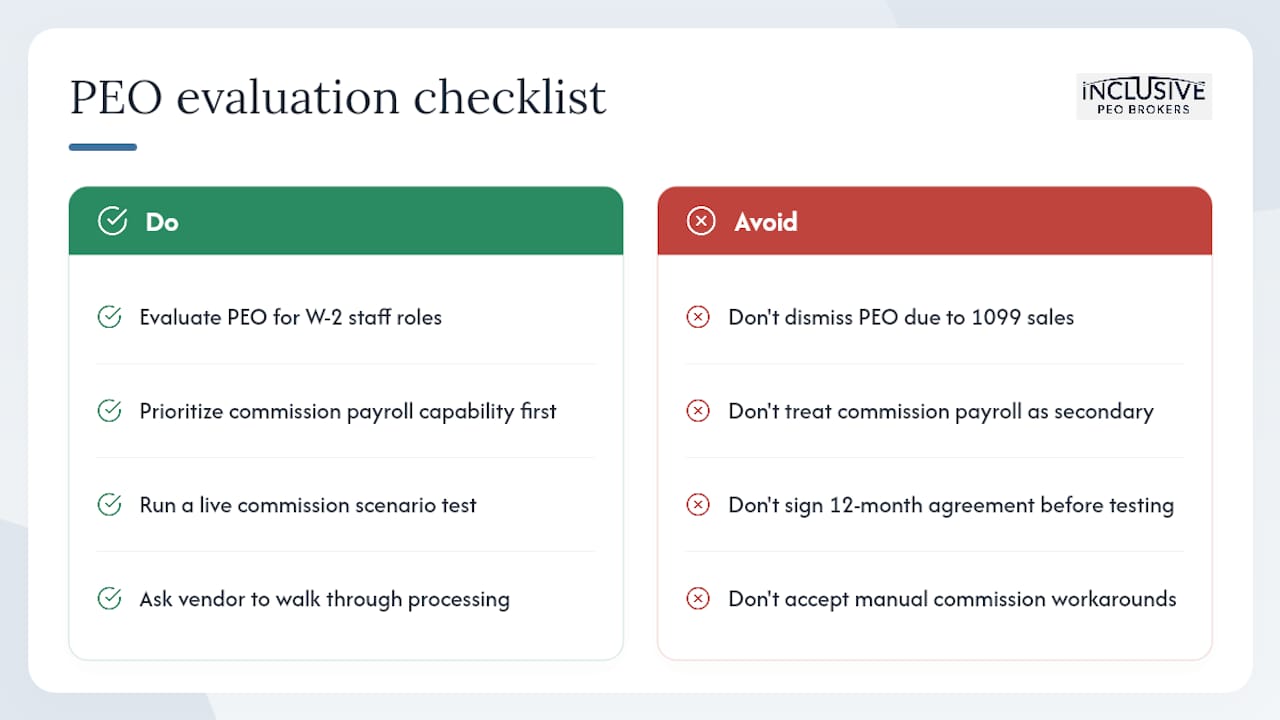
The most common mistake I see is real estate owners dismissing a PEO because their sales force is 1099. That logic misses the point entirely. The PEO is for your W-2 staff: the transaction coordinators, office managers, marketing associates, and property maintenance teams who keep the operation running. Those employees are where payroll errors, benefits gaps, and compliance exposure actually live.
The second mistake is treating commission payroll as a secondary feature to evaluate after pricing. It should be the first question on every call. A PEO that handles standard bi-weekly payroll cleanly but fumbles commission runs will create more administrative work than it eliminates. I’ve seen firms sign 12-month agreements only to discover the vendor requires manual workarounds for every commission disbursement.
The practical fix is straightforward: run a live scenario test during the sales process. Give the vendor a real commission scenario from your last quarter and ask them to walk through exactly how it would be processed. Their answer tells you more than any feature sheet.
Get matched with the right PEO for your real estate business
Real estate firms that work with Inclusive PEO Brokers save an average of 80 hours on the vendor search and $634 compared to negotiating directly. These results are drawn from 133 successful implementations where clients benefited from a vetted shortlist and pre-negotiated pricing tailored to real estate needs.

A no-obligation discovery call takes about 30 minutes. Inclusive PEO Brokers maps your workforce structure, state footprint, and benefit goals, then returns a side-by-side comparison of vetted providers with pricing already negotiated. The process moves clients from first call to signed agreement faster than any self-directed search, as shown in their track record of 133 successful implementations.
Book your free PEO matchmaking consult and get a shortlist built specifically for your real estate operation, not a generic list of providers who happen to serve small businesses.
Useful sources and references
- irs.gov
- esac.org
- What is a PEO and How Can It Help Your Business?
- How PEOs Empower Real Estate & Hospitality Businesses
- PEOs in Real Estate — MarshMcLennan Agency
- EOR for Real Estate & PropTech in the GCC | Auxilium
Recommended
.svg)
Seeking a different solution? Meet Your Business Needs