.png)

PEO for Cannabis Businesses: Your 2026 Decision Guide

Most cannabis operators should hire a specialized PEO. The fastest next step is booking a PEO matchmaking consultation with Inclusive PEO Brokers to get a shortlist of vetted providers matched to your state, size, and license type.
Here is why that recommendation holds for most small-to-mid cannabis operators:
- Compliance and licensing support. Cannabis businesses face state-by-state licensing conditions, labor peace agreement (LPA) requirements, and a persistent federal-state conflict that general PEOs are not equipped to navigate. A cannabis-specialized PEO monitors those moving parts on your behalf.
- Payroll and banking expertise. Banking access for cannabis companies remains constrained under federal Schedule I classification. A specialized PEO brings payroll processing experience with cannabis-compatible banking partners, so your employees get paid reliably.
- Access to benefits and shared liability. Through the co-employment model, recognized by NAPEO as the standard PEO structure, the PEO becomes a co-employer of record, sponsoring group health benefits and sharing employment-related liability, which would otherwise be out of reach for a small dispensary or cultivator.
The article below gives you the full decision framework: what to look for, what to ask vendors, what onboarding looks like, and how to avoid the most common mistakes.
Table of Contents
- What is a PEO for cannabis businesses and how does co-employment work?
- Why cannabis businesses hire a specialized PEO
- What core services should a cannabis PEO provide?
- What compliance and banking risks does a cannabis PEO help you manage?
- How shared liability under co-employment protects you and where your exposure remains
- How do you choose the right cannabis-specialized PEO?
- What does PEO onboarding look like for a cannabis operator?
- How Inclusive PEO Brokers helps cannabis businesses find the right PEO
- Key Takeaways
- Why cannabis matchmaking is different from standard PEO brokerage
- Get matched with a cannabis-experienced PEO today
- Useful sources for further research
What is a PEO for cannabis businesses and how does co-employment work?
A cannabis-specialized PEO is a Professional Employer Organization that combines standard HR outsourcing with deep knowledge of cannabis industry regulations, licensing conditions, and payroll constraints. Think of it as an off-site HR department that also speaks the language of state cannabis boards and federal tax authorities.
Under the co-employment model, the PEO becomes a co-employer of your workforce on paper. The PEO files payroll taxes under its own Employer Identification Number, sponsors group health and workers’ compensation benefits, and manages HR administration including onboarding paperwork, employee handbooks, and compliance recordkeeping. Your business remains the worksite employer: you hire, fire, set schedules, and direct daily operations. The PEO handles the back-office employment infrastructure.
One regulatory nuance matters here. Cannabis remains a Schedule I controlled substance under federal law, even as 38+ states have legalized medical or adult-use programs. That gap creates compliance complexity no general PEO is built to handle. A cannabis-specialized PEO understands how to structure co-employment agreements that account for this tension, including how federal tax obligations interact with state-licensed operations.
Why cannabis businesses hire a specialized PEO
The practical benefits go well beyond basic HR outsourcing. Cannabis operators face a combination of risks that make specialized support genuinely valuable.
Core benefits of a cannabis-specialized PEO:
- Continuous monitoring of state licensing conditions, LPA requirements, and regulatory updates
- Payroll processing through banking partners that accept cannabis-industry clients
- Group health, dental, and vision benefits at pooled rates unavailable to small standalone operators
- Workers’ compensation coverage that accounts for cannabis-specific workplace hazards, from chemical exposure in extraction facilities to ergonomic risks in cultivation
- Recruiting, onboarding, and retention support in a sector with high turnover
- Shared employment liability that reduces your exposure to wage-and-hour claims
The benefit profile looks different depending on your operation. A single dispensary with 12 employees gains the most from benefits access and payroll reliability. A multi-site cultivator with operations in two or three states needs the compliance monitoring and multi-state payroll registration support most urgently. A processing or manufacturing facility has the highest workers’ comp exposure, making pooled coverage and a documented safety program the priority.
Banking and payroll reality check: Many cannabis businesses cannot access standard business banking. A specialized PEO’s ability to process payroll through compliant financial partners is often the single most operationally critical service it provides.
What core services should a cannabis PEO provide?
Use this breakdown to verify what any prospective PEO actually delivers, not just what it lists on a brochure.
Payroll and payroll tax filing
The PEO processes payroll, files federal and state payroll taxes under its EIN, and manages direct deposit or alternative disbursement for employees. For cannabis operators, the critical verification is whether the PEO has an established relationship with a bank or credit union that accepts cannabis-industry payroll accounts.
HR administration and employee handbooks
The PEO maintains compliant employee handbooks, manages onboarding and offboarding paperwork, and administers leave policies. Cannabis-specific handbooks must address drug testing policies carefully, since testing positive for cannabis can create legal exposure in states with employee-use protections.
Benefits administration
The PEO sponsors and administers group health, dental, vision, and retirement plans. Small cannabis operators typically cannot access competitive group rates independently. Co-employment pools your employees with the PEO’s broader workforce, unlocking Fortune 500-level benefits at a fraction of the standalone cost.
Workers’ compensation and claims management
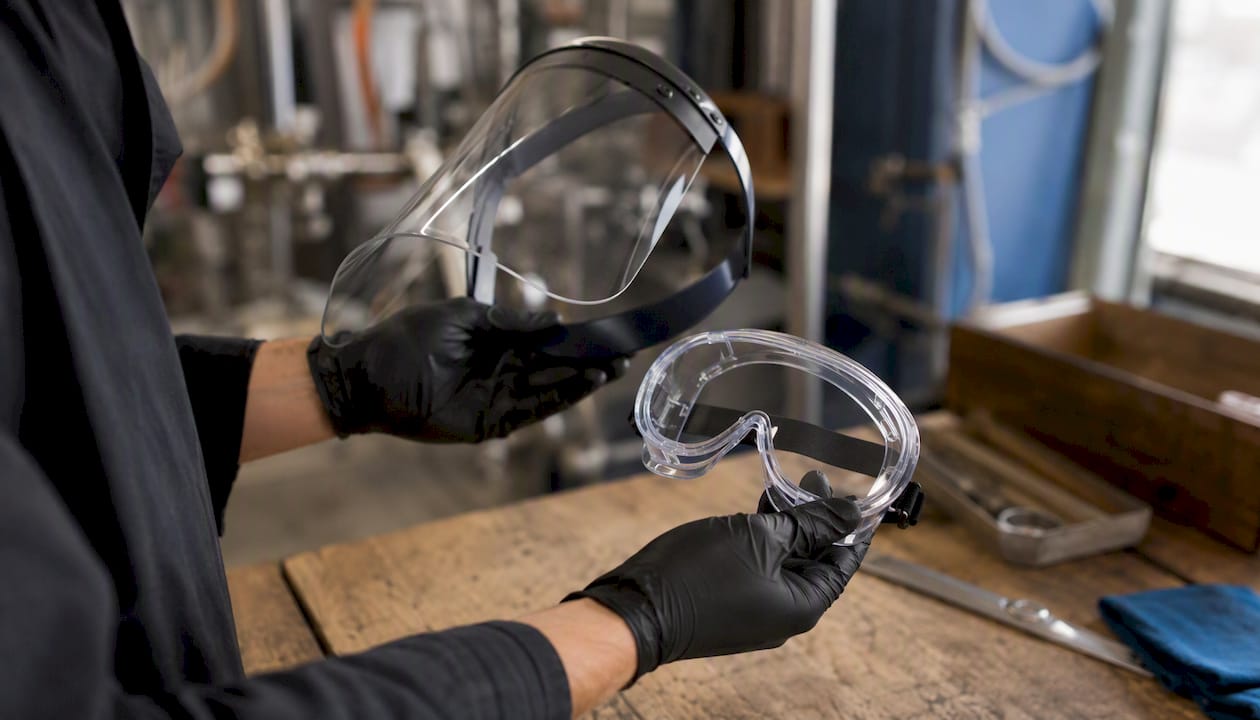
Cannabis workplaces carry occupational hazards that most general workers’ comp carriers underwrite poorly or refuse outright. A specialized PEO maintains coverage that accounts for extraction chemical exposure, repetitive-motion risks in trimming, and slip-and-fall risks in retail environments, as documented in occupational health guidance for the marijuana industry.
Risk management and licensing support
This is where specialization earns its price. A cannabis PEO tracks state license renewal dates, monitors LPA conditions, and flags regulatory changes that affect your employment practices.
Recruiting and retention support
Turnover in cannabis retail runs high. A PEO with cannabis experience can provide job description templates, background-check protocols calibrated to state cannabis licensing rules, and onboarding workflows that reduce time-to-productivity.
| Service | Typical Deliverable | Cannabis-Specific Verification |
|---|---|---|
| Payroll processing | Weekly or bi-weekly payroll runs, tax filings | Confirm banking partner accepts cannabis clients |
| HR administration | Handbooks, onboarding, leave tracking | Verify drug-testing policy language for your state |
| Benefits administration | Health, dental, vision | Confirm group plan includes cannabis-sector employees |
| Workers’ compensation | Policy, claims management, safety programs | Confirm coverage for extraction and cultivation hazards |
| Risk and licensing support | License calendar, LPA tracking, audit prep | Ask for examples from your state specifically |
| Recruiting support | Job templates, background checks, onboarding | Confirm background-check protocol aligns with state cannabis licensing |
What compliance and banking risks does a cannabis PEO help you manage?
The federal-state tension in cannabis is not just a legal abstraction. It creates real operational risk every payroll cycle, every license renewal, and every time a worker files a complaint. This section is general information, not legal advice. Consult qualified counsel for legal interpretation specific to your situation.
States including New York, New Jersey, and California have built LPA requirements or labor-organization preferences into their cannabis licensing frameworks. Those conditions can raise complex questions about NLRA preemption, since federal labor law governs collective bargaining regardless of what a state licensing board requires. A cannabis PEO with labor-relations experience helps you understand which obligations are enforceable and which may be contested.
Union organizing is active in the sector. A Missouri cannabis facility’s workers recently won a union vote after federal officials rejected the company’s attempt to block the ballot count, as reported by Cannabis Cultivator News. That case reflects a broader pattern. The McCarter legal analysis of cannabis and labor law confirms that NLRA applicability in cannabis is a recurring legal issue, not a settled one. Meanwhile, a Utah cannabis operator’s attempt to escape NLRB jurisdiction stalled in federal court, with the case returned to the NLRB process, illustrating that jurisdictional arguments are not a reliable defense strategy.
A cannabis PEO should take these concrete mitigation steps on your behalf:
- Monitor state licensing conditions and flag any LPA or labor-organization requirements tied to your license renewal.
- Maintain documentation of your employment practices in a format suitable for NLRB audit or state labor board review.
- Coordinate payroll processing through a banking partner that has a documented compliance program for cannabis-industry clients.
- Keep employee handbooks and arbitration agreements current with state law, particularly in states with active labor-relations developments.
- Provide HR guidance on how to respond lawfully if employees begin organizing, without crossing into unfair labor practice territory.
Labor-relations trend to watch: Union drives in cannabis are accelerating, not slowing. Employers who prepare their HR documentation, supervisory training, and grievance procedures before an organizing campaign begins are in a far stronger position than those who react after the fact.
How shared liability under co-employment protects you and where your exposure remains
Co-employment splits employment liability between you and the PEO, but it does not eliminate your exposure entirely. Understanding the split before you sign is the most important due-diligence step in the process.
What the PEO typically covers:
- Payroll tax filing errors and associated penalties
- Benefits administration errors (enrollment, COBRA notices)
- Workers’ compensation claims management
- Employment practice liability arising from HR administration the PEO controls
- Compliance with federal employment laws (FLSA, ADA, FMLA) as they apply to HR processes the PEO manages
What you keep:
- Hiring and termination decisions
- Day-to-day supervision and operational control
- Compliance with state cannabis licensing conditions specific to your facility
- Liability arising from your own supervisory conduct or workplace safety failures
The unsettled jurisdictional questions in cannabis labor law make the contract language especially important. Before signing a PEO agreement, insist on these items:
- Clear indemnity language specifying which party bears liability for which employment-related claims
- Minimum insurance levels for employment practices liability, workers’ comp, and general liability
- An audit cooperation clause requiring the PEO to provide records within a defined timeframe
- Data access rights so you can retrieve employee records if the relationship ends
- Defined termination terms, including transition support and a notice period
Pro Tip: Negotiate a defined SLA for claims response, specifically a written commitment that the PEO will acknowledge a workers’ comp or employment claim within 24–48 hours and provide a status update within five business days. Vague “we’ll handle it” language in a contract is not a substitute for a documented response protocol.
How do you choose the right cannabis-specialized PEO?
Selection criteria, vendor questions, pricing, and red flags, all in one place.
Selection criteria checklist
Evaluate every candidate PEO against these dimensions:
- Documented cannabis-industry experience in your state
- Active relationships with cannabis-compatible banking or payroll partners
- Workers’ comp coverage that explicitly includes cannabis workplace hazards
- Benefits plans that do not exclude cannabis-sector employees
- HR and compliance staff with knowledge of LPA requirements and NLRB processes
- Real-time data access and reporting through a client portal
- Verifiable references from cannabis operators in your state or a comparable regulatory environment
Questions to ask in a discovery call
Use these verbatim or adapt them to your situation:
- How many cannabis-industry clients do you currently serve, and in which states?
- Which banking or payroll partners do you use for cannabis clients, and what is their compliance program?
- How do you handle payroll if our primary bank account is closed or restricted?
- Does your workers’ comp coverage explicitly include extraction, cultivation, and retail environments?
- How do you track state licensing conditions and LPA requirements for clients?
- What is your process if one of our employees files an NLRB charge?
- Can you provide two or three references from cannabis operators in our state?
- What employment practices liability coverage do you carry, and what are the limits?
- How do you handle multi-state payroll registration if we expand to a second state?
- What does your termination and transition process look like, and what notice period do you require?
Pricing models and typical ranges
PEO pricing typically follows either a per-employee-per-month (PEPM) model charging a flat fee per employee, or a percentage-of-payroll model charging based on total gross payroll. Cannabis operators with high-wage technical staff often find PEPM more predictable; those with variable seasonal workforces may prefer percentage-of-payroll.
| Pricing Model | Typical Range | Best Fit |
|---|---|---|
| Per-employee-per-month (PEPM) | A range of fees per employee per month typical for the industry | Stable headcount, predictable wages |
| Percentage of payroll | A portion of gross payroll typical for the industry | Variable or seasonal workforce |
| Hybrid (base + PEPM) | Varies by provider | Multi-site or complex benefit structures |
Ranges reflect general industry guidance. Cannabis-specific complexity, state licensing requirements, and benefits breadth can push costs toward the higher end of each range.
Onboarding timeline
| Phase | Typical Duration |
|---|---|
| Discovery and vendor selection | 1–2 weeks |
| Contract negotiation and signing | 1 week |
| System setup and tax registrations | 1–2 weeks |
| Benefits enrollment | 1–2 weeks |
| First payroll run | Week 4–6 from kickoff |
Red flags to walk away from:
- No verifiable cannabis-industry clients or references
- Vague or absent indemnity language in the contract
- No established banking partner for cannabis payroll
- Inability to support your specific state’s licensing or LPA requirements
- No client portal or real-time data access
What does PEO onboarding look like for a cannabis operator?
Expect four to six weeks from signed contract to first payroll run, with the complexity of your state licensing and banking situation being the main variable.
Documents you will need to gather before kickoff:
- Federal EIN and state tax registration numbers
- Prior payroll history (last 12 months minimum)
- Current workers’ comp loss runs (three years preferred)
- State cannabis license copies and renewal dates
- Benefits elections or current carrier information
- Employee roster with job classifications, pay rates, and hire dates
Week-by-week milestones:
- Weeks 1–2: Discovery call, system access setup, employee data migration, and tax registration review. If you operate in multiple states, the PEO initiates state payroll tax registrations during this window.
- Weeks 2–3: Benefits carrier setup, workers’ comp policy binding, and employee handbook review. Cannabis-specific handbook language (drug testing, use-of-force policies for security staff, state-mandated disclosures) gets finalized here.
- Weeks 3–4: Benefits enrollment window opens for employees. Payroll parallel-run or test cycle completed.
- Week 4–6: First live payroll run under the PEO. Banking partner confirmation that payroll ACH will process without interruption.
Common hurdles and how to handle them:
Mid-cycle transfers are the most disruptive. If you are switching PEOs mid-quarter, coordinate the cutover date with your accountant to avoid duplicate payroll tax filings. Multi-state payroll registrations can take two to four weeks if a state requires manual processing, so start that paperwork on day one. If your current bank account is flagged or restricted, work with the PEO to establish a compliant payroll account before the first live run, not after.
How Inclusive PEO Brokers helps cannabis businesses find the right PEO
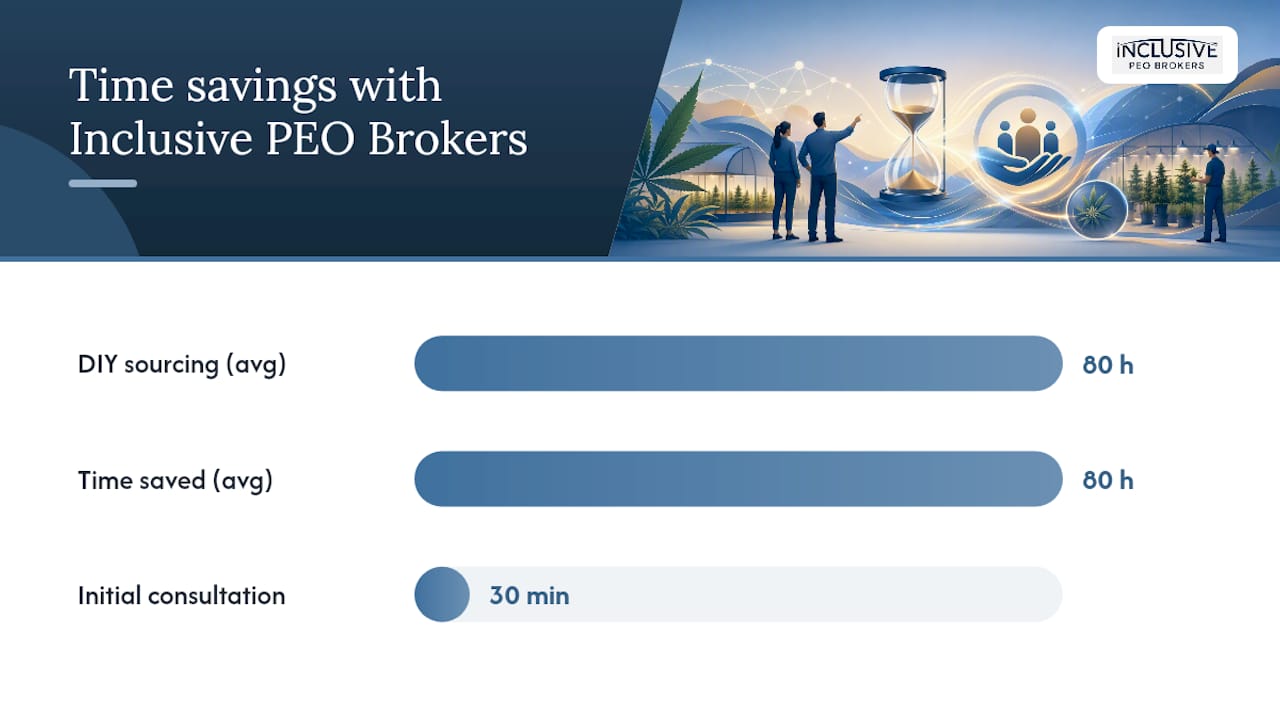
Finding a cannabis-specialized PEO on your own means cold-calling providers, building your own comparison spreadsheet, and negotiating contract terms without a benchmark. Most operators spend about 80 hours on that process and still end up with a suboptimal match.
Inclusive PEO Brokers takes a different approach. The firm acts as a matchmaking broker: it maps your business profile (state, size, license type, payroll complexity, benefits needs) against a vetted network of PEO providers, then delivers a shortlist of matched options with side-by-side cost modeling and negotiation support. Clients save an average of 80 hours and $634 in the selection process compared to sourcing a PEO independently.
What you get from an Inclusive PEO Brokers engagement:
- A curated shortlist of PEOs with documented cannabis-industry experience in your state
- Side-by-side cost comparisons across PEPM and percentage-of-payroll models
- Contract review guidance and negotiation support on indemnity, SLAs, and termination terms
- Post-implementation check-ins to confirm the match is performing as expected
- Access to 133 successful implementations across industries, including operators navigating regulatory complexity comparable to cannabis
NAPEO defines the co-employment model and sets industry standards for PEO service agreements. Inclusive PEO Brokers uses those standards as a baseline and screens providers for cannabis-specific capabilities on top of them.
The first-time PEO selection service is the right starting point if you have never worked with a PEO before. The initial consultation takes about 30 minutes, covers your payroll size, state licensing situation, and benefits goals, and results in a shortlist and a preliminary cost estimate you can act on immediately.
Key Takeaways
A cannabis-specialized PEO is the most practical way for small-to-mid cannabis operators to manage payroll, compliance, and benefits without building an in-house HR department from scratch.
| Point | Details |
|---|---|
| Who should use a cannabis PEO | Most small-to-mid cannabis operators, such as dispensaries, cultivators, and processors with a typical range of employees suitable for PEO services. |
| Core protections to demand | Indemnity language, workers’ comp for cannabis hazards, banking-compatible payroll, and a defined claims SLA. |
| Pricing shapes | PEPM or percentage of payroll; cannabis complexity pushes costs toward the higher end. |
| Onboarding timeline | Expect 4–6 weeks from signed contract to first live payroll run. |
| Recommended next step | Inclusive PEO Brokers matches you with vetted cannabis-experienced PEOs, saving clients an average of 80 hours and $634 in the selection process. |
Why cannabis matchmaking is different from standard PEO brokerage
Most PEO brokers treat cannabis businesses like any other small employer. They run the same comparison spreadsheet, recommend the same three national providers, and hand you a contract. That approach fails cannabis operators because the risks are not standard.
The federal-state conflict in cannabis is not a compliance footnote. It shapes every employment decision, from how you structure your payroll account to how you respond when an employee files an NLRB charge. A general PEO broker who has never navigated a state LPA requirement or a cannabis-specific workers’ comp exclusion cannot give you a reliable match, no matter how polished the comparison tool looks.
What cannabis operators actually need is a broker who has already filtered the provider pool for cannabis-specific capabilities: banking relationships, license-condition monitoring, and labor-relations experience. That filtering work is what saves the 80 hours. It is also what prevents the more expensive mistake of signing with a PEO that drops your account six months in because their insurance carrier excludes cannabis clients.
The clients who get the most from a matchmaking engagement are the ones who come in with clear documentation: their state license, their payroll history, and a list of the compliance questions keeping them up at night. The broker does the rest.
Get matched with a cannabis-experienced PEO today
Cannabis HR is too complex to hand off to a generalist. Inclusive PEO Brokers specializes in matching cannabis operators with PEOs that have documented experience in your state, banking relationships that work for your industry, and workers’ comp coverage that does not exclude your workplace.

In a single 30-minute consultation, you get a shortlist of matched PEO providers, a side-by-side cost comparison, and a preliminary onboarding timeline. Clients save an average of 80 hours and $634 compared to sourcing a PEO independently. With 133 successful implementations behind the process, the matchmaking is grounded in real outcomes, not guesswork.
Book your free PEO matchmaking consultation and get your shortlist within days, not weeks.
Useful sources for further research
The following sources support the claims in this article and are useful starting points for deeper research. This article is general information, not legal advice. Consult qualified employment counsel for legal interpretation specific to your state and license type.
- State LPA requirements and NLRA preemption (Lexology)
- Guide to Worker Safety and Health in the Marijuana Industry (University of Washington DEOHS)
- Missouri Marijuana Workers Win Union Vote After Federal Officials Reject Company’s Argument On Blocking Ballots | Cannabis Cultivator News
- Cannabis and labor law (McCarter article)
- Utah Cannabis Firm’s Bid to Escape Labor Board Stalls in Court — MyCannabis.com
- PEO Services for Small Businesses in San Francisco | Inclusive PEO Brokers
- PEO for Small Business Employee Benefits in San Francisco, CA
Recommended
.svg)
Seeking a different solution? Meet Your Business Needs