.png)

How to Manage Your PEO Relationship for Long-Term Success

A working PEO relationship depends on five things: role clarity, a single internal liaison, a predictable communication cadence, measurable performance reporting, and treating your PEO as a strategic advisor rather than a vendor. Start with these four moves this week:
- Appoint one internal HR liaison and set a “sunset rule”: respond to PEO inquiries by the end of the business day.
- Document task-level ownership with a simple RACI-lite chart or checklist.
- Set your cadence: monthly operational check-ins, quarterly reviews, a mid-year benefits analysis, and an annual renewal meeting.
- Agree on performance metrics and a clear escalation path before you need one.
Key Takeaways
A PEO relationship performs best when role clarity, a single liaison, scheduled reviews, and measurable reporting replace informal, ad hoc contact.
| Point | Details |
|---|---|
| Assign one liaison | Appoint a single internal contact and enforce the sunset rule: respond by end of business day. |
| Document ownership | Use a task-level RACI-lite table for payroll, benefits, handbook edits, and investigations. |
| Set a fixed cadence | Hold monthly check-ins, quarterly reviews, a mid-year benefits analysis, and an annual renewal meeting. |
| Track metrics quarterly | Request payroll accuracy, response times, and escalation counts, then compare trends each quarter. |
| Treat the PEO as an advisor | Build a small advisory council and ask for recommendations, not just data. |
Table of Contents
- How Do You Manage a PEO Relationship? Define Roles First
- What Communication Cadence Works Best With a PEO?
- What Metrics Should You Track to Measure PEO Performance?
- How Do You Handle Service Issues and Escalations With a PEO?
- Turning Your PEO Into a Strategic Advisor, Not Just a Vendor
- Onboarding, Reviews, and Renewal: Keeping the Partnership on Track
- Templates You Can Reuse for Every PEO Conversation
- How Do You Manage Compliance Updates Through Your PEO?
- Connecting Your Systems: Data Sharing Between You and Your PEO
- How Should Employee Concerns Get Routed Through the PEO?
- Protecting Confidentiality and Data in a PEO Partnership
- What Business Owners Get Wrong About Managing a PEO
- Frequently Asked Questions
- Sources
How Do You Manage a PEO Relationship? Define Roles First
Most friction between a business and its PEO comes down to one thing: nobody wrote down who does what. You assume the PEO handles employee handbook updates. The PEO assumes you do. Six months later, an outdated policy causes a real problem, and both sides are pointing fingers.
The fix is a task-level ownership table covering payroll input submission, benefits communication, handbook edits, and employee investigations. A documented division of responsibilities prevents the duplication and confusion that erode trust in a co-employment model, where you and the PEO both legally share employer responsibilities but split the operational work differently.
Build it in three steps:
- List every recurring HR task your business touches, from onboarding paperwork to termination documentation.
- Mark each task “Client,” “PEO,” or “Shared,” and note who signs off on shared tasks.
- Revisit the table any time your internal team changes.
Responsibilities should shift over time. A ten-person company might lean on the PEO for nearly everything; once you hire your own HR manager, tasks like handbook edits and first-line employee questions often move in-house.
Pro Tip: Review your ownership table every time you add a manager or hire dedicated HR staff. Roles that made sense at 15 employees rarely fit at 50.
Brokers like Inclusive PEO Brokers build this division of labor into the selection process itself, matching you to a PEO whose service model fits how much you want to own internally.
What Communication Cadence Works Best With a PEO?
Silence is where PEO relationships go wrong. A payroll question sits unanswered for three days, an employee gets the wrong benefits information, and suddenly the relationship feels adversarial instead of collaborative.
Fix this with a named liaison and a firm response standard. Appointing one primary internal contact and adopting the sunset rule, replying to PEO inquiries by the end of the business day, keeps small issues from becoming urgent ones.
Layer your cadence like this:
- Weekly or biweekly: operational touchpoints for payroll runs, new hires, and terminations.
- Monthly: a shorter check on open items and upcoming compliance deadlines.
- Quarterly: a strategic review covering metrics, benefits utilization, and upcoming needs.
- Mid-year: a claims and benefits analysis so renewal numbers don’t arrive as a surprise.
- Annually: a full renewal meeting comparing performance against the prior year.
Consistent, structured communication, including client report cards and scheduled reviews, is one of the strongest predictors of long-term PEO loyalty, according to industry research on client retention.
Use shared tools where possible: a ticketing system or HCM dashboard both sides can see, and a simple approval step for any employee-facing message the PEO drafts on your behalf. Every meeting should produce written minutes, a list of action items with owners, and a date for the next touchpoint. Distribute that recap within 48 hours, not “whenever someone gets to it.”
What Metrics Should You Track to Measure PEO Performance?
You can’t manage what you don’t measure, and too many businesses never ask their PEO for numbers beyond the invoice. That’s a missed opportunity, because a quarterly report card turns a vague feeling (“service seems fine”) into a documented trend you can act on.
A useful metric set includes:
- Payroll accuracy rate and number of payroll exceptions per cycle.
- Average response time to HR or employee inquiries.
- Open escalations and average days to resolution.
- Benefits enrollment and utilization rates.
- Client satisfaction indicators, gathered through short periodic surveys.
Ask your PEO to supply payroll and compliance data directly, since they own that system of record. Track response times and escalation counts yourself, since that’s your firsthand experience of the relationship. Bring both sets of numbers into the quarterly review and compare them against the prior quarter.
Watch the trend line, not the single data point. A payroll accuracy rate that slips two quarters in a row is worth a direct conversation well before renewal, not a surprise you discover when you’re already locked into another year.
How Do You Handle Service Issues and Escalations With a PEO?
Every PEO relationship hits a snag eventually: a benefits enrollment error, a delayed W-2 correction, a compliance question that sits too long. What separates a well-run relationship from a frustrating one is whether you’ve agreed on an escalation path before the problem hits.
- Frontline support handles routine questions and standard requests, typically with a same-day acknowledgment.
- Supervisor level takes anything unresolved after 48 hours or involving payroll or benefits errors.
- Account manager steps in for recurring issues or anything affecting multiple employees.
- Executive contact gets involved only for contract-level disputes or repeated service failures.
A tiered escalation structure paired with a ticketing system shortens resolution times and keeps small issues from becoming executive-level fires. Log every issue with the date, description, employee(s) affected, and who you notified. If the same problem recurs three times in a quarter, that’s your signal to raise it at the next contract review, not wait for renewal.
Turning Your PEO Into a Strategic Advisor, Not Just a Vendor
The businesses that get the most out of a PEO stop treating it as a transactional payroll processor and start treating it as an advisor with a seat at the planning table. That shift moves the relationship from executing tasks to shaping decisions on compliance, benefits design, and hiring plans.
Build this by creating a small advisory council, finance, HR, and your PEO account team, that meets quarterly to discuss more than invoices. Schedule a mid-year claims and benefits analysis specifically so renewal pricing doesn’t blindside you in December. Push your PEO for recommendations, not just data dumps: ask what other clients your size are doing about rising benefits costs, or how they’d restructure your PTO policy.
Elevating a PEO from service provider to advisor works best with multi-year benefits planning, cross-functional councils, and year-round vendor coordination rather than one-time renewal conversations.
Inclusive PEO Brokers builds this advisory relationship in from day one. Clients working with a broker to select their PEO save an average of 80 hours and $634 in the selection process alone, time that goes back into running the business instead of comparing spreadsheets. That process has produced 133 completed implementations, each one matched to the client’s actual workforce needs rather than a generic package.
Onboarding, Reviews, and Renewal: Keeping the Partnership on Track
The first 90 days set the tone for everything that follows. Rush onboarding and you’ll spend the next year fixing preventable errors.
- Days 1 to 30: complete the data handoff (payroll history, employee census, benefits elections), confirm the SLA and escalation contacts, and sync benefits enrollment systems.
- Days 30 to 60: run your first payroll cycles under close review, confirm employee communications are landing correctly, and hold a check-in with both HR and finance present.
- Days 60 to 90: conduct a formal review of accuracy and response times, then adjust the ownership table based on what you’ve learned.
After that, quarterly meetings should cover performance metrics, upcoming compliance changes, and any staffing shifts on your end. Annual renewal reviews need a full checklist: rate comparisons, service history, escalation counts, and whether your responsibilities split still makes sense. If you’ve hired internal HR staff, that’s the moment to formally shift tasks and confirm both sides agree on the new division.
Templates You Can Reuse for Every PEO Conversation
Having a template ready removes the awkward guesswork of what to say when an issue comes up or a meeting needs structure. Three are worth building once and reusing indefinitely.
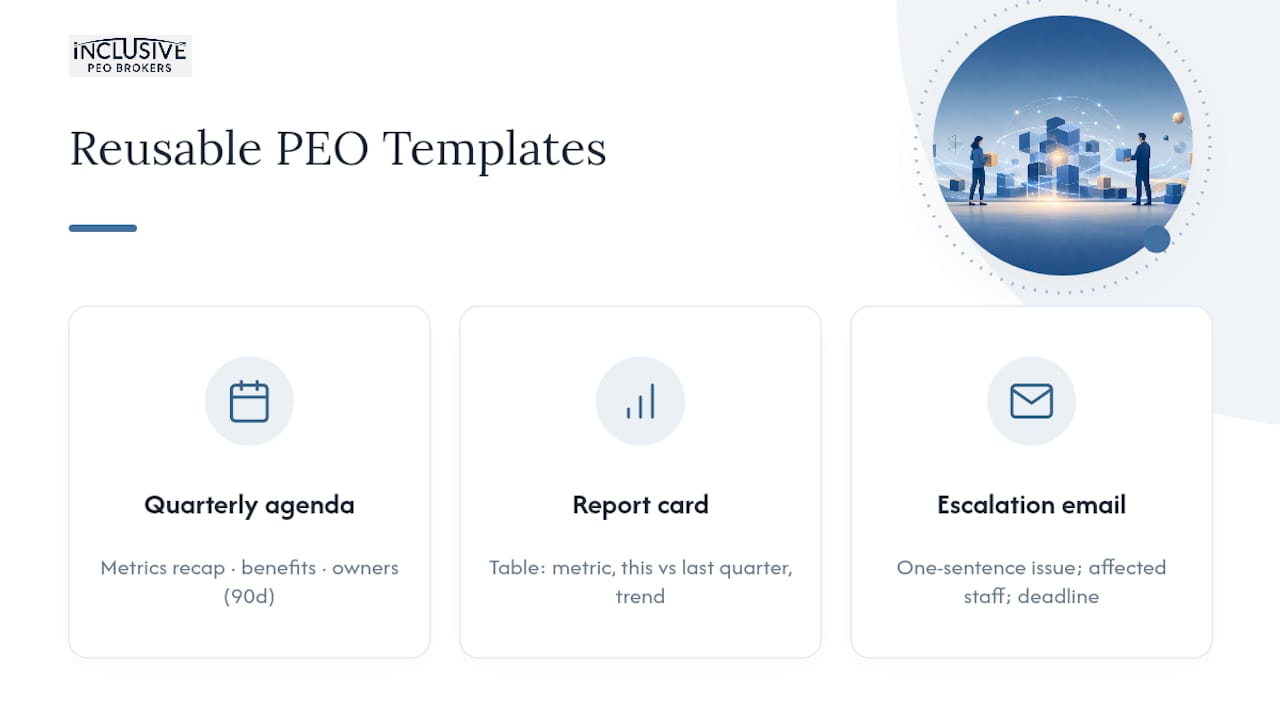
Quarterly review agenda: Open with a metrics recap (accuracy rate, response times, open escalations), move to benefits utilization and any upcoming compliance changes, then close with action items and owners for the next 90 days. Keep it to one page. A dense agenda gets skipped; a tight one gets read.
Performance report card: A simple table works better than a narrative report. List each metric, this quarter’s number, last quarter’s number, and a short note on trend direction. Send it to your liaison 48 hours before the quarterly meeting so both sides arrive with the same numbers in hand.
Issue escalation email: State the issue in one sentence, list the employee(s) affected, note when it started, and specify what resolution you need and by when. Copy your primary liaison and, if it’s the second occurrence of the same issue, copy their supervisor too. Closing with a specific ask (“please confirm correction by Thursday”) gets faster action than an open-ended complaint.
Keep all three templates in a shared folder your team can access without hunting through old email threads. Update the report card template each quarter as you refine which metrics actually drive decisions, and retire any column nobody references after two quarters.
How Do You Manage Compliance Updates Through Your PEO?
Compliance is the single biggest reason businesses use a PEO in the first place, and it’s also where communication gaps cause the most damage. A missed update to paid sick leave rules or an overtime threshold change doesn’t just cost money. It creates legal exposure that lands on your desk, not the PEO’s.
Build a standing compliance checkpoint into your quarterly review, not a separate emergency call every time a law changes. Ask your PEO directly: what changed this quarter at the federal or state level, and what does our business need to do differently? Get their answer in writing, even a short email summary, so you have a record of what you were told and when.
Don’t assume “the PEO handles compliance” means you can skip reading the summary. You remain the employer of record for many purposes even in a co-employment arrangement, so you need to understand what changed well enough to implement it, especially for state-specific rules that vary widely if you operate in more than one state. If your PEO flags a required handbook update, confirm the timeline for rolling it out to employees and who’s responsible for the communication.
When a major law shift hits, like a new paid leave mandate or a minimum wage change, ask your PEO for a short written brief: what the law requires, your compliance deadline, and what they’re handling versus what you need to do internally. That single document, filed and dated, becomes your defense if a compliance question ever comes up later.
Connecting Your Systems: Data Sharing Between You and Your PEO
A PEO relationship runs on data: employee records, hours worked, benefits elections, tax withholding. When your internal systems and the PEO’s platform don’t talk to each other cleanly, someone ends up re-entering the same information twice, and that’s where errors creep in.

Start by mapping exactly what data flows where. Time-tracking data typically flows from your scheduling tool into the PEO’s payroll system. New-hire information flows from your applicant tracking system into their onboarding module. Identify every handoff point and confirm who’s responsible for verifying accuracy at each one.
Where possible, use the PEO’s provided integrations rather than manual exports and imports. Most established PEOs offer connections to common time-tracking and accounting platforms, and using those built-in links cuts down on the manual re-entry that causes payroll exceptions. If your PEO doesn’t support a direct integration with a tool you rely on, ask about their standard file format and build a lightweight, repeatable process rather than reinventing a workaround every payroll cycle.
Set a regular data audit, quarterly is reasonable, where someone checks that employee counts, department codes, and pay rates match between your internal records and the PEO’s system. Small discrepancies compound over time if nobody’s checking, and catching them quarterly is far cheaper than discovering a mismatch during an audit or a benefits renewal.
How Should Employee Concerns Get Routed Through the PEO?
Employees often don’t know or care whether HR sits with your company or the PEO. They just want their question answered. Confusion about where to send a benefits question or a workplace complaint slows everything down and can make employees feel like nobody owns their problem.
Give employees one clear front door. Whether that’s your internal HR liaison or the PEO’s employee service line, publish it clearly and use it consistently, rather than making employees guess based on the topic. Behind that front door, your ownership table determines who actually resolves the issue, but the employee shouldn’t have to know that structure.
For anything involving a workplace complaint, harassment concern, or investigation, confirm in advance which party leads and which supports. Many PEOs offer investigation support or guidance, but the client company typically needs to stay closely involved given its direct relationship with the employee and the workplace. Document who handled what and when, since that record matters if the issue escalates further.
Route benefits questions, especially claims or enrollment problems, directly to the PEO’s benefits team, but keep your internal liaison copied so you’re aware of patterns. If the same benefits complaint surfaces from three different employees in a month, that’s a signal worth raising at your next quarterly review, not something to let slide as isolated noise.
Protecting Confidentiality and Data in a PEO Partnership
A PEO holds sensitive information: Social Security numbers, health data, salary history, and performance records. That makes data privacy a governance issue, not just a legal formality buried in your service agreement.
Start with your contract’s data-handling terms: who can access employee records, how long data is retained after the relationship ends, and what happens to your data if you switch providers. Read this section closely before signing, not after a problem surfaces. If your business handles particularly sensitive data (healthcare-adjacent work, for instance), confirm the PEO’s specific safeguards match your industry’s expectations.
Internally, limit who on your team can access the PEO’s HR platform to those who genuinely need it. A manager who only needs to approve timesheets doesn’t need full access to compensation history or medical benefits details. This is basic access control, but it’s the step most small businesses skip because it feels like extra setup work.
Confirm how the PEO handles a data breach: their notification timeline, their remediation process, and your company’s responsibilities if employee data is compromised. Get this in writing rather than assuming it’s covered. Finally, if you ever transition away from a PEO, plan the data handoff explicitly. Knowing what records you’re entitled to and in what format prevents a scramble later, a process worth planning before you need it rather than during a rushed transition.
What Business Owners Get Wrong About Managing a PEO
Most businesses treat PEO management as a onetime decision: pick a provider, sign the contract, check back at renewal. That’s backward. The selection is the easy part. The relationship is where the value actually gets made or lost.
The mistake I see most often is businesses waiting for the PEO to drive the relationship forward. A good PEO will bring recommendations, but you’re the one who knows your workforce, your growth plans, and your risk tolerance. If you show up to quarterly reviews with only “how’s it going,” you’ll get a status update instead of a strategic conversation. Show up with your own metrics and specific questions, and the same PEO suddenly looks a lot more like an advisor.
Brokerage work at Inclusive PEO Brokers, including the 80 hours and $634 in average selection savings and the 133 completed implementations we’ve supported, has shown that the businesses getting the most value are the ones who kept managing the relationship after the paperwork was signed, not just during the search. Adapt the cadence and metrics here to your headcount. What a 12-person company needs from quarterly reviews looks different from what a 150-person company needs, but the discipline of asking, tracking, and documenting scales in either direction.
Frequently Asked Questions
How often should I meet with my PEO? Plan for monthly operational check-ins, a quarterly strategic review, a mid-year benefits and claims analysis, and a full annual renewal meeting. That cadence catches small issues before they compound and keeps benefits pricing from surprising you at renewal.
Who should be my main point of contact when I manage a PEO relationship? One internal liaison, ideally the same person every time, paired with a consistent contact on the PEO’s side. Splitting communication across multiple people on either end is the fastest way to lose track of who agreed to what.
What metrics should I actually ask my PEO to report? Payroll accuracy rate, exception counts, average response time, open escalations, and benefits enrollment or utilization. Ask the PEO to supply payroll and compliance figures directly, since they own that data, and track response times yourself from your own experience.
What’s the biggest mistake businesses make in managing PEO relationships? Treating the relationship as a one-time selection decision instead of an ongoing partnership. Businesses that skip quarterly reviews and rely only on the annual renewal conversation tend to discover service or pricing problems too late to negotiate from a position of strength.
When should I consider switching PEO providers? When escalations recur despite documented issues, when performance metrics decline for two or more consecutive quarters, or when your business has outgrown the PEO’s service model. A broker-guided evaluation can help you compare your current provider against alternatives before you commit to another year.
Sources
- How to Make HR-PEO Partnerships Succeed — HRMorning
- The dual HR model: building strong partnerships between PEOs and client HR leaders — PEO Insider
Recommended
.svg)
Seeking a different solution? Meet Your Business Needs