.png)

PEO Service Escalation: A Step-by-Step Playbook

When a PEO service failure hits payroll, benefits enrollment, or compliance filings, your first move is simple: document what happened, notify your dedicated PEO contact in writing, and escalate along the written matrix in your service agreement. Every hour you wait without a paper trail weakens your position if you later need to invoke notice, cure, or termination clauses in your contract.
A PEO service escalation is the structured process you use to move an unresolved issue from your day-to-day contact up through the vendor’s leadership until it gets fixed. It only works if you act fast in the first hour and stay organized through the first day.
First hour: capture the incident (screenshots, timestamps, affected employees), call or email your dedicated contact, and open a case number.
First day: send written notice referencing your service level agreement (SLA), loop in your internal payroll and HR leads, and confirm the case has moved to a named person, not a general inbox.
Here’s a template you can copy right now:
Subject: Urgent — Service Issue [Case #] Requires Immediate Attention Hi [Contact Name], we identified [issue] at [time] affecting [number] employees / [payroll run / benefits enrollment]. Per our SLA, we expect acknowledgment within [X hours]. Please confirm receipt and provide an interim workaround and resolution timeline by [deadline].
Pro Tip: Keep every escalation email in one thread. A single, unbroken chain is far easier to hand to a lawyer or a NAPEO complaint reviewer than a scattered mess of calls and texts.
- Document the failure with timestamps and business impact
- Notify your dedicated PEO contact in writing, not just by phone
- Reference your SLA and request a specific acknowledgment window
- Loop in internal payroll, HR, and executive stakeholders same day
- Capture the problem
- Notify the contact
- Escalate per the matrix
- Track every response
Roughly 84% of prospects abandon slow-responding vendors in the insurance and benefits space, a signal that speed expectations are now the norm, not a luxury. If your PEO can’t meet that bar, Inclusive PEO Brokers can help you find one that does.
Key Takeaways
Resolving a PEO service escalation successfully depends on immediate documentation, a clear escalation matrix, contractual leverage, and internal coordination working together.
| Point | Details |
|---|---|
| Act within the first hour | Document the issue, notify your dedicated contact in writing, and open a case number immediately. |
| Follow the five-level matrix | Escalate from specialist to executive sponsor when SLA acknowledgment or resolution windows are missed. |
| Preserve written evidence | Keep timestamps, names, case numbers, and impact details outside the PEO’s own portal. |
| Use contract clauses deliberately | Invoke notice, cure periods, and dispute resolution language to formally preserve your rights. |
| Ask escalation questions before signing | Vet SLA specifics and named contacts upfront with help from Inclusive PEO Brokers to prevent future crises. |
Table of Contents
- Who to Contact First in a PEO Service Escalation?
- How Do You Document and Escalate a PEO Service Problem?
- What Contract Clauses Can Force a Faster PEO Fix?
- How Do You Keep Your Team Aligned During an Escalation?
- When Should You Involve Regulators or Industry Bodies?
- What Questions Prevent Future PEO Escalation Problems?
- Why Structured Escalation Protects More Than Just Payroll
- Get Escalation Risk Reviewed Before It Becomes a Crisis
- Frequently Asked Questions
- Sources
Who to Contact First in a PEO Service Escalation?
Most PEO contracts build in a five-level chain, though few clients ever read it before they need it. Knowing the ladder before a crisis hits means you stop wasting days at the wrong level.
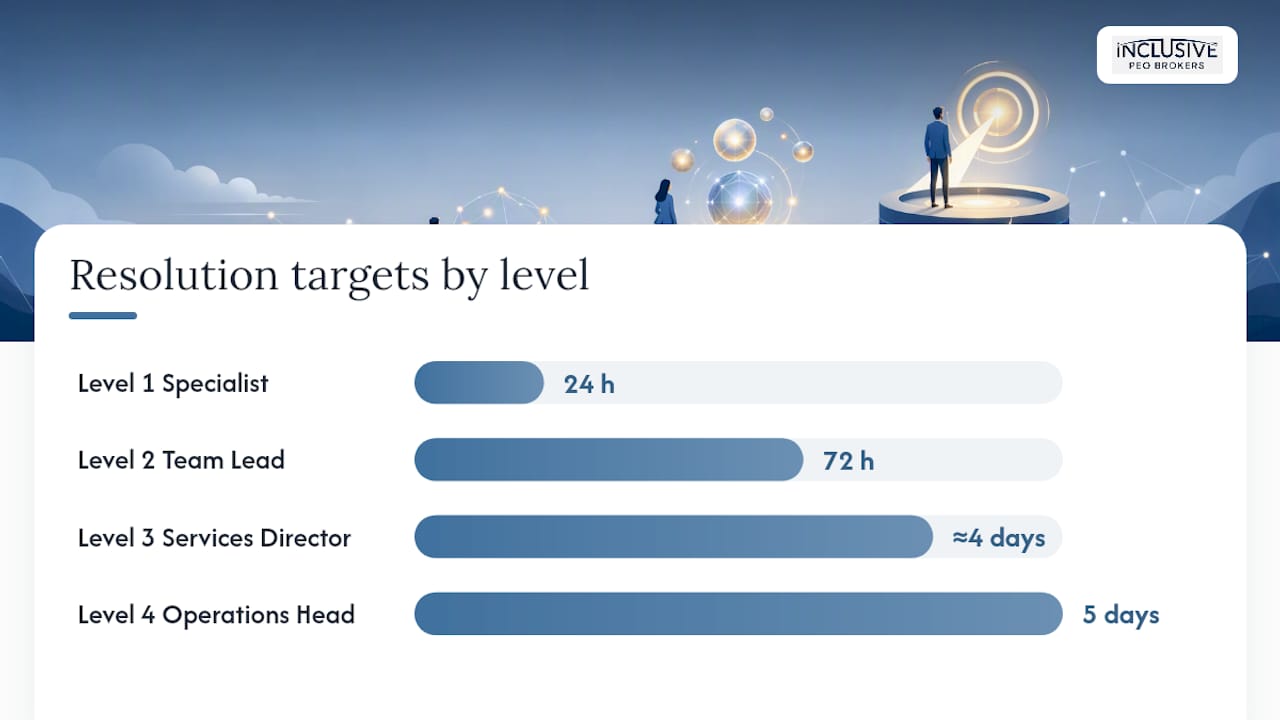
Level 1 is your dedicated service specialist, the person who normally handles day-to-day payroll and benefits questions. Level 2 is a team lead or account manager who can pull in specialists from compliance or IT. Level 3 is a client services director with authority to approve workarounds and compensation. Level 4 is an operations head who can commit resources across departments. Level 5 is an executive sponsor or legal counsel, reserved for breach-level failures or contract disputes.
Each level should carry its own expected response time. Most written SLAs separate acknowledgment (how fast someone confirms they’ve seen your issue) from resolution (how fast it’s actually fixed).
| Escalation Level | Acknowledgment Target | Resolution Target |
|---|---|---|
| Level 1: Specialist | 1-4 hours | 24 hours |
| Level 2: Team Lead | 2-6 hours | 72 hours |
| Level 3: Client Services Director | 4-8 hours | 3-5 business days |
| Level 4: Operations Head | Same business day | 5 business days |
| Level 5: Executive/Legal | Same business day | Per contract remedy clause |
At each level, ask for something concrete: acknowledgment in writing, an interim workaround so payroll or benefits keep running, a root cause explanation, and a dated remediation plan. Vague reassurance (“we’re looking into it”) is not a resolution.
Pro Tip: Print this table and keep it in your internal escalation playbook. When a call goes sideways at 4:45 PM on a Friday, you don’t want to be hunting through a 40-page service agreement for the right phone number.
How Do You Document and Escalate a PEO Service Problem?
A clean paper trail is what turns a frustrating vendor dispute into a fast, defensible resolution. Skip the documentation step and you’re negotiating from memory against a company with call logs and time-stamped tickets.
Here’s the sequence that works, from the moment you spot a problem to the moment it’s closed:
- Detect and log. Note the exact time you discovered the issue and who reported it.
- Assess impact. Identify which employees, payroll runs, or benefits enrollments are affected, and by how much.
- Notify Level 1. Send a written message (email beats phone, always) describing the issue and referencing your SLA.
- Set a deadline. State the acknowledgment window you expect based on your contract.
- Track responses. Log every call, email, and promise with dates and names attached.
- Escalate on missed deadlines. If Level 1 doesn’t respond in the SLA window, move to Level 2 immediately, and say so in writing.
- Confirm resolution. Get written confirmation that the issue is fixed and impacted employees are made whole.
- Follow up. Check payroll or benefits records a few days later to confirm the fix held.
Build a simple documentation template with these fields: date and time, issue description, business impact (dollars, employees, or compliance risk), names of every representative you spoke with, case or ticket numbers, and attachments like screenshots or payroll reports. This becomes your internal audit trail if the dispute escalates to a contractual remedy or a regulatory complaint.
A short, professional email works better than a long one. Something like:
Subject: Escalation Required — Case #4471 Unresolved Past SLA Window Hi [Name], per our SLA, acknowledgment was due by [time] and we have not received confirmation. This is affecting [specific impact]. Please escalate to your Level 2 contact and provide a revised timeline within four hours.
If you’re on the phone instead, keep it direct: “I need a case number, your name, and a written follow-up email within the hour confirming what we discussed.” That single sentence does three things: it creates a record, puts the representative on notice that you’re tracking the call, and sets a deadline they have to acknowledge out loud.
A verbal promise with no case number and no name attached is functionally worthless the moment the call ends. Written confirmation is the only version of “resolved” that holds up later.
Pro Tip: During every call, write down the representative’s full name, the exact time, any specific promises made (“resolved by Thursday”), and the case number before you hang up. Read it back to them to confirm you got it right.
Keep copies of everything outside the PEO’s own portal. If your relationship deteriorates to the point of a contractual dispute, you want records that exist independent of a system you might lose access to.
What Contract Clauses Can Force a Faster PEO Fix?
Your service agreement almost certainly contains levers you haven’t used yet. The four clauses worth finding immediately are: SLA definitions and response windows, notice requirements, cure periods, and dispute resolution or termination rights.
Most contracts follow a predictable timeline once you invoke them formally. Notice starts the clock. The cure period, typically 30 to 60 days depending on the agreement, gives the PEO a defined window to fix the problem. If that window passes without resolution, you move to formal escalation, and from there to contractual remedies, which might include service credits, renegotiated terms, or termination.
- Identify the exact clause governing the failure (SLA breach, data security, compliance error)
- Send formal written notice citing the clause and the specific failure
- State the cure period deadline explicitly, using the contract’s own language
- Track the deadline and prepare for the next step if it passes unmet
- SLA definitions: what response and resolution actually mean in your contract
- Notice requirements: how notice must be delivered and to whom
- Cure periods: how long the PEO has to fix the issue once formally notified
- Dispute resolution: mediation or arbitration requirements before litigation
- Termination rights: what triggers your right to exit the relationship
Attach documentation to every formal notice: the incident timeline, business impact, prior communication attempts, and the specific clause you’re invoking. Language matters here. Say “this constitutes formal notice under Section [X] of our service agreement” rather than a casual complaint email. That phrasing preserves your legal position if the dispute escalates further.
A short notice template:
This letter constitutes formal written notice under Section [X] regarding [issue], first reported on [date]. Per our agreement, we require cure within [contractual period]. Failure to resolve by [date] will result in escalation per Section [Y].
If termination becomes the likely outcome, start planning the transition early rather than waiting for the cure period to lapse. Exit planning takes weeks, not days.
How Do You Keep Your Team Aligned During an Escalation?
An escalation that’s chaotic internally looks unprofessional externally, and it slows you down. Assign ownership before you need it: one person handles vendor communications, one tracks payroll risk, one fields employee questions, and someone senior gets executive updates.
- Vendor communications owner: single point of contact with the PEO, no side conversations
- Payroll risk owner: monitors financial exposure and compliance deadlines
- Employee communications owner: answers staff questions with approved, consistent messaging
- Executive updates owner: briefs leadership on status and financial exposure
- Legal hold owner: preserves records the moment litigation or arbitration becomes plausible
Set a notification cadence early, such as a daily 15-minute stand-up during active escalations, so nobody is guessing what happened overnight. Cross-functional alignment sessions built around a simple decision framework cut resolution time significantly compared to ad hoc coordination.
Pro Tip: Give employees a short, factual update before rumors fill the gap. “We’re aware of the payroll delay and expect resolution by Thursday” beats silence every time.
Link every internal update to your documentation file so contract evidence and resolution tracking stay in one place, not scattered across email threads and Slack channels.
When Should You Involve Regulators or Industry Bodies?
Most PEO disputes resolve internally, but some don’t, and knowing when outside help actually accelerates resolution (versus when it slows everything down) matters.
State labor departments handle wage and hour violations tied to payroll errors. State insurance regulators oversee issues involving workers’ compensation or benefits administration. NAPEO offers industry guidance and best practices, though it is not a regulatory enforcement body.
- Exhaust your internal escalation matrix first and document every attempt
- Identify the correct external body based on the nature of the failure
- Compile your evidence package before filing
- Submit your complaint with a clear, factual timeline
Regulators typically expect a complete timeline, all correspondence, payroll or benefits records showing the impact, and proof you attempted internal resolution first. Investigations can take weeks or months, so regulator engagement rarely solves an urgent, in-progress crisis. It’s most useful for pattern complaints or unresolved breaches.
- Confidentiality: some complaints become part of public regulatory filings
- Relationship impact: formal complaints can end the vendor relationship, plan for transition
- Timing: use contractual remedies first when speed matters more than precedent
What Questions Prevent Future PEO Escalation Problems?
The best escalations are the ones you never have to run, and that starts with better vendor selection.
Ask every PEO finalist these questions before signing: What are your support hours, and is there after-hours emergency coverage? Who is our dedicated contact, and what’s their backup? What are your specific SLA metrics for acknowledgment and resolution? What does your five-level escalation path look like, in writing? Can you handle multi-state compliance if we expand? How does your platform integrate with our existing HR systems? What’s your outage history over the past two years? How many implementations have you completed, and can you share references?
Red flags to watch for: no named dedicated contact, SLAs described in vague terms like “prompt” or “timely” instead of hours, manual underwriting processes, and reporting that changes format month to month.
Request specific contract language before you sign: measurable SLA metrics, service credit or remedy provisions for missed SLAs, a named escalation contact list, and a defined reporting cadence.
| Contract Element | What to Request |
|---|---|
| SLA metrics | Specific hours for acknowledgment and resolution, not vague terms |
| Remedy language | Service credits or fee adjustments tied to missed SLAs |
| Escalation contacts | Named individuals at each level, with direct contact info |
| Reporting cadence | Defined frequency and format, confirmed in writing |
Building these requirements into your RFP process, rather than negotiating them after a crisis, is what separates a strategic PEO selection from a reactive one.
Why Structured Escalation Protects More Than Just Payroll
Most businesses treat escalation as damage control. That’s backwards. A documented escalation matrix is a diagnostic tool. When you track acknowledgment times, resolution times, and which level actually fixes problems, you learn something most companies never bother to measure: whether their PEO relationship is fundamentally sound or quietly failing.

Across the 133 implementations Inclusive PEO Brokers has guided, the pattern is consistent. Businesses that ask hard questions about escalation paths before signing rarely need to use them. Businesses that skip that step end up building the escalation matrix reactively, mid-crisis, which is the worst possible time to learn your vendor has no Level 3 contact.
Cross-functional alignment isn’t a nice idea, it’s the actual mechanism that prevents the departmental runaround where your issue bounces between payroll, compliance, and IT with nobody owning the fix. Vendors who’ve built no-friction workflows solve this before it starts.
Get Escalation Risk Reviewed Before It Becomes a Crisis
You’ve just read what it takes to fight through a PEO service failure after it happens. Inclusive PEO Brokers exists so you spend less time fighting and more time running your business. Instead of discovering your vendor’s escalation gaps during a payroll crisis, we review contracts, SLA language, and support structures before you sign.

A service review with Inclusive PEO Brokers covers a contract scan for vague SLA language, a checklist of the escalation contacts and response times you should have in writing, and an honest read on whether a prospective PEO fits your company’s size and complexity. Clients working with us save an average of 80 hours and $634 in the selection process alone, and that’s before counting the hours saved avoiding a service failure altogether. Our PEO broker services walk you through comparison, negotiation, and post-implementation support so escalation questions get answered before contract signature, not during a Friday afternoon crisis.
If you’re evaluating a PEO for the first time or you’re stuck in a relationship with unclear escalation paths, book a review with Inclusive PEO Brokers and get a straight answer on where your risk actually sits.
Frequently Asked Questions
What is a PEO service escalation, exactly? It’s the formal process of moving an unresolved service problem, like a payroll error or benefits enrollment failure, from your everyday contact up through the PEO’s management chain until it gets fixed within your agreed SLA terms.
How fast should a PEO acknowledge a service issue? Most written SLAs require acknowledgment within one to eight business hours depending on escalation level, with resolution timelines ranging from 24 hours to several business days for more complex issues.
What should I document before escalating a PEO complaint? Capture timestamps, affected employees, financial or compliance impact, screenshots, case numbers, and the names of every representative you’ve spoken with before you escalate.
When should I involve a regulator instead of escalating internally? Only after exhausting your internal escalation matrix and contractual remedies. Regulators expect proof of prior attempts to resolve the issue and typically take weeks or months to investigate.
Can Inclusive PEO Brokers help if I’m already in an active escalation? Inclusive PEO Brokers specializes in vendor selection and contract review to prevent escalation problems before they start. If you’re mid-crisis with a current PEO, our exit strategy guidance can help you plan a transition if the relationship isn’t recoverable.
Sources
- The no-friction workflow: defining the new standard of client-centric agility in PEOs
- Empower your business with PEOs — NAPEO
Recommended
.svg)
Seeking a different solution? Meet Your Business Needs